Are Anti-Beta ETFs Like BTAL Worth Owning In 2026?
When high-beta stocks stumble and markets turn volatile, AGFiQ U.S. Market Neutral Anti-Beta Fund (NYSEARCA:BTAL) is designed to deliver. The fund goes long low-beta stocks and short high-beta stocks, betting that defensive names will outperform momentum favorites when risk appetite…

When high-beta stocks stumble and markets turn volatile, AGFiQ U.S. Market Neutral Anti-Beta Fund (NYSEARCA:BTAL) is designed to deliver. The fund goes long low-beta stocks and short high-beta stocks, betting that defensive names will outperform momentum favorites when risk appetite fades. It’s portfolio insurance with a 1.40% price tag.
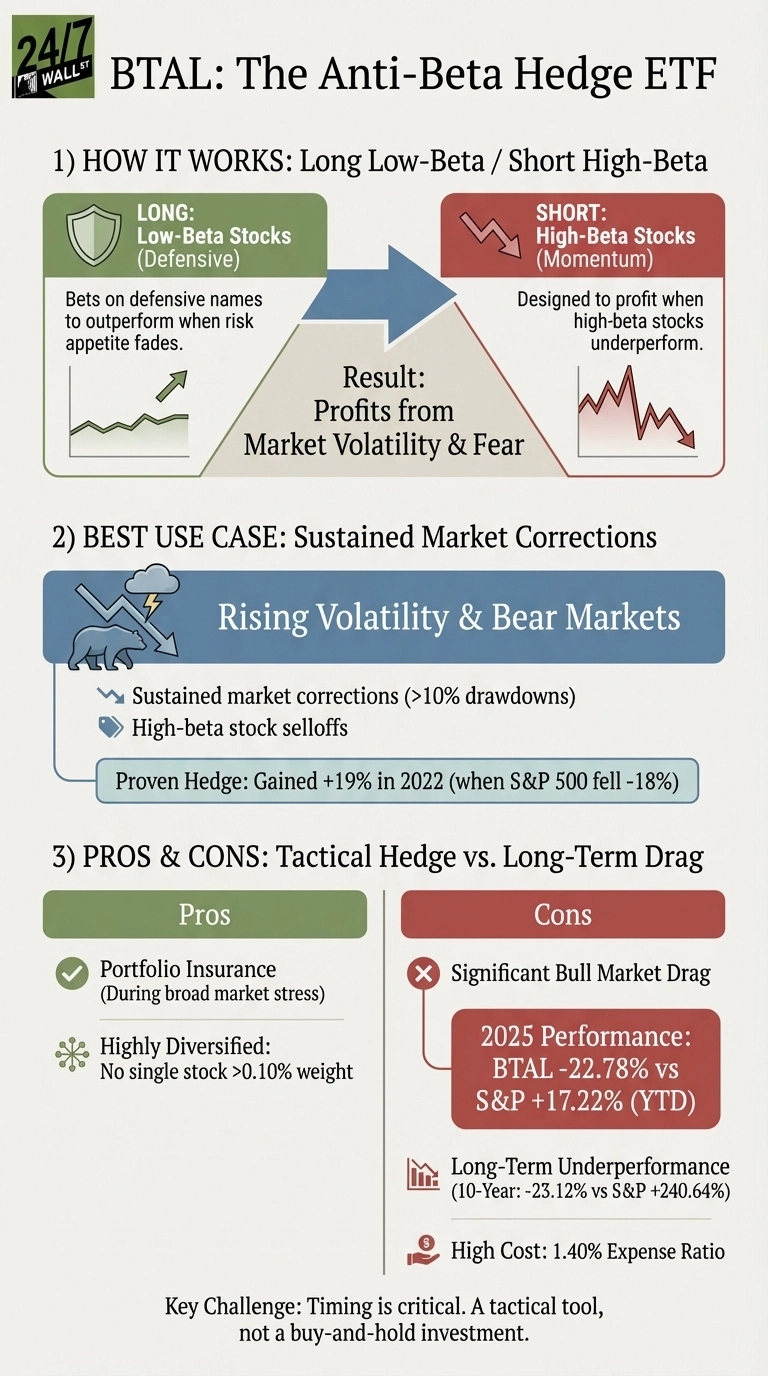
The problem? 2025 was the opposite of a defensive year. BTAL lost 22.8% while the S&P 500 gained 17.2%, a 40-percentage-point gap that highlights the fund’s core limitation: it only works when markets cooperate. Over the past decade, BTAL has declined 23% while the S&P 500 has surged 241%. That’s a 264-percentage-point opportunity cost for holding what amounts to permanent portfolio drag during bull markets.
When BTAL Actually Works
The fund isn’t broken. It gained 19% in 2022 when the S&P 500 fell 18%, proving the strategy can deliver during broad market stress. The anti-beta approach provides genuine diversification when traditional equity hedges fail, but timing when to hold it remains the challenge for most investors.
The question about whether BTAL makes sense to own in 2026 depends on your view of what markets will do. the S&P 500 has had three years of back-to-back-back positive returns. And the gains have all been meaningfully positive with double digit returns. Vanguard’s 2026 investment outlook forecasts mid single digit returns for the year, while also expecting elevated valuations. That’s a bit of a knife’s edge to walk, continuing to see appreciation with stretched multiples.
Blackrock is also calling for US equities to outperform peers again in 2026, while JP Morgan sees slower growth but no recession. If you align with these reports, BTAL is likely dead money in 2026. But if you think there is a reasonable (say, 20% chance or greater) that the S&P 500 puts up a down year and volatility rips back, then BTAL is a worthy insurance policy in your portfolio.
For my money, I say even after a poor performance the last few years, the AGFiQ U.S. Market Neutral Anti-Beta Fund is worth holding on to.
Contact [email protected] for any questions or corrections.
Austin Smith is a financial publisher with over two decades of experience as an investor, analyst, and advisor. He covers stocks, ETFs, Artificial intelligence and personal finance for 24/7 Wall St. Previously, he spent over a decade at The Motley Fool as a senior editor for Fool.com, portfolio advisor for Millionacres, and launched The Ascent to help reader take control of their personal finances.
His work has been featured on Fool.com, NPR, CNBC, USA Today, Yahoo Finance, MSN, AOL, Marketwatch, and many other publications. He is as an advisor to private companies, and co-hosts The AI Investor Podcast with Eric Bleeker.
When not looking for investment opportunities, he can be found skiing, running, or playing soccer with his children. Learn more about Austin's investment approach here.