Will Simplify Managed Futures ETF Finally Move Higher In 2026?
Simplify Managed Futures Strategy ETF (NYSEARCA:CTA) has disappointed investors seeking diversification through trend-following strategies. Since launching in March 2022, the fund has struggled to generate meaningful returns in the low-volatility equity bull market environment that has dominated recent years. The…


Simplify Managed Futures Strategy ETF (NYSEARCA:CTA) has disappointed investors seeking diversification through trend-following strategies. Since launching in March 2022, the fund has struggled to generate meaningful returns in the low-volatility equity bull market environment that has dominated recent years.
The challenge is simple: managed futures strategies thrive on volatility and sustained trends, not relentless equity bull markets. When stocks grind higher month after month, trend-following algorithms that go long commodities, short bonds, or rotate across global futures markets generate modest returns at best. The fund has faced headwinds in environments characterized by persistent equity strength and limited cross-asset volatility.
What Could Spark a Reversal: Market Volatility Returns
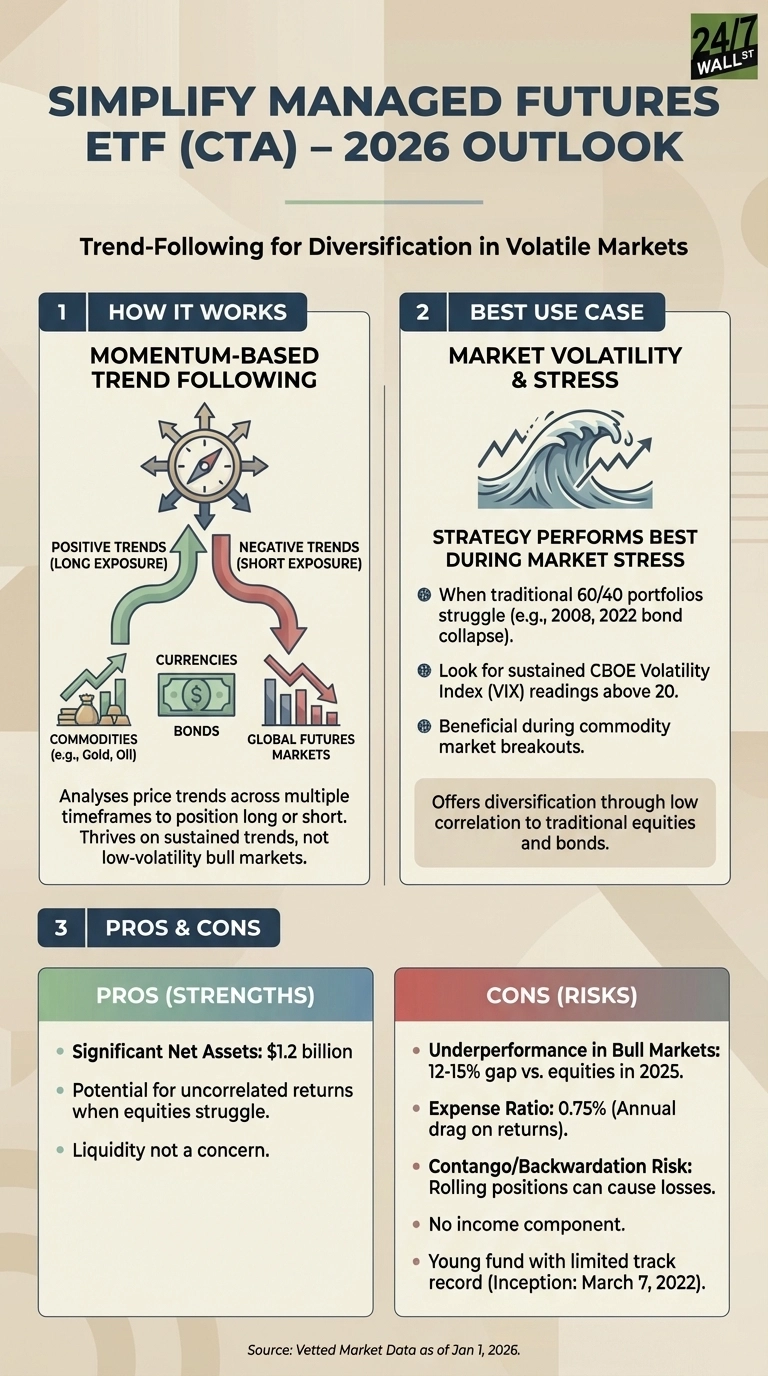
CTA’s 2026 performance hinges on whether markets experience sustained volatility and directional trends. Managed futures historically perform best during market stress when traditional 60/40 portfolios struggle—think 2008, 2022’s bond collapse, or the COVID crash.
Monitor the CBOE Volatility Index (VIX) closely. When the VIX sustains readings above 20 for extended periods, it signals environments where trend-following can capture profits. Watch for commodity market breakouts. Rising oil prices, surging agricultural commodities, or gold breaking to new highs create trending conditions CTA’s models exploit.
The CME Group’s daily settlement prices for major futures contracts provide real-time insight into developing trends. If crude oil moves decisively above $85 per barrel or gold pushes past $2,150, managed futures strategies could start generating returns. Check these weekly, particularly around Federal Reserve meetings and major economic data releases.
Fund Mechanics: The Momentum Model Under the Hood
CTA uses a momentum-based approach analyzing price trends across multiple timeframes. According to the prospectus, the fund positions long in futures experiencing positive trends and short in those with negative momentum.
The fund’s exposure to contango and backwardation in futures markets represents a structural headwind. When futures curves are in contango (near-term contracts cheaper than distant ones), rolling positions forward creates return drag. The prospectus explicitly warns that “extended periods of contango or backwardation have occurred in the past and can in the future cause significant losses.”
Review Simplify’s quarterly fact sheets to understand current positioning. The fund’s 0.75% expense ratio means it needs to generate at least that much return annually just to break even after fees. With $1.2 billion in assets, liquidity isn’t a concern.
A Better Alternative: DBMF Offers More Assets and Lower Fees
For investors committed to managed futures exposure, consider the iMGP DBi Managed Futures Strategy ETF (NYSEARCA:DBMF) as an alternative. With $2 billion in assets versus CTA’s $1.2 billion and an expense ratio of 0.85% (just 10 basis points higher), DBMF offers greater scale and a longer track record dating to 2019.
The key advantage is DBMF’s multi-manager approach, which diversifies across different trend-following methodologies rather than relying on a single model. This could provide more consistent performance across varying market environments. While both funds struggled in 2025’s low-volatility equity rally, DBMF’s additional assets and proven ability to attract capital suggest stronger institutional confidence.
The Bottom Line
CTA’s 2026 performance hinges on whether market volatility returns to create trending conditions managed futures need to thrive, while the fund’s exposure to futures curve dynamics and 0.75% expense ratio will continue impacting returns regardless of market direction.
Contact [email protected] for any questions or corrections.
I am a long time investor and student of business, and believe finding good companies that can become great investments is the best game on earth. After 20 years of writing and researching the public markets it is clear that individuals have never had more tools and information to take control of their financial lives. From ETFs and $0 commissions to cryptos and prediction markets there has never been a greater democratization of access to investing.
I write to help people understand the investments available to them so they can make the best choice for their portfolio, whether they're starting out or looking for income in retirement.