Who is Winning AI Workflow Automation? We Compared 4 Enterprise Stocks.
Enterprise software companies are racing to capture the AI automation opportunity, but exposure varies dramatically. We looked at Pegasystems (NASDAQ:PEGA | PEGA Price Prediction), ServiceNow (NYSE:NOW), Microsoft (NASDAQ:MSFT), and Accenture (NYSE:ACN) to see which stands to benefit most from the…

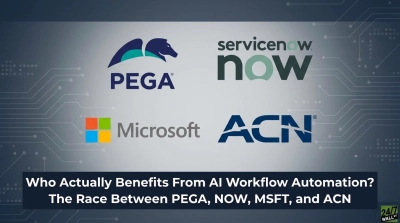
Enterprise software companies are racing to capture the AI automation opportunity, but exposure varies dramatically. We looked at Pegasystems (NASDAQ:PEGA | PEGA Price Prediction), ServiceNow (NYSE:NOW), Microsoft (NASDAQ:MSFT), and Accenture (NYSE:ACN) to see which stands to benefit most from the workflow automation wave reshaping enterprise operations.
The Automation Bet Taking Shape
Enterprises are pouring resources into AI-powered workflow automation to eliminate manual processes and accelerate decision-making. This isn’t about chatbots. It’s about replacing entire layers of business process management with intelligent systems that route work, make recommendations, and execute decisions autonomously.
PEGA builds workflow automation and CRM software specifically designed for this transformation. The company generates $1.73 billion in trailing revenue with a 16.1% profit margin, focusing on AI-driven customer engagement and process automation. Recent quarters show dramatic profitability improvement, with Q1 2025 delivering $85.4 million in net income after the company posted losses in 2022.
ServiceNow operates a cloud-based enterprise workflow platform generating $12.67 billion in trailing revenue. The company dominates IT service management and is expanding aggressively into enterprise-wide automation. Despite 21.8% revenue growth, the stock has fallen 34.5% over the past year as investors question its premium valuation.
Microsoft brings massive scale with $281.7 billion in annual revenue and 36.1% net margins. Azure cloud infrastructure underpins many automation deployments, while Dynamics 365 and Power Platform compete directly in workflow automation. The company invested $32.5 billion in R&D last year, much of it directed toward AI capabilities.
Accenture provides consulting and implementation services with $70.73 billion in trailing revenue and 10.8% margins. They don’t build the software but profit from helping enterprises deploy and integrate automation solutions across their operations.
Pegasystems (PEGA)
PEGA’s entire business revolves around workflow automation. Their AI-powered platform handles complex decision-making processes for customer service, claims processing, and operational workflows. The company posted 17.3% quarterly revenue growth with earnings growth of 337.8% year over year, reflecting both recovery from 2022 losses and accelerating adoption. All eight recent quarters delivered positive earnings surprises, with Q1 2025 beating estimates by 255.8%.
ServiceNow (NOW)
ServiceNow’s platform started in IT service management but now extends across enterprise workflows. They’re capturing 78% gross margins on $12.67 billion in revenue, with strong 21.8% top-line growth. The challenge is valuation: NOW trades at 83x trailing earnings and 49.5x EBITDA, requiring sustained growth to justify the premium. Recent quarters show consistent earnings beats, but the stock decline suggests investors are repricing expectations.
Microsoft (MSFT)
Microsoft’s exposure comes primarily through Azure infrastructure and Dynamics 365 applications. While workflow automation represents a meaningful opportunity, it’s a fraction of their $281.7 billion revenue base. The company’s strength lies in distribution and integration across their enterprise stack, but automation isn’t driving overall results the way it does for pure-play competitors.
Accenture (ACN)
Accenture benefits indirectly by implementing automation solutions for clients. Their 6% revenue growth and 10.8% margins reflect a services model where they capture implementation fees but don’t own the recurring software revenue. They’re positioned to benefit from the transition period as enterprises deploy automation, but long-term value accrues to software vendors.
Who’s Best Positioned
PEGA offers the most direct exposure to workflow automation with the best risk-reward profile. Their business is purpose-built for this trend, recent profitability improvements demonstrate execution, and valuation remains reasonable at 26.5x forward earnings compared to ServiceNow’s 33.6x. The 52% return on equity and consistent earnings surprises support the growth narrative.
ServiceNow has superior scale and market position but faces valuation headwinds that explain recent underperformance despite strong fundamentals. Microsoft benefits from the trend but lacks concentrated exposure. Accenture captures near-term implementation revenue without long-term recurring value.
The Bottom Line
For investors seeking concentrated exposure to enterprise workflow automation, PEGA’s focused business model and improving profitability make it the most direct beneficiary. ServiceNow offers similar exposure with greater scale but at a premium valuation that’s currently compressing. Watch PEGA’s ability to sustain recent profitability gains and ServiceNow’s success defending its market position as the automation wave accelerates.
Contact [email protected] for any questions or corrections.
I write to invest, and I invest to spend more time with nature. Usually all at the same time. I'm a retired equities guy who saw a recession or four, and lives for what comes out of the other side of them.
I cover stocks across the board cause even though I feel like I've seen it all, there's always another way out there to make, and lose money. I want to help you do more of the former, and none of the latter. Making money with friends is my oxygen.
Let's go!