Dave Ramsey: “It’s Been Two Decades, Man” on Parents Who Promised to Pay $80,000 Student Loan
On a January 2026 episode of The Dave Ramsey Show, caller Shane laid out a situation that had festered for 17 years. His parents promised to pay his student loans when he was 18. The original debt was $120,000. Today,…

This post may contain links from our sponsors and affiliates, and Flywheel Publishing may receive compensation for actions taken through them.

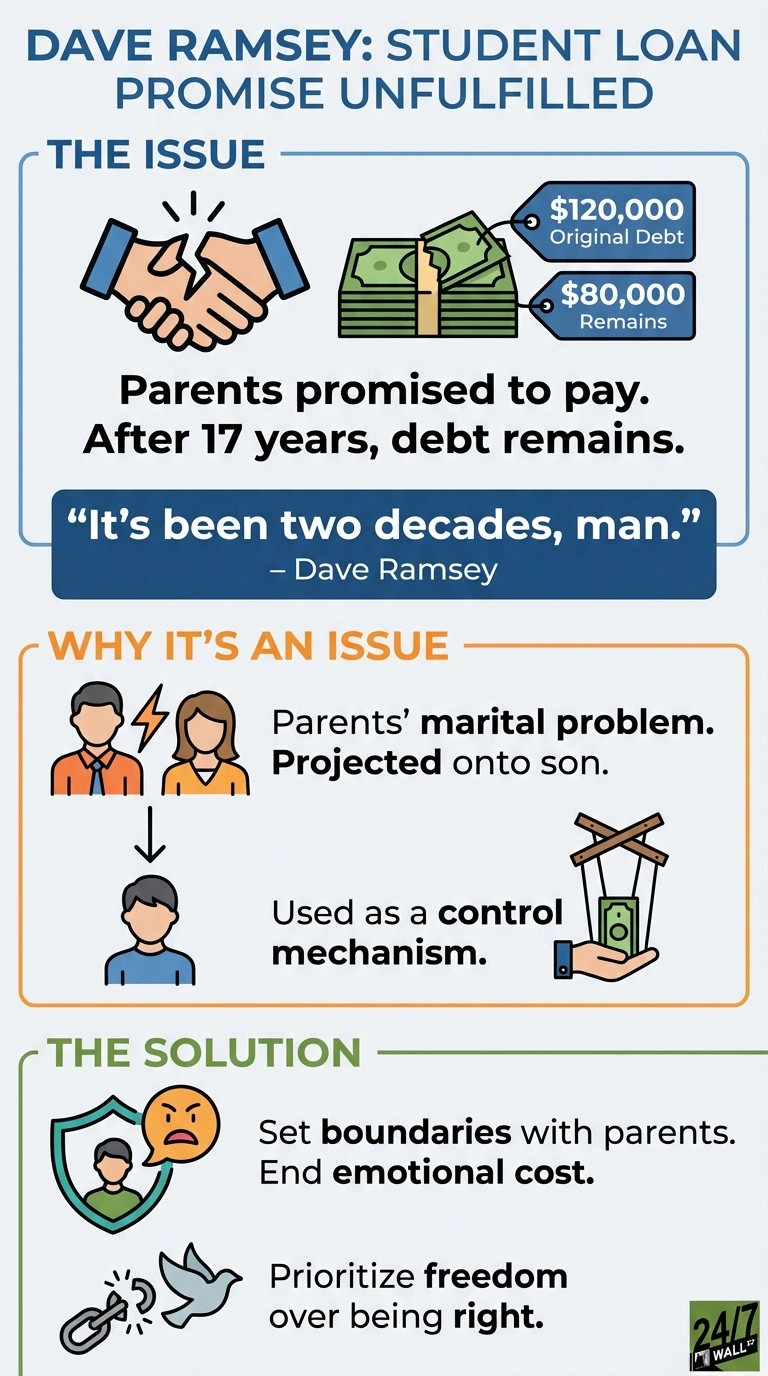
On a January 2026 episode of The Dave Ramsey Show, caller Shane laid out a situation that had festered for 17 years. His parents promised to pay his student loans when he was 18. The original debt was $120,000. Today, $80,000 remains. His parents are financially comfortable and continue making minimum payments, but his mother routinely criticizes how Shane spends his own money. “A lot of the times it’s like, oh, you just bought a truck, like that could have gone to the student loans,” Shane explained.
Ramsey cut straight to the heart of it: “It’s been two decades, man.” Working with co-host Jade Warshaw, Ramsey diagnosed the real dysfunction. This was no longer a debt problem. “This is now a marital problem they have of mom disagrees with how dad is handling a debt they agreed to pay,” Ramsey said. In his framing, Shane had become the emotional proxy for a conflict his parents were refusing to resolve between themselves.
Why This Advice Resonates
Ramsey’s diagnosis speaks to anyone caught between a broken promise and family guilt. After 17 years, Shane carries no obligation to fix his parents’ emotional impasse. They made a commitment when he was barely an adult, and their ongoing failure to honor it, combined with using his purchases as ammunition for criticism, has created a dynamic that poisons every conversation. The core problem Ramsey identifies is not the debt itself but the passive-aggressive communication pattern that has corroded the relationship for close to two decades.
Families that use money as a control mechanism rarely see it that way themselves. Shane’s parents likely believe they are being responsible by spreading out payments over time. What they miss is that every comment about his truck or his spending transforms their original promise into ongoing leverage, converting a financial obligation into an emotional toll Shane pays every time they speak.
Where the Advice Holds Up
Ramsey is right that Shane needs firm boundaries with his mother. When parents make a financial commitment and then weaponize it for criticism, they violate the implicit contract behind that promise. Stretching out payments across two decades while commenting on Shane’s purchases is not responsible financial management; it is using debt as a control tool rather than treating it as their own responsibility.
The marital conflict observation is particularly sharp. One parent likely wants to resolve the debt while the other resists. Rather than settling this between themselves, they have made Shane the proxy for their disagreement. Every passive comment erodes trust and turns what should be a clean financial obligation into a relational minefield that Shane never agreed to enter.
The Missing Context
Ramsey did not fully explore whether Shane’s parents’ circumstances changed dramatically after they made the promise. If they agreed to pay $120,000 when they were financially secure and then faced job loss, medical expenses, or other setbacks, the conversation becomes more nuanced. An honest discussion about changed circumstances is entirely reasonable. Seventeen years of minimum payments combined with guilt trips is not.
The advice also sidesteps important tax considerations that apply in 2026. If Shane’s parents have been claiming the student loan interest deduction while making payments, they can deduct up to $2,500 annually, subject to income limits. For 2026, the deduction phases out for single filers with modified adjusted gross income between $85,000 and $100,000, and for married joint filers between $175,000 and $205,000. If Shane’s parents were to pay off the remaining $80,000 balance, gift tax rules come into play. The 2026 annual gift tax exclusion is $19,000 per recipient, so any amount above that threshold requires filing Form 709. A couple who gift-splits can transfer up to $38,000 per year without triggering that filing requirement. Though actual gift tax is rarely owed, the paperwork matters. Under the One Big Beautiful Bill Act (OBBBA), signed into law on July 4, 2025, the lifetime gift and estate tax exemption was permanently raised to $15 million per person ($30 million for married couples), up from $13.99 million in 2025, so the exemption is high enough that no actual tax would be owed in a scenario like Shane’s.
The broader student loan landscape has also shifted significantly since Shane’s loans were first taken out. The American Rescue Plan Act provision that shielded income-driven repayment (IDR) forgiveness from federal taxation expired on December 31, 2025. Borrowers who receive IDR forgiveness in 2026 or later now face taxable income on the forgiven amount, creating what experts call a “tax bomb.” For someone with $80,000 forgiven, the federal tax liability alone could exceed $12,000 depending on their bracket. Public Service Loan Forgiveness remains tax-free under a separate, permanent statutory provision. The OBBBA also restructured federal repayment options: for loans disbursed on or after July 1, 2026, the new Repayment Assistance Plan (RAP) is the sole income-driven option available, requiring 30 years of qualifying payments before forgiveness. Income-Based Repayment (IBR) continues to exist for borrowers who took out loans before July 1, 2026, but SAVE, PAYE, and ICR are being phased out for all borrowers by July 2028. The SAVE plan itself ended formally following a March 2026 court order, and affected borrowers are now being transitioned to new plans. Shane’s situation is a reminder that multi-decade debt arrangements increasingly collide with shifting policy, and the longer a family dispute drags on, the more complex any resolution becomes.
How to Think About Broken Financial Promises
If you find yourself in Shane’s position, weigh whether ending the emotional cost is worth taking over the debt yourself, even when you are technically right. Being right can cost more than being free. Setting a boundary might sound like: “I will take over the remaining balance so we can move forward without this hanging over every conversation.”
If you are a parent in a similar situation and circumstances have changed since you made the promise, have that honest conversation now. Seventeen years of resentment compounding alongside interest serves no one. If you made a commitment you now regret or cannot fully afford, own it directly rather than letting passive comments do the work. Financial promises that become emotional weapons destroy relationships far more effectively than they manage debt.
Editor’s note: This revision clarified that Income-Based Repayment (IBR) survives for pre-July 2026 borrowers under the OBBBA while SAVE, PAYE, and ICR are phased out, noted the SAVE plan’s formal end following a March 2026 court order, and added that a married couple can gift-split up to $38,000 per recipient annually before triggering a Form 709 filing requirement under 2026 gift tax rules.
Contact [email protected] for any questions or corrections.
I am a long time investor and student of business, and believe finding good companies that can become great investments is the best game on earth. After 20 years of writing and researching the public markets it is clear that individuals have never had more tools and information to take control of their financial lives. From ETFs and $0 commissions to cryptos and prediction markets there has never been a greater democratization of access to investing.
I write to help people understand the investments available to them so they can make the best choice for their portfolio, whether they're starting out or looking for income in retirement.