Why Your Retirement Age Doesn’t Matter (But This Number Does)
If you have a target retirement age circled on your calendar, you may be planning around the wrong metric. According to finance expert Dave Ramsey, retirement readiness is not determined by hitting 60, 65, or any other birthday milestone. What…


If you have a target retirement age circled on your calendar, you may be planning around the wrong metric. According to finance expert Dave Ramsey, retirement readiness is not determined by hitting 60, 65, or any other birthday milestone. What matters is whether you have accumulated enough invested assets to generate the income you need for the rest of your life.
The right question to ask is not “Am I old enough to retire?” but “Do I have enough money to retire?” Your investment account balance, not your age, is what determines when you can afford to stop working. Here is how to calculate your personal financial number.
Consider This: Dave Ramsey: “You Make $140K. Stay Out of Restaurants, Don’t Go on Vacation, And Get Rid of the Ferrari Bike”
Three Methods to Calculate Your Retirement Number
Method 1: The Precise Budget Approach
This method delivers the most accurate result but requires detailed planning. Start by estimating your annual retirement spending, then subtract guaranteed income sources like Social Security to find your true income gap.
Consider this example: if you need $60,000 annually and expect $25,000 from Social Security, your portfolio must generate $35,000 per year. The 4% rule, a widely accepted planning guideline, holds that you can withdraw 4% of your portfolio in year one and then adjust for inflation each subsequent year. Multiply your income gap by 25 to arrive at your target: $35,000 x 25 = $875,000 needed.
The 4% rule works because historical data shows this withdrawal rate has sustained portfolios through 30-year retirement periods. That picture has grown more nuanced in recent research. The rule’s original author, Bill Bengen, updated his “Universal SAFEMAX” figure to 4.7% in his August 2025 book “A Richer Retirement: Supercharging the 4% Rule to Spend More and Enjoy More” (Wiley). His argument: expanding the portfolio beyond large-cap stocks and Treasuries to include small-cap, mid-cap, and international equities raises the historical floor. Morningstar, taking a more cautious forward-looking view, put the safe starting rate at 3.9% for 2026 retirees in its December 2025 “State of Retirement Income” report, up from 3.7% the prior year as improved bond yields lifted projected returns. Neither revision overturns the basic 4% math, but both confirm that the right withdrawal rate for any individual depends heavily on portfolio composition and time horizon.
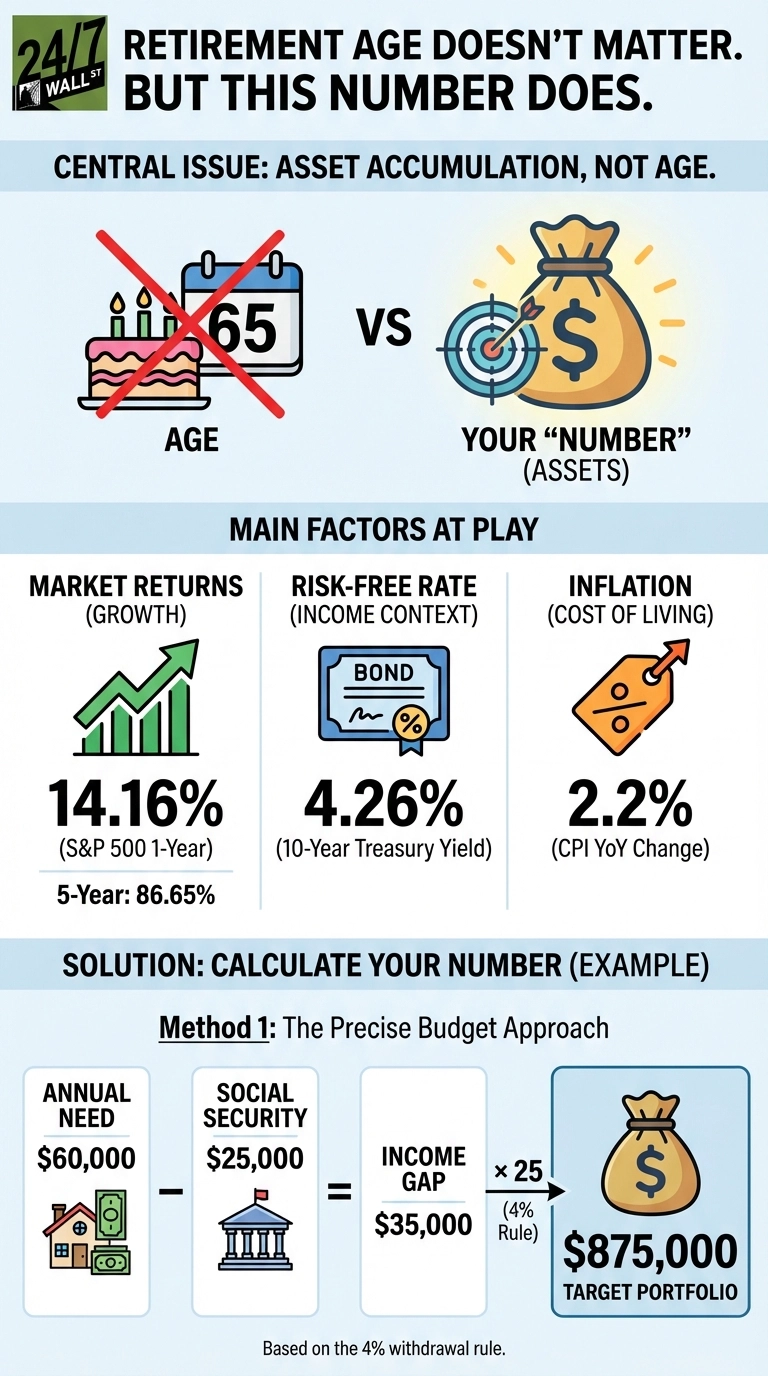
The macro backdrop matters as much as any formula. Headline inflation ran as hot as 4.2% year-over-year in May 2026, driven by an energy price surge tied to geopolitical tensions, before cooling to 3.5% in June as energy prices reversed sharply. The most recent Bureau of Labor Statistics report, released September 11, 2026, put the August year-over-year headline rate at 3.4%, still well above the Federal Reserve’s 2% target. Meanwhile, 10-year Treasury yields climbed to around 5% in mid-September 2026, the highest level since 2007, as rising oil prices and expectations of a Federal Reserve rate hike pushed bond markets higher. That yield level offers meaningful income on the bond side of a balanced portfolio, but also signals that today’s environment demands more careful inflation modeling than the 4% rule’s original 1994 assumptions contemplated.
Try This: Suze Orman Says This Is the One Expense You Must Cut in Retirement
Method 2: Income Replacement Ratio
For workers years away from retirement, pinning down exact future expenses can feel like guesswork. A practical shortcut is targeting 70% to 90% of your pre-retirement income. Someone earning $50,000 who aims for a 90% replacement rate would need $45,000 annually. Subtract projected Social Security income, then multiply the remaining gap by 25 to arrive at a nest-egg target. This method trades precision for simplicity, making it well-suited for mid-career planning when your spending picture will sharpen considerably as retirement draws closer.
Method 3: The 10x Rule
The simplest benchmark is to multiply your final working salary by 10. A worker earning $100,000 at retirement should target a $1 million portfolio. Less detailed than a full budget analysis, this approach gives younger savers a concrete anchor early in their careers, when compounding has the most time to work in their favor. Treat it as a starting point to refine, not a finishing line to coast toward.
Which Method Should You Use?
Your life stage drives the choice. Workers within five years of retirement benefit most from the precise budget approach, where accuracy counts most. Mid-career professionals can rely on the income replacement ratio as a reliable compass. Younger workers should anchor to the 10x rule and recalibrate as retirement nears and their financial picture becomes clearer. No single method fits every situation, but using at least one of them is far better than planning around a birthday.
Ramsey’s core insight holds up under scrutiny: age is irrelevant if the assets are not there. A 55-year-old with $1.5 million invested is more retirement-ready than a 67-year-old carrying only $200,000. The number in your investment accounts, not the number of candles on your birthday cake, determines when you can truly afford to stop working. If you have not yet reached your target, the task is straightforward: keep building until the math actually works.
Editor’s note: This article has been updated to reflect new market and economic data. The full title of Bill Bengen’s updated 2025 book has been added, along with Morningstar’s December 2025 confirmation that the safe starting withdrawal rate for 2026 retirees is 3.9%, up from 3.7% the prior year. The 10-year Treasury yield reference has been revised to reflect the mid-September 2026 level of approximately 5%, its highest point since 2007, and the CPI inflation figure has been refreshed to include the August 2026 reading of 3.4% year-over-year per the Bureau of Labor Statistics.
Contact [email protected] for any questions or corrections.
Joel South covers large-cap stocks, dividend investing, and major market trends, with a focus on earnings analysis, valuation, and turning complex data into actionable insights for investors.
He brings more than 15 years of experience as an investor and financial journalist, including 12 years at The Motley Fool, where he served as an investment analyst, Bureau Chief, and later led the Fool.com investing news desk. He has also co-hosted an investing podcast and appeared across TV and radio discussing market trends.