Top 10 States Charging The Most in Taxes In 2026 – See Where Yours Ranks
The gap between high-tax and low-tax states has never been wider. While residents in states such as Alaska and Tennessee pay well under $5,000 per person in combined state and local taxes, those in more costly states can pay as…


The gap between high-tax and low-tax states has never been wider. While residents in states such as Alaska and Tennessee pay well under $5,000 per person in combined state and local taxes, those in more costly states can pay two or three times as much. For anyone weighing where to live, work, and retire, that difference compounds into real money over time.
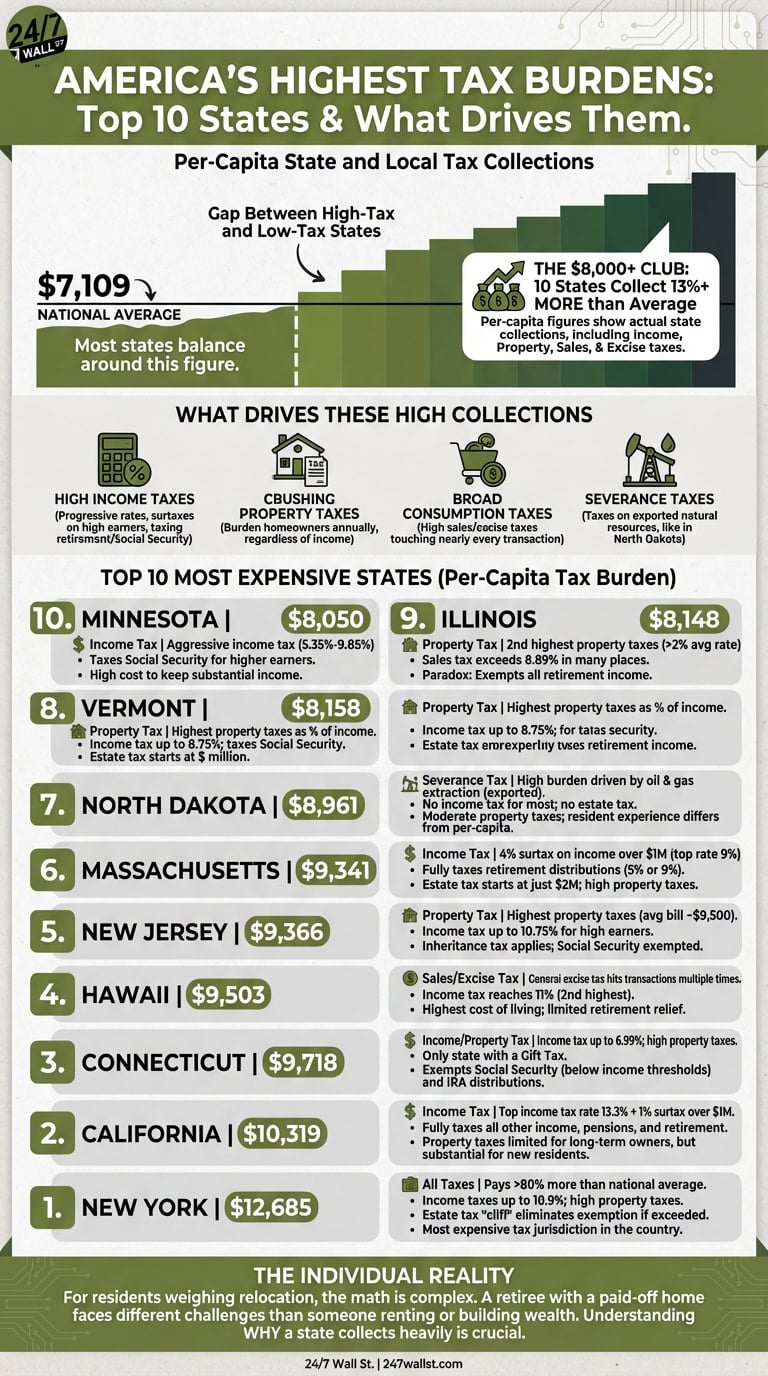
According to Census Bureau data compiled by the Tax Foundation, the national average for per-capita state and local tax collections stands at $7,109. Most states cluster somewhere around that figure, balancing revenue needs with the competitive pressure to keep taxes reasonable.
At least 10 states have crossed the $8,000 threshold, collecting at least 13% more than average from every person within their borders. That total spans income, property, sales, and excise taxes combined. The per-capita figures cut through the marketing and reveal what state governments are actually collecting from residents.
What Drives These High Collections
States land in the $8,000-plus club for very different reasons. Some get there through high income taxes. Others impose crushing property taxes that hit homeowners year after year regardless of income. A few apply broad consumption taxes that touch nearly every transaction. And some states, like North Dakota, appear on the list because of severance taxes on natural resources that are largely paid by energy companies and exported to out-of-state consumers.
Understanding why a state collects so heavily matters as much as knowing that it does. A retiree on a fixed income in Illinois will experience the state’s heavy property taxes very differently from someone navigating California’s income-tax-heavy system.
Someone building wealth through investments faces a different set of challenges depending on the state. Washington residents contend with a capital gains levy and high estate taxes. New York residents face steep income taxes but no special capital gains rate. In each case, the per-capita burden tells only part of the story. If you happen to live in any of the 10 states listed below, you are paying more than $8,000 per person in combined taxes.
10. Minnesota
With an $8,050 per-capita tax burden, Minnesota’s high collections are driven primarily by aggressive income taxation. The state applies progressive rates from 5.35% to 9.85% on all income, including retirement distributions, without any special exemptions for pension income. Minnesota also taxes Social Security benefits for higher earners. Property tax relief programs exist, but for anyone with substantial income, the state remains one of the most expensive places in which to keep what you earn.
9. Illinois
Illinois presents a real paradox: it exempts all retirement income from taxation yet still breaks into the top 10. The culprit is property taxes. Illinois ranks second-highest in the nation for property tax rates, with an average effective rate exceeding 2%, meaning a $350,000 home can face roughly $7,000 in annual property taxes. Add a sales tax that can exceed 8.89% in many localities, and the per-capita burden reaches $8,148. Illinois is all the proof you need that an income-tax exemption for retirees does not guarantee a lower overall tax bill.
8. Vermont
Vermont’s $8,158 per-capita burden is anchored by some of the nation’s highest property taxes as a percentage of income. Income taxes compound the pressure, with a top rate of 8.75% on earnings above roughly $229,550 for single filers. Vermont still taxes Social Security benefits for higher earners, applying a full exemption only to single filers with an adjusted gross income below $55,000 (and joint filers below $65,000). The state also levies an estate tax with a $5 million exemption, applying a flat 16% rate on anything above that threshold. For property-owning retirees in Vermont, the costs stack up quickly.
7. North Dakota
North Dakota’s $8,961 per-capita tax burden looks misleading on its face. The number largely reflects severance taxes on oil and gas extraction, revenue paid by energy companies and mostly exported out of state through higher fuel prices paid by consumers elsewhere. For residents, the picture is more favorable. The state has cut income taxes significantly, leaving a 0% bracket for single filers earning under roughly $48,475 and a top rate of just 2.5%, among the lowest of any state with an income tax. North Dakota also charges no estate tax and maintains below-average property taxes, so the per-capita figure overstates the burden most residents actually feel.
6. Massachusetts

Massachusetts added a 4% surtax on income above $1 million in 2023, pushing its top effective rate to 9% for millionaires. That change, combined with a base flat rate of 5% on all other income including pensions and retirement distributions, helps drive its $9,341 per-capita burden. Social Security is exempt from state tax, but nearly everything else is not. Property taxes rank among the nation’s highest, and the estate tax kicks in at just $2 million, one of the lowest thresholds in the country. Massachusetts residents are getting hit from multiple directions at once.
5. New Jersey
New Jersey’s defining tax characteristic is its property taxes, which push its per-capita burden to $9,366 and rank among the highest in the nation, with typical annual bills of around $9,500. The state exempts Social Security and offers retirement income exclusions of up to $100,000 for those earning under $150,000. For high earners, income tax reaches 10.75%, and an inheritance tax applies to certain beneficiaries. The practical upshot for New Jersey homeowners is that the property tax bill alone can rival the total tax burden in many other states.
4. Hawaii
At $9,503 per capita, Hawaii’s burden is shaped above all by its General Excise Tax (GET), a broad levy that functions like a sales tax but applies at multiple levels of a transaction, stacking costs that ultimately fall on consumers. Income tax adds further pressure, reaching 11% at the top bracket, the second-highest rate of any state as of 2026. Hawaii does exempt Social Security but offers only limited relief for other retirement income. A new 13% top bracket is set to take effect in 2027, which will push the state’s income tax to within a fraction of California’s. Combined with the nation’s highest cost of living, Hawaii’s tax environment is challenging even before accounting for the logistical premium of island life.
3. Connecticut
Connecticut taxes income at rates up to 6.99% and maintains some of the nation’s highest property taxes, together driving its $9,718 per-capita burden. Recent reforms have exempted Social Security for single filers with adjusted gross income below $75,000 and joint filers below $100,000, and IRA distributions are now also exempt. Connecticut remains the only state in the country that levies a gift tax, making intergenerational wealth transfers more complicated and costly. On the positive side, the state estate tax now matches the federal exemption, which provides meaningful relief for wealthier residents.
2. California
California’s top income tax rate is 13.3%, which includes a 12.3% base rate plus a 1% Mental Health Services surcharge on income above $1 million. The resulting $10,319 per-capita burden is one of the heaviest in the country. The state exempts Social Security but fully taxes pensions, retirement account distributions, and all other income at ordinary rates, without preferential treatment. Property taxes for long-term owners are held down by Proposition 13, but anyone buying a home or moving to the state encounters assessed values tied to the purchase price, which can mean a significant tax jump compared to a neighbor who bought decades ago.
1. New York

At $12,685 per capita, New York’s tax burden exceeds the national average by roughly 78%, and the gap with other high-tax states is substantial. Income taxes reach 10.9% on the highest earners, and property taxes are also among the nation’s heaviest. The estate tax includes a notorious cliff: the 2026 exemption is $7,350,000, but any estate worth more than 105% of that amount (roughly $7,717,500) loses the exemption entirely and faces tax on the full value of the estate from the first dollar. New York exempts Social Security and offers a $20,000 retirement income exclusion, but those provisions are far from enough to offset the overall burden. New York remains the most expensive tax jurisdiction in the country by a wide margin.
For residents weighing whether to stay or relocate, the math looks different depending on the situation. A retiree with a paid-off home in Illinois faces very different calculations from someone renting in California, and a high earner in New York City carries combined city, state, and federal obligations that few places in the world can match.
Editor’s note: This update corrects the Vermont estate tax threshold (revised to $5 million with a flat 16% rate), updates the New York estate tax exemption to the 2026 figure of $7,350,000 (with a cliff threshold of $7,717,500), clarifies North Dakota’s current income tax structure (a 0% bracket for lower earners with a 2.5% top rate), and notes Hawaii’s newly enacted 13% top income tax bracket taking effect in 2027.
Contact [email protected] for any questions or corrections.
David Beren has been a Flywheel Publishing contributor since 2022. Writing for 24/7 Wall St. since 2023, David loves to write about topics of all shapes and sizes. As a technology expert, David focuses heavily on consumer electronics brands, automobiles, and general technology. He has previously written for LifeWire, formerly About.com. As a part-time freelance writer, David’s “day job” has been working on and leading social media for multiple Fortune 100 brands. David loves the flexibility of this field and its ability to reach customers exactly where they like to spend their time. Additionally, David previously published his own blog, TmoNews.com, which reached 3 million readers in its first year. In addition to freelance and social media work, David loves to spend time with his family and children and relive the glory days of video game consoles by playing any retro game console he can get his hands on.