Apple Just Paid Investors And This Is AAPL’s Dividend Grade

This post may contain links from our sponsors and affiliates, and Flywheel Publishing may receive compensation for actions taken through them.
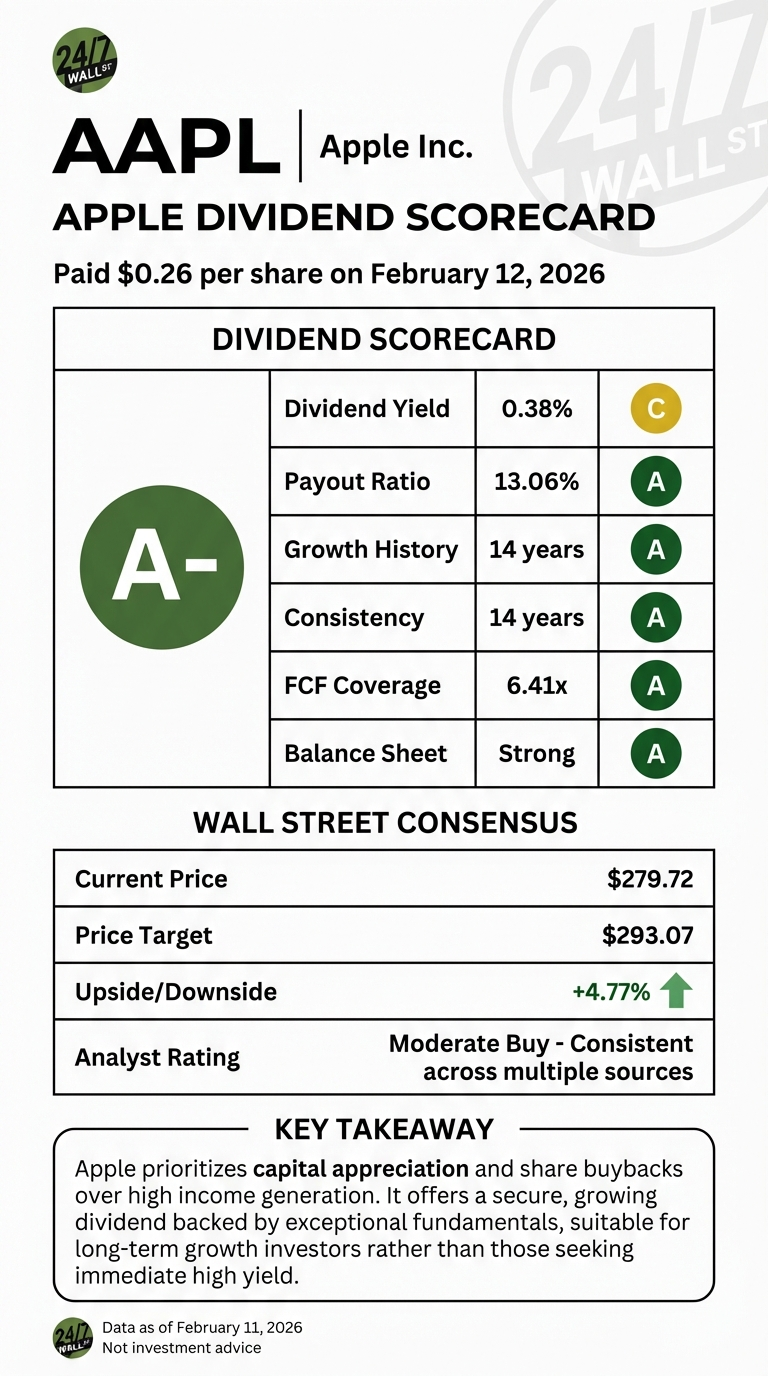
Apple (Nasdaq: AAPL) | AAPL Price Prediction just distributed $0.26 per share to shareholders on February 12, 2026, marking another quarterly payment in the company’s uninterrupted dividend streak spanning over a decade. With a current yield of 0.38% and shares trading at $279.72, Apple’s dividend profile reflects a company prioritizing capital appreciation and share buybacks over income generation. Here’s how the tech giant’s dividend stacks up across key sustainability metrics.
Dividend Grade: A-
Apple earns an A- grade for dividend quality, driven by exceptional coverage ratios and robust cash generation despite a yield well below market averages. The company’s 13.06% payout ratio leaves substantial room for future increases, while operating cash flow of $111.5 billion in fiscal 2025 covered dividends by 7.23 times. This cushion positions Apple to maintain payments even during market downturns.
The grade reflects a tension between safety and income. Apple’s dividend is extraordinarily secure — backed by $435.6 billion in trailing revenue and 27% profit margins — but the 0.38% yield trails both the 2.45% average of the Vanguard High Dividend Yield ETF and the broader income-focused universe. Investors seeking current income will find better yields elsewhere; those prioritizing safety and growth potential will appreciate Apple’s fortress balance sheet.
Recent Dividend Growth
Apple increased its quarterly dividend from $0.25 to $0.26 per share in May 2025, representing a 4% increase. The current annualized rate stands at $1.04 per share, up from $1.00 the prior year. While modest, this growth trajectory has remained consistent since Apple reinstated dividends in 2012 after a 16-year hiatus.
The company’s capital allocation strategy favors share repurchases over aggressive dividend hikes. In fiscal 2025, Apple returned $106.1 billion to shareholders through $15.4 billion in dividends and $90.7 billion in buybacks. This 6-to-1 ratio demonstrates management’s preference for reducing share count — a strategy that benefits long-term holders through earnings-per-share accretion rather than immediate income.
Cash Flow Coverage and Sustainability
Apple’s dividend sustainability is among the strongest in technology. The most recent quarter showed operating cash flow of $53.9 billion covering the $3.9 billion quarterly dividend by 13.76 times. Free cash flow of $98.8 billion in fiscal 2025 provides ample cushion for both dividends and buybacks while funding $12.7 billion in capital expenditures.
The company’s $152.9 billion in EBITDA and 35.4% operating margin underscore operational efficiency. With quarterly earnings growth of 18.3% year-over-year, Apple generates sufficient cash to support dividend growth without straining the balance sheet. The 13.06% payout ratio means the company could theoretically increase dividends sevenfold before reaching a 100% payout threshold, an unlikely scenario but one illustrating the dividend’s safety margin.
Total Return Context
While the 0.38% yield appears underwhelming, Apple’s total return profile compensates. The stock has gained 20.76% over the past year and 112.13% over five years, delivering substantial capital appreciation alongside its dividend payments. Combined with dividends, this performance positions Apple as a growth-oriented holding that happens to pay dividends rather than a traditional income investment.
The company’s $4.02 trillion market capitalization and trailing P/E of 34.73 reflect investor confidence in continued capital appreciation. For income-focused portfolios, Apple’s contribution will remain minimal. For balanced portfolios seeking quality companies with modest but growing dividends backed by exceptional fundamentals, Apple’s A- grade reflects a dividend that prioritizes sustainability and long-term growth over immediate yield.
Contact [email protected] for any questions or corrections.
Joel South covers large-cap stocks, dividend investing, and major market trends, with a focus on earnings analysis, valuation, and turning complex data into actionable insights for investors.
He brings more than 15 years of experience as an investor and financial journalist, including 12 years at The Motley Fool, where he served as an investment analyst, Bureau Chief, and later led the Fool.com investing news desk. He has also co-hosted an investing podcast and appeared across TV and radio discussing market trends.