Retirees Are Quietly Accumulating This Dividend King With 54 Consecutive Years of Increases
PepsiCo has now declared its 54th consecutive annual dividend increase, raising the quarterly payout to $1.48 per share beginning with the June 2026 payment. At a recent price near $135, the annualized dividend of $5.92 delivers a yield of approximately…


PepsiCo (NASDAQ:PEP | PEP Price Prediction) has now declared its 54th consecutive annual dividend increase, raising the quarterly payout to $1.48 per share beginning with the June 2026 payment. That brings the annualized dividend to $5.92, a 4% step up from the prior year’s $5.69. Few companies in any sector can point to an unbroken streak that spans more than half a century, and that consistency is precisely what attracts income-focused retirees to the stock.
PepsiCo’s shares have pulled back meaningfully since the original publication of this article. At a recent price near $135, the annualized dividend of $5.92 delivers a yield of approximately 4.4%, well above where it stood in February 2026. For context, the 10-year Treasury yield currently sits near 4.56%, a narrower gap than income investors often assume, and PepsiCo’s dividend carries a growth engine that Treasuries simply cannot match.
The Growth Record Speaks for Itself
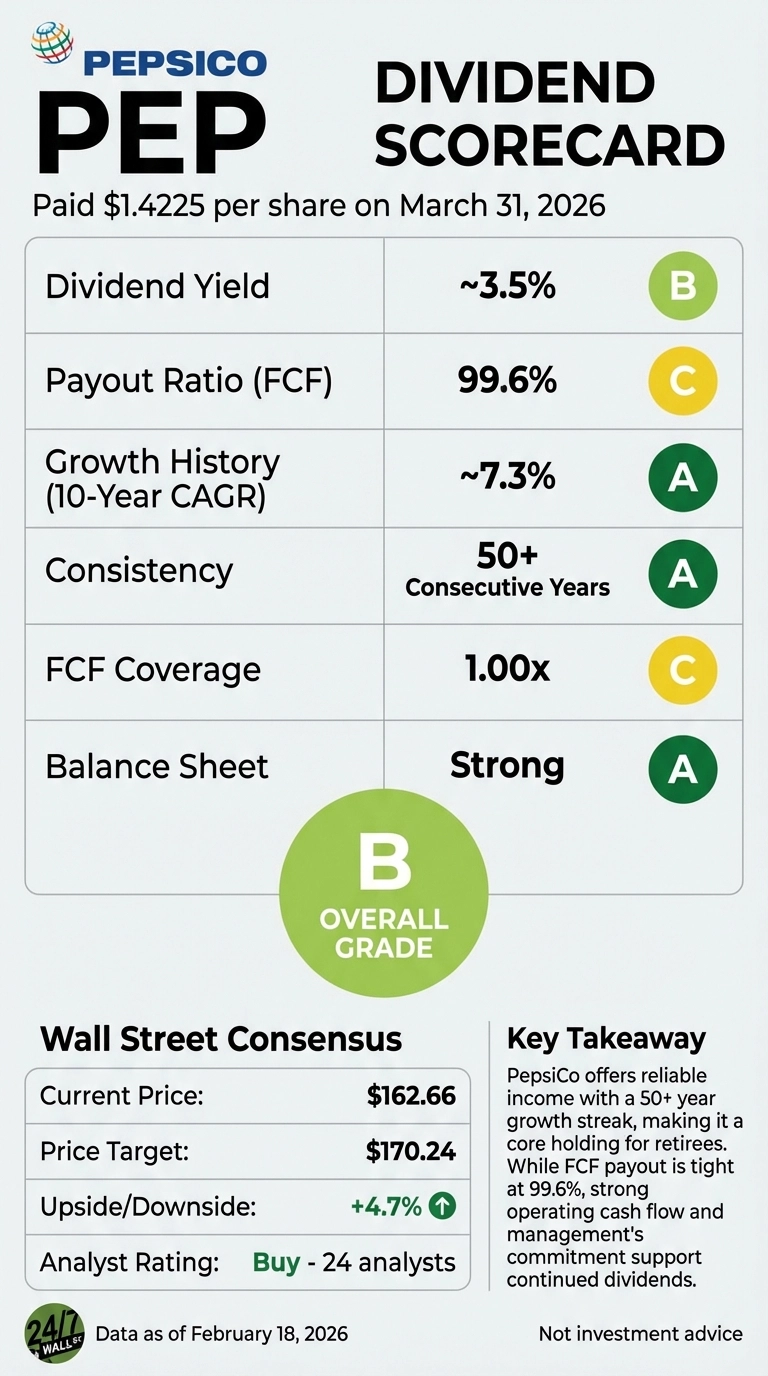
Over the past decade, PepsiCo’s quarterly dividend climbed from $0.7025 in 2016 to $1.48 in mid-2026, representing a compound annual growth rate of approximately 7.3%. The five-year CAGR sits around 6.8%, reflecting consistent mid-to-high single-digit growth across multiple economic cycles. That kind of steady compounding is what separates a true Dividend King from companies that grow the payout opportunistically and then stall during downturns.
The most recent increase of 4% year-over-year is a slight moderation from prior years, but it reflects management’s deliberate preference for sustainable, predictable raises. The company’s 2026 guidance calls for organic revenue growth of 2% to 4% and core EPS growth of 5% to 7%, providing a reasonable foundation for continued dividend progress in coming years.
Cash Flow Coverage Tightens But Holds
The dividend’s sustainability hinges on free cash flow generation, and here the picture warrants careful attention. In fiscal 2025, PepsiCo generated $7.67 billion in free cash flow while paying out $7.64 billion in dividends, a payout ratio of 99.6%. That is notably tighter than the 60% to 85% range that prevailed from 2015 through 2021, and it leaves very little margin for error.
The compression stems largely from elevated capital expenditures of $4.42 billion in 2025, as the company modernized its manufacturing footprint and expanded capacity. Operating cash flow of $12.09 billion provides broader context. For 2026, management is targeting a free cash flow conversion ratio of at least 80%, and the company plans to return approximately $8.9 billion to shareholders through $7.9 billion in dividends and $1.0 billion in share repurchases.
Management Signals Continued Commitment
During the February 3, 2026 earnings call, CEO Ramon Laguarta emphasized the company’s balanced approach to capital allocation, pointing to operational leverage in Frito-Lay as a tailwind for continued dividend growth. CFO Steve Schmitt reinforced that outlook, noting that productivity gains from the fourth quarter were expected to carry forward and fund further investments.
PepsiCo’s Q2 2026 results, reported on July 9, offered a mixed but stable picture. Net revenue rose 6.4% to $24.18 billion, and core EPS of $2.20 narrowly beat the Wall Street consensus of $2.19. International operations were a clear bright spot, with revenue on pace to exceed $40 billion in 2026 and operating margin expanding by one percentage point year over year. North American foods remained softer, with organic revenue down 2%, though volume returned to growth. Management reaffirmed full-year guidance while cautioning that earnings may trend toward the lower end of the projected range.
The company also announced a new $10 billion share repurchase program spanning 2026 through 2030, underscoring confidence in its ability to sustain capital returns alongside consistent dividend growth.
Insider Conviction Adds Credibility
Director-level insiders reinforced their confidence in December 2025, with five board members acquiring shares at $149.51. Director Susan M. Diamond purchased 535 shares, while Directors Segun Agbaje, Jennifer Bailey, Daniel Vasella, and Dave J. Lewis each acquired approximately 401 shares. These purchases came during a period of stock weakness, signaling board-level conviction in PepsiCo’s long-term value at that price level.
The Retiree Calculation
For income-focused investors, PepsiCo’s recent pullback to near $135 has actually improved the dividend proposition. A yield of roughly 4.4% is now competitive with many investment-grade corporate bonds, and it comes backed by 54 consecutive years of annual increases. The stock’s decline from its 52-week high near $171 has created a wider margin of safety on the valuation side, even as near-term earnings visibility has moderated.
The tight free cash flow coverage and softness in the North American snacks business are real risks that warrant monitoring. But the company’s portfolio of global billion-dollar brands, steadily growing international revenues, and management’s long institutional memory around dividend discipline all argue that the 55th consecutive increase is more likely than not. For retirees building income that outpaces inflation, that track record still carries real weight.
Editor’s note: This article has been updated to reflect PepsiCo’s 54th consecutive annual dividend increase and the new quarterly rate of $1.48 per share (annualized $5.92), the company’s Q2 2026 results including 6.4% revenue growth and affirmed full-year guidance, the current stock price near $135 and the resulting yield of approximately 4.4%, and the 10-year Treasury yield of approximately 4.56% as of mid-July 2026.
Contact [email protected] for any questions or corrections.
Joel South covers large-cap stocks, dividend investing, and major market trends, with a focus on earnings analysis, valuation, and turning complex data into actionable insights for investors.
He brings more than 15 years of experience as an investor and financial journalist, including 12 years at The Motley Fool, where he served as an investment analyst, Bureau Chief, and later led the Fool.com investing news desk. He has also co-hosted an investing podcast and appeared across TV and radio discussing market trends.