Live: Will Palo Alto (PANW) Beat Q2 Earnings Tonight?
Quick Read
-
Palo Alto Networks (PANW) reports Q2 results tonight with shares down 8% YTD despite beating earnings for 12 straight quarters.
-
Palo Alto closed its $25B CyberArk acquisition on February 11. Management announced a 10% workforce reduction one day after closing.
-
Palo Alto trades at 105x trailing earnings and 27% below its $223.61 peak as investors seek integration clarity.
Are you ahead, or behind on retirement? SmartAsset's free tool can match you with a financial advisor in minutes to help you answer that today. Each advisor has been carefully vetted, and must act in your best interests. Don't waste another minute; learn more here.(Sponsor)
Live Updates
Does the Stock Reaction Make Sense?
Palo Alto Networks beat on both lines—revenue up 15% to $2.6B and non-GAAP EPS of $1.03 versus the $0.96 estimate—yet the stock sits down 2.15%. The disconnect is about optics, not execution.
The EPS Mirage in Q3
Q3 guidance calls for $0.78–$0.80 EPS despite revenue jumping 28%–29% year-over-year. The culprit: higher share count from recent acquisitions. Investors see sequential EPS compression and react, even as the business accelerates.
Valuation Still Commands a Premium
At 105x trailing earnings and 14x sales, Palo Alto trades at a steep premium. When guidance creates optical friction, high-multiple stocks give ground quickly—especially when CrowdStrike is down 9.5% over the past month and Zscaler has dropped 19%.
The Verdict
Short-term traders fixate on Q3 EPS optics while ignoring 33% Next-Gen ARR growth and a full-year revenue guide of $11.28B–$11.31B. This stock trades the shape of near-term numbers, not business trajectory.
PANW Down 5.6% After Earnings. What You Need to Know
Palo Alto’s quarter highlights a familiar tension: the fundamentals are accelerating, but the story has become more complex.
Growth is re-accelerating. Next-Gen ARR is compounding above 30%. Revenue guidance for FY26 stepped meaningfully higher. Free cash flow remains elite. By any operational measure, demand is not the issue.
What is being debated is execution complexity.
CyberArk and Chronosphere materially expand Palo Alto’s footprint in identity and AI-driven security. Strategically, it makes sense. Financially, it enlarges the revenue base. But integration changes the short-term math — particularly around share count, margins, and modeling visibility. That is what the stock is wrestling with, not demand.
The key takeaway: this is no longer just a platformization story. It is now a scale-and-integration story. Investors are asking whether Palo Alto can absorb transformative acquisitions while preserving its margin profile and growth velocity.
If management proves that the 30% margin framework survives this integration cycle, the valuation can hold. If integration friction creeps into operating leverage, volatility will persist.
Key Operating Highlights
Subscription and support revenue continues to drive the majority of growth, reinforcing the recurring model strength.
| KPI | Result | Why It Matters |
|---|---|---|
| Next-Gen Security ARR | $6.3B (+33%) | Core growth engine intact |
| RPO | $16.0B (+23%) | Multi-year visibility improving |
| Non-GAAP Op Margin | 30.3% | Margin discipline holding |
| FY26 FCF Margin Guide | 37% | Cash profile remains elite |
What Changed This Quarter
-
FY26 revenue outlook stepped meaningfully higher.
-
ARR growth guidance signals >50% expansion.
-
Share count in guidance increased significantly, altering EPS optics.
-
The narrative has shifted from “platformization acceleration” to “integration execution.”
Management Commentary
CEO Nikesh Arora emphasized accelerating platformization driven by AI modernization and strong adoption of AI security.
CFO Dipak Golechha highlighted the third consecutive quarter of 30%+ non-GAAP operating margins and said the same operational discipline will now be applied to CyberArk and Chronosphere.
So Why Is the Stock Down After Earnings?
Two likely reasons:
-
EPS optics in Q3 — despite explosive revenue growth, the Q3 EPS guide looks compressed due to a materially higher assumed share count.
-
Integration risk now dominates the story — CyberArk and Chronosphere integration execution is the swing factor for the next two quarters.
Guidance Update
Q3 FY26 Outlook
-
Revenue: $2.941B–$2.945B (+28%–29% YoY)
-
Next-Gen ARR: $7.94B–$7.96B (+56% YoY)
-
RPO: $17.85B–$17.95B (+32%–33% YoY)
-
Non-GAAP EPS: $0.78–$0.80
-
Shares assumed: 812M–817M
FY26 Outlook
-
Revenue: $11.28B–$11.31B (+22%–23% YoY)
-
Next-Gen ARR: $8.52B–$8.62B (+53%–54% YoY)
-
RPO: $20.2B–$20.3B (+28% YoY)
-
Non-GAAP Op Margin: 28.5%–29.0%
-
Non-GAAP EPS: $3.65–$3.70
-
Adjusted FCF Margin: 37%
The revenue guide is significantly higher than pre-earnings expectations around the $10.5B range for FY26. Growth is clearly accelerating.
Q2 Earnings Are In
Headline numbers are strong, but the stock is trading the shape of guidance and the EPS mechanics. The stock initially jumped before settling down 2.15%
What the quarter actually looked like
-
Revenue +15% YoY to $2.6B
-
Next-Gen Security ARR +33% YoY to $6.3B
-
RPO +23% YoY to $16.0B
-
Non-GAAP EPS $1.03 (vs $0.81 YoY)
-
Non-GAAP operating margin 30.3% (third straight quarter 30%+)
If this were only about execution, the stock would be up.
| Metric | Reported | YoY | Verdict |
|---|---|---|---|
| Revenue | $2.6B | +15% | ✅ Beat vs $2.63B est range |
| Non-GAAP EPS | $1.03 | vs $0.81 LY | ✅ Beat vs $0.96 est |
| Next-Gen Security ARR | $6.3B | +33% | Strong |
| RPO | $16.0B | +23% | Strong |
| Non-GAAP Op Margin | 30.3% | 3rd straight 30%+ | Stable |
Earnings Snapshot

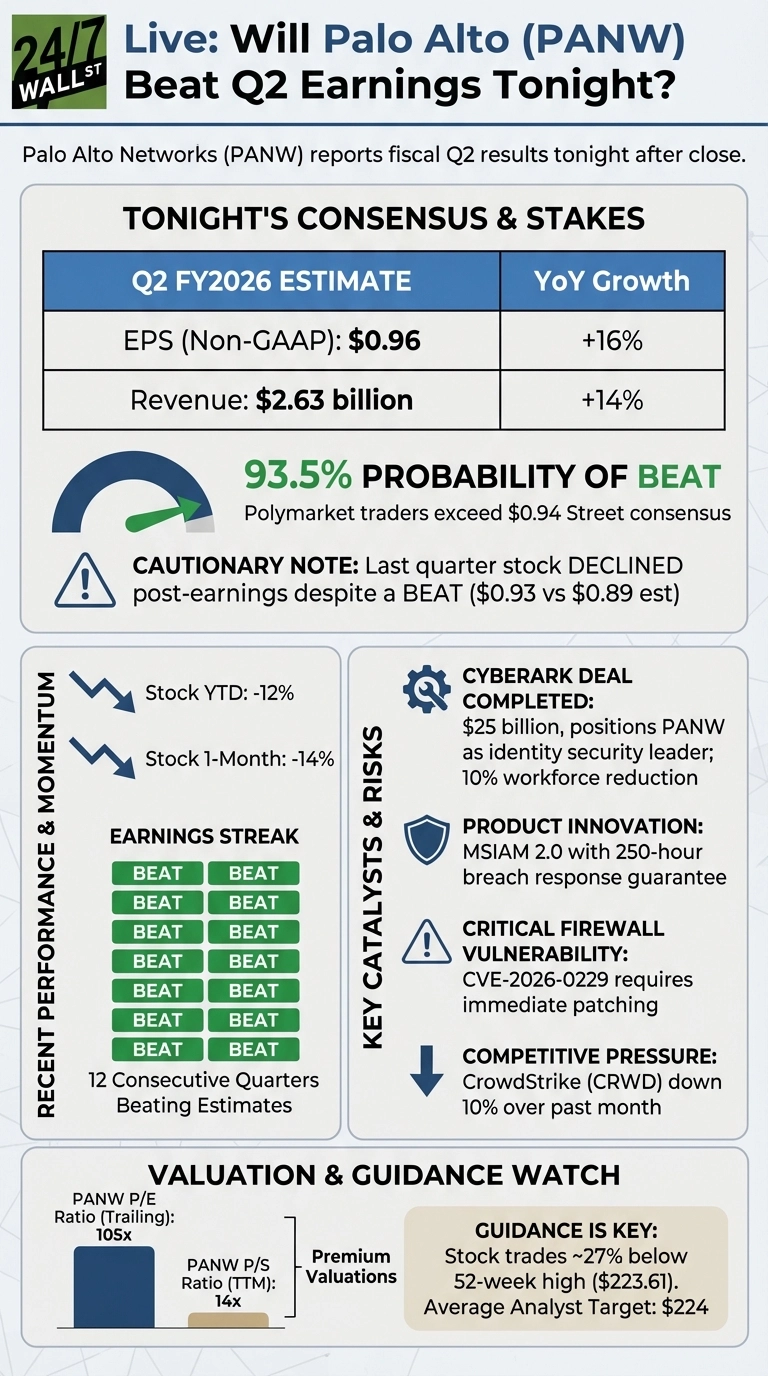
Palo Alto Networks (NASDAQ: PANW | PANW Price Prediction) reports fiscal second-quarter results tonight after the close. After a challenging start to 2026, with shares down 8% year-to-date and 11% over the past month, this report will test whether the cybersecurity leader can reassure investors that its platformization strategy and recent megadeals are translating into sustainable growth.
Recent Momentum Points to Execution Strength
The company enters tonight’s report with solid recent history. Palo Alto has beaten earnings estimates for 12 consecutive quarters, including last quarter’s $0.93 result that topped the $0.89 consensus. That November 20, 2025 report showed 16% revenue growth and 29% growth in Next-Gen Security ARR to $5.9 billion.
Since then, the company closed two transformative deals. The $3.35 billion Chronosphere acquisition bolsters AI capabilities, while the $25 billion CyberArk deal completed February 11 positions Palo Alto to dominate identity security across human, machine, and AI workloads. The CyberArk integration makes Palo Alto the largest company on the Tel Aviv Stock Exchange with a $115 billion market cap.
Tonight’s Consensus and What’s at Stake
| Metric | Q2 FY2026 Estimate | YoY Growth | Full Year FY2026 |
|---|---|---|---|
| EPS (Non-GAAP) | $0.96 | +16% | N/A |
| Revenue | $2.63 billion | +14% | $10.50-$10.54 billion |
Prediction markets reflect strong confidence in a beat, with Polymarket traders pricing in a 93.5% probability that Palo Alto will exceed the $0.94 Street consensus. However, history offers a cautionary note. Despite beating estimates last quarter, shares declined post-earnings, suggesting guidance and forward commentary matter more than the headline print.
Watching Integration Risk and Competitive Pressure
I’ll focus on three areas tonight. First, management’s integration roadmap for CyberArk matters. The 10% workforce reduction announced one day after the deal closed signals aggressive cost management, but investors need clarity on revenue synergies and execution timelines.
Second, platformization momentum will determine whether Palo Alto can sustain premium valuations. The stock trades at 105x trailing earnings and 14x sales. Recent product launches like MSIAM 2.0 with a 250-hour breach response guarantee and new browser security offerings show innovation, but you should watch whether these translate into bookings growth and customer consolidation wins.
Third, competitive dynamics are intensifying. While the broader cybersecurity sector is weak (CrowdStrike down 10% over the past month), rivals are making moves. A recent critical firewall vulnerability (CVE-2026-0229) that forces reboots reminds investors that execution lapses carry real costs.
Guidance Will Define the Reaction
With the stock trading 27% below its 52-week high of $223.61 and analysts maintaining a $224 average price target, tonight’s forward guidance will determine whether this selloff was an overreaction or a justified reset. If management can articulate how two megadeals strengthen competitive positioning without derailing near-term profitability, sentiment could shift quickly.
Joel South has been an avid investor and financial writer for over 15 years, publishing thousands of articles analyzing stocks, markets, and investment strategies across multiple leading financial media platforms. He spent 12 years at The Motley Fool, where he worked as an investment analyst and Bureau Chief before ascending to direct the Fool.com investing news desk, overseeing editorial operations and content strategy. During his tenure, Joel co-hosted an investing podcast and became a recognized voice in financial media through numerous TV and radio appearances discussing stock market trends and investment opportunities.
Currently serving as General Manager and Managing Editor at 24/7 Wall Street, Joel has published hundreds of in-depth analyses focusing on large-cap stocks, dividend-paying equities, and market-moving developments. His comprehensive coverage spans earnings previews, price predictions, and investment forecasts for major companies across all sectors—from technology giants and semiconductor manufacturers to consumer brands and financial institutions. Joel's expertise encompasses t fundamental analysis, options market interpretation, institutional investor behavior, and translating complex market dynamics into clear, actionable insights for individual investors.
© 24/7 Wall St.