





Nvidia‘s (NASDAQ:NVDA | NVDA Price Prediction) strategic investment portfolio has gained more attention amongst investors as it increasingly targets companies that enhance its AI ecosystem. While the “secret portfolio” has faced headwinds amid questions about AI’s momentum, the spending going on to support it, and the potential for a meaningful return on investment, Nvidia revealed in its latest 13F filing that it sold its entire stakes in two stocks — Arm Holdings (NASDAQ:ARM) and Applied Digital (NASDAQ:APLD), its best-performing stock.
At the same time, AI chipmaker added several new positions, including Nokia (NYSE:NOK) and Synopsys (NASDAQ:SNPS), as well as its investment in Intel (NASDAQ:INTC), which was valued at almost $8 billion at the end of December.
Strategic Shift Away from a Former Target
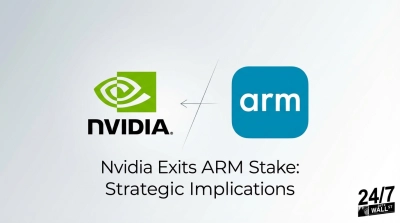
Nvidia sold its 1.1 million- share position in Arm Holdings, worth about $140 million based on closing prices at the time of the filing. This comes after Nvidia’s failed $40 billion attempt to acquire Arm back in 2020, which was blocked by regulators. The sale may reflect Nvidia’s evolving priorities, as its new partnership with Intel overlaps with some of Arm’s chip design functions, potentially reducing the strategic value of holding Arm stock. Further, its plans to begin manufacturing its own chips puts it in competition with Nvidia, a risk that was highlighted at the time.
However, Nvidia’s portfolio shift points to a focus on infrastructure enablers rather than design specialists like Arm, whose stock faced tough headwinds late last year. Shares fell from a November peak around $183 per share to close out 2025 at $109, a 40% drop in a little over a month. Still, Nvidia continues supplying Arm-based CPUs to clients like Meta Platforms (NASDAQ:META), showing it hasn’t cut all ties to the chip designer.
Profit-Taking on a Top Performer
Applied Digital was Nvidia’s best-performing holding in 2025, with its stock rising 238% due to its role in data center operations supporting AI workloads. Nvidia’s decision to sell its full stake may stem from profit-taking after this strong run, as part of a broader portfolio rebalancing. The 13F filing shows Nvidia shifting investments away from smaller AI ecosystem players like Applied Digital toward larger hardware and networking firms that bolster data center infrastructure.
Despite the sale, Applied Digital maintains a $16 billion contracted revenue backlog, suggesting ongoing demand for its services in high-performance computing. This backlog spans multiple years and could support future growth, but Nvidia’s exit indicates a preference for reallocating capital elsewhere in the AI supply chain.
Betting on a Rival’s Revival
The Intel stake was not a surprise. In September, Nvidia said it would invest $5 billion in Intel as part of a broader collaboration on AI products. It purchased over 214 million shares that were valued at $7.9 billion by the end of the year. The investment makes Nvidia one of Intel’s largest shareholders, holding about 4%.
Key to the deal is a collaboration where Intel will manufacture custom x86 CPUs for Nvidia’s AI platforms using NVLink technology, and develop x86 SoCs integrating Nvidia RTX GPU chiplets for personal computing. This partnership aims to fuse Nvidia’s AI stack with Intel’s ecosystem, diversifying Nvidia amid competition from firms like Broadcom (NASDAQ:AVGO) and Amazon (NASDAQ:AMZN).
For Intel, the capital provides a lifeline after a string of challenges, including a CEO change and large losses in 2024. It also follows the U.S. government acquiring a 10% stake in August under the CHIPS Act to bolster domestic manufacturing.
Key Takeaway
Intel’s stock has surged over 70% in the past year, trading at a higher near $55 per share in January, as AI optimism and investments from Nvidia, the government, and others burnished its brand again. However, analysts largely recommend holding or reducing positions, with an average price target around $46 per share, indicating it is fairly valued.
Intel’s first-quarter guidance projects $11.7 billion to $12.7 billion in revenue with it breaking even on earnings. Its forward P/E of 48x suggests risk if its foundry execution falters or adoption of AI PCs stall. While partnerships like the $100 million deal with SambaNova could boost Intel’s AI efforts, the stock’s premium leaves little room for error, making it a risky buy for most investors.












 Top Gaining Stocks
 Top Losing Stocks
