




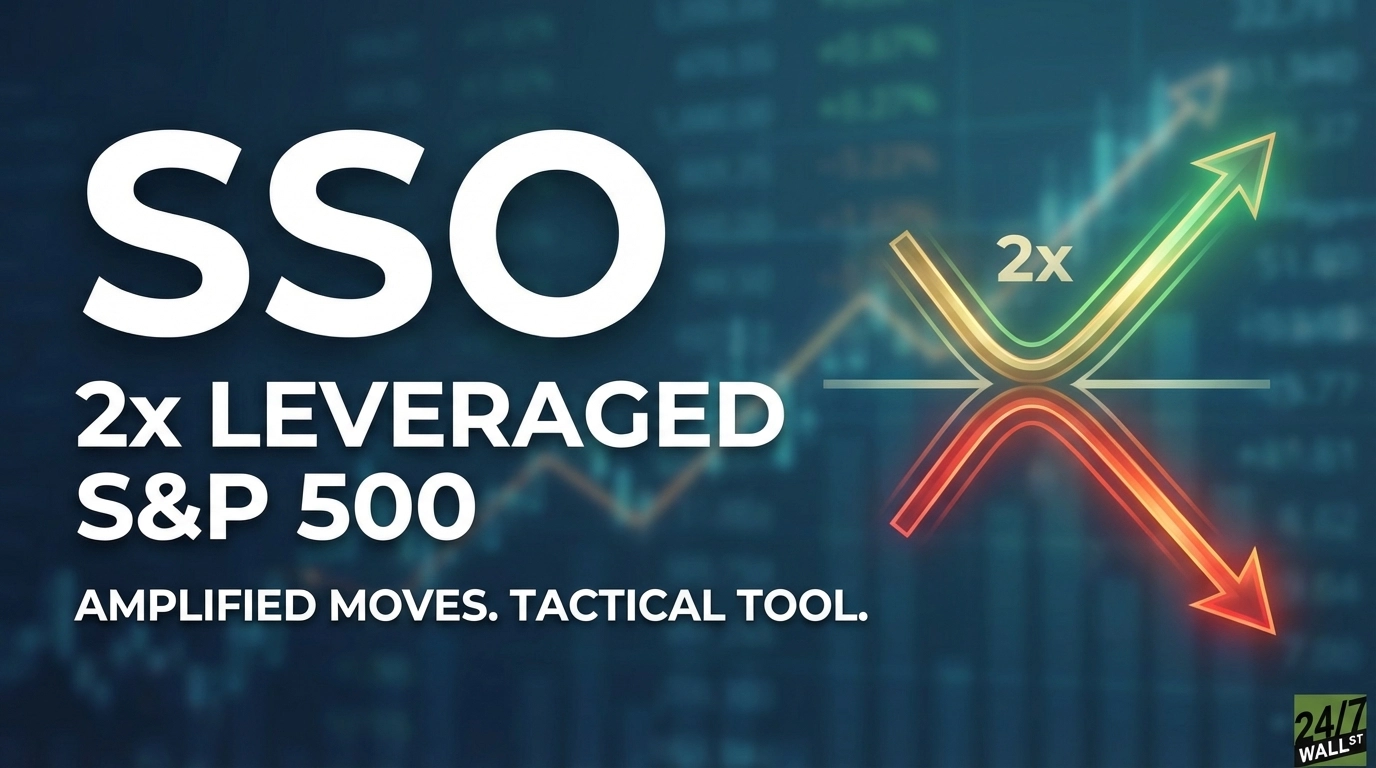
If the market goes up 1%, a leveraged ETF promises to go up 2%. That sounds like free money until you understand the catch: daily rebalancing means the math only works in one direction at a time. ProShares Ultra S&P500 (NYSEARCA:SSO) delivers exactly what it advertises, but only for traders who understand that leverage is a tool, not a strategy.
Built for Short-Term Conviction, Not Long-Term Holds
SSO amplifies S&P 500 moves by 2x through a combination of direct stock holdings and derivatives like swaps. With $8.1 billion in assets, the fund has proven it can track its benchmark efficiently—but only on a daily basis. That daily reset is the critical detail that separates tactical traders from buy-and-hold investors.
The past year tells the leverage story clearly: SSO returned 16.5% while SPY gained 11.8%. That 1.4x multiplier falls short of the promised 2x because of volatility drag. Daily rebalancing means choppy markets erode returns through compounding effects—losses hurt more than equivalent gains help.
When It Works and When It Doesn’t
SSO shines during sustained uptrends. From February 2021 to February 2026, it gained 135% versus SPY’s 74%. That 1.8x multiplier over five years shows leverage working as intended in a bull market, delivering nearly double the index return when direction stays consistent.
In April 2025, SSO experienced intraday swings exceeding 20% during a volatility spike, demonstrating how leverage magnifies both directions. This is the tradeoff: amplified gains in uptrends come with amplified pain when markets reverse or whipsaw.
Technology dominates at 25.8% of the portfolio, with NVIDIA and Apple representing the two largest individual positions. This concentration means SSO isn’t just a leveraged S&P 500 bet—it’s a magnified wager on mega-cap tech leadership continuing.
The Tradeoffs You Accept
Three realities define SSO ownership. First, volatility decay is real and unavoidable in choppy markets. Second, this is a trading vehicle, not a retirement account holding. Third, you need conviction about near-term direction because time works against you when markets stagnate.
SSO belongs in portfolios as a tactical position for investors with a three-to-six-month bullish view on large-cap U.S. equities, but the daily reset mechanism makes it unsuitable for passive buy-and-hold strategies.
Contact [email protected] for any questions or corrections.













 Top Gaining Stocks
 Top Losing Stocks