Retirees Lose Half of Every Dollar Earned Above $24,480 Tipping Point
Many retirees find Social Security covers essentials but not much more. Rising costs create pressure, and a 2.8% cost-of-living adjustment for 2026 did little to close the gap as healthcare expenses continue to climb. This financial squeeze explains why people…


Many retirees find that Social Security covers essentials but leaves little room for anything more. Rising costs create steady pressure, and while benefits received a 2.8% cost-of-living adjustment for 2026, healthcare expenses have climbed well ahead of the general price level for years. That financial squeeze explains why people who claimed benefits early often continue working to supplement income, even though doing so triggers withholding rules they never anticipated.
Social Security does not prohibit working while collecting benefits. It temporarily reduces what recipients receive if earnings exceed certain thresholds before full retirement age. The withheld money does not disappear permanently, but understanding how the mechanics work matters, because the penalty arrives fast and hits hard.
How the Earnings Limit Works
The Social Security Administration sets an annual earnings cap for those collecting benefits before full retirement age. For 2026, that threshold is $24,480 for anyone who remains under full retirement age the entire year, up from $23,400 in 2025. The cap sits surprisingly low, roughly equivalent to part-time work at about $12 an hour over a standard schedule. Above that level, Social Security deducts $1 for every $2 earned, so a worker who brings in even a modest paycheck above the line quickly loses a meaningful slice of monthly benefits.
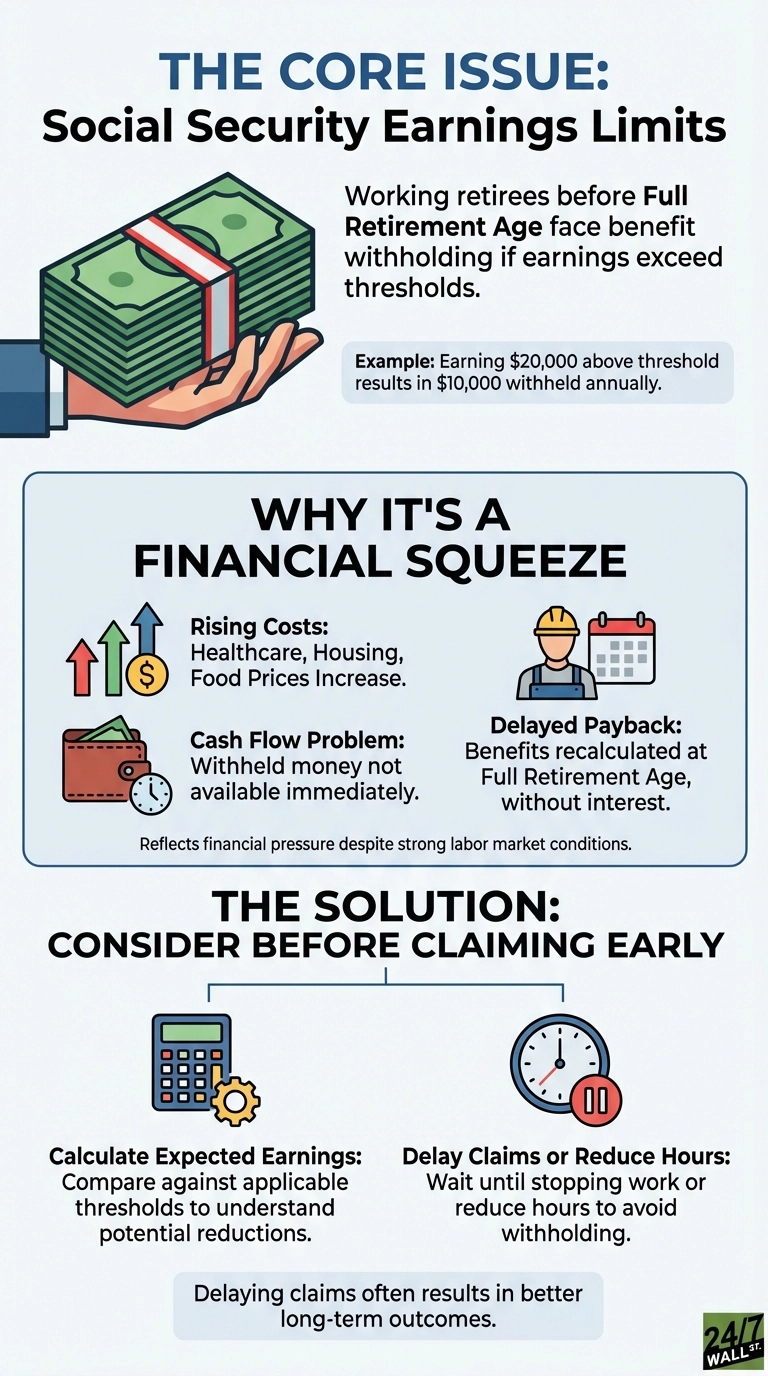
Consider a 64-year-old working part-time who earns $20,000 above the threshold. Social Security withholds $10,000 annually, working out to roughly $833 per month in lost income. With the average retired worker collecting about $2,086 per month as of July 2026, that shortfall represents roughly four and a half months of a typical benefit payment. The cash flow problem hits hardest for someone who claimed early precisely because they needed income right away, rather than years later when the government eventually recalculates benefits upward.
The rules ease as workers approach full retirement age. A separate, more generous threshold applies in the year someone reaches full retirement age: for 2026, earnings up to $65,160 are permitted before any withholding begins, and even then only $1 is deducted for every $3 earned above that limit, covering only the months prior to the birthday month. Once full retirement age arrives, all earnings restrictions disappear entirely.
The Money Comes Back, Eventually
Withheld benefits are not lost permanently. Once someone reaches full retirement age, the Social Security Administration recalculates the monthly payment to credit the months when benefits were reduced or not received due to the earnings test. The monthly benefit rises to compensate going forward, but that adjustment is gradual and carries no interest or inflation protection for the years when that income was unavailable.
For someone who needs money now to cover rising costs, waiting years to recover withheld benefits offers little comfort. The tension between immediate financial needs and long-term benefit optimization forces working retirees into difficult tradeoffs: accept substantial benefit withholding in the near term, or reduce work hours to preserve monthly payments. Neither choice is straightforward when bills arrive monthly but benefit recalculations happen years later.
The issue has drawn fresh attention on Capitol Hill. On March 24, 2026, Sen. Rick Scott introduced the Senior Citizens’ Freedom to Work Act (S. 4184) in the Senate, with Sen. Tommy Tuberville joining as a cosponsor. Rep. Greg Murphy introduced companion legislation in the House on April 16, 2026. The bill would repeal the retirement earnings test entirely. That provision dates to 1935, when policymakers designed it to push older Americans out of the workforce and free up jobs for younger workers during the Great Depression, a rationale that critics argue has long since expired.
Historical context adds some nuance to the current debate. In April 2000, President Bill Clinton signed an earlier law sharing the same name after it passed the House 419 to 0 and the Senate 100 to 0. That legislation eliminated the earnings test for beneficiaries who had already reached full retirement age, but it left the test intact for early retirees between age 62 and full retirement age. The 2026 proposal aims to close that remaining gap. Proponents point out that workers aged 55 and over are the fastest-growing segment of the labor force, making the decades-old disincentive to work increasingly difficult to justify. As of September 2026, both the Senate and House versions remain in committee, with no floor vote scheduled.
What to Consider Before Claiming Early
Financial advisors typically recommend that anyone considering claiming Social Security before full retirement age while continuing to work should first calculate expected earnings against the applicable annual threshold. Understanding the potential benefit reductions before they arrive prevents unpleasant surprises. Delaying the claim until work stops, or reducing hours enough to stay below the cap, often produces better cash-flow outcomes for those who have that flexibility.
The decision grows more complicated when health concerns or family circumstances make an early claim unavoidable. In those situations, understanding the withholding mechanics at least prevents surprises when benefit checks arrive smaller than expected. Every situation differs, and factors such as exact full retirement age, annual income level, and other household resources can shift the outcome considerably. Notably, income from pensions, annuities, investments, or veterans benefits does not count toward the earnings test, a distinction that matters greatly for retirees drawing from multiple income sources.
Editor’s note: This update refreshes the average monthly retired-worker benefit to $2,086 (the July 2026 figure from the SSA’s Monthly Statistical Snapshot, as reported by Kiplinger), adds historical context on the year 2000 predecessor law that eliminated the earnings test only for those at or past full retirement age, and notes that as of September 2026 neither the Senate nor House version of the current bill has a floor vote scheduled.
Contact [email protected] for any questions or corrections.
Austin Smith is a financial publisher with over two decades of experience as an investor, analyst, and advisor. He covers stocks, ETFs, Artificial intelligence and personal finance for 24/7 Wall St. Previously, he spent over a decade at The Motley Fool as a senior editor for Fool.com, portfolio advisor for Millionacres, and launched The Ascent to help reader take control of their personal finances.
His work has been featured on Fool.com, NPR, CNBC, USA Today, Yahoo Finance, MSN, AOL, Marketwatch, and many other publications. He is as an advisor to private companies, and co-hosts The AI Investor Podcast with Eric Bleeker.
When not looking for investment opportunities, he can be found skiing, running, or playing soccer with his children. Learn more about Austin's investment approach here.