




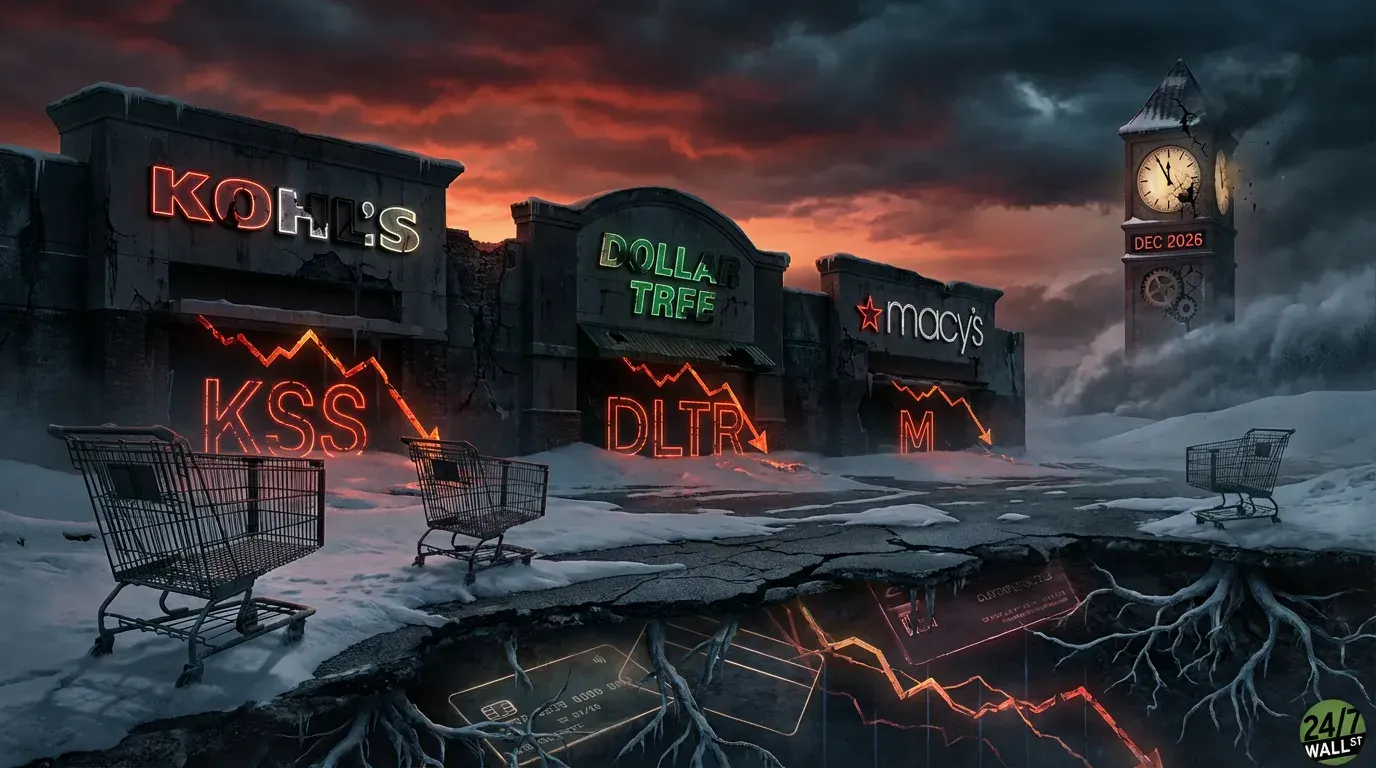
The American retail landscape is littered with the corpses of once-dominant chains that failed to adapt. Well ahead of the 2026 holiday season, three household names—Dollar Tree (NASDAQ: DLTR), Kohl’s (NYSE: KSS), and Macy’s (NYSE: M)—are flashing warning signs that suggest they could join that list before year’s end. Despite recent earnings beats and management optimism, the underlying fundamentals tell a story of retailers running out of runway.
Consumer sentiment sits at 57.9, below the recessionary threshold of 60. Retail sales growth has stalled at just 3.3% year-over-year, with December 2025 sales unchanged month-over-month despite peak holiday season. That flat momentum is the backdrop against which these three retailers must prove they can survive.
Kohl’s: The Turnaround That’s Running Out of Time
Kohl’s posted its third consecutive quarter of beating expectations in Q3 FY2026 (reported November 2025), with revenue of $3.58 billion and adjusted EPS of $0.10. CEO Michael Bender, appointed after serving as interim since May 2025, declared the company was “moving in the right direction.” The numbers tell a different story.
Revenue declined 2.8% year-over-year, net income collapsed 63.64% to just $8 million, and cash reserves dropped 17.24% to $144 million. For a retailer with $15.75 billion in trailing 12-month revenue, $144 million in cash is dangerously thin. The stock has rallied 65% over the past year to $19.26, but shareholders have lost 63.5% over five years. A profit margin of 1.24% leaves zero room for error.
Insider activity reveals the tension. Seven board members purchased a total of 1,187 shares on December 24, 2025, while CFO Jill Timm sold 35,000 shares for approximately $808,750 just weeks earlier. When your CFO is heading for the exits while the board makes token purchases, that’s not a vote of confidence.
Dollar Tree: Free Cash Flow Crisis Behind the Growth Story
Dollar Tree looks healthier on the surface. The company posted $4.75 billion in Q3 revenue with 9.4% year-over-year growth, beat EPS estimates with $1.21, and expanded same-store sales by 4.2%. CEO Mike Creedon boasted about “strong momentum” and keeping 85% of assortment priced at $2 or less.
The problem is in the cash flow statement. Dollar Tree generated $958.5 million in operating cash flow but burned $870.3 million on capital expenditures, leaving free cash flow of just $88.2 million. For a company with a $27.2 billion market cap, that’s razor-thin. Opening 106 new stores per quarter and converting hundreds to the Dollar Tree 3.0 format leaves almost nothing for shareholders.
The company completed $1.5 billion in share repurchases year-to-date out of a $2.5 billion program—funded how, exactly, when free cash flow is $88 million? The balance sheet shows total liabilities of $10.19 billion against equity of $3.46 billion. The stock has surged 76.63% over the past year to $133.57, but that valuation assumes the growth story holds. If consumer spending weakens further, the capital-intensive expansion model becomes unsustainable.
Macy’s: The Bold New Chapter That’s Still Bleeding
Macy’s CEO Tony Spring was “very bullish” about Q3, claiming “the strongest sales in 13 quarters.” The company reported $4.713 billion in revenue, beat EPS estimates with $0.09, and grew comparable sales 2.5% on an owned basis, with Bloomingdale’s up 8.8%.
Strip away the spin and the picture darkens. Revenue declined 3.88% year-over-year. Gross profit fell 8.88%, with margin down 20 basis points due to tariff impacts. Operating income dropped 34.38%, and net income collapsed 60.71% to just $11 million on $22.7 billion in trailing revenue. The “Bold New Chapter” strategy is shrinking the company into profitability rather than growing into it. Macy’s returned $99 million to shareholders through dividends and buybacks on $11 million in quarterly net income—burning capital it can’t afford.
The stock has gained 43.6% over the past year to $22.01 but remains down 45.3% over 10 years. Analysts hold a consensus target of $21.80, essentially flat, with 11 Hold ratings and only 1 Buy.
The Common Thread: No Margin for Error
What unites these three retailers is the absence of financial cushion. Kohl’s has $8 million in quarterly net income. Dollar Tree has $88 million in free cash flow. Macy’s has $11 million in net income. None have the resources to weather a prolonged consumer downturn, absorb tariff shocks, or invest in the digital transformation needed to compete with Amazon. If spending remains weak through Christmas 2026, these retailers face significant financial pressure. Investors and analysts will be watching closely to see whether management strategies can stabilize operations before conditions worsen.













 Top Gaining Stocks
 Top Losing Stocks
