AAPD’s 3.43% Yield Looks Great Until You See the 40% Hangover
Direxion Daily AAPL Bear 1X Shares (NYSEARCA:AAPD) carries a 3.43% dividend yield, but calling these payments “dividends” in the traditional sense is misleading. Understanding what actually generates this income is essential before treating AAPD as an income vehicle.How AAPD Generates…


Direxion Daily AAPL Bear 1X Shares (NYSEARCA:AAPD) carries a 3.43% dividend yield, but calling these payments “dividends” in the traditional sense is misleading. Understanding what actually generates this income is essential before treating AAPD as an income vehicle.
How AAPD Generates Income
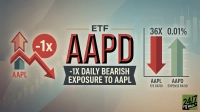
AAPD is not a dividend stock fund. It seeks daily investment results of -100% of Apple (NASDAQ:AAPL | AAPL Price Prediction)’s daily return using swap agreements and derivatives. The distributions investors receive come primarily from interest earned on cash collateral held against those swap positions, not from underlying company dividends. Think of it as the interest income generated while maintaining a synthetic short position on Apple.
Why the Distributions Are Declining
AAPD’s distributions have deteriorated sharply since the fund’s early years. Annual payouts peaked at $0.883 in 2023 and have fallen steadily since, dropping 21.3% to $0.695 in 2024 as the rate environment began shifting. By 2025, the decline accelerated — the Q4 payment of $0.108 marked the lowest single quarterly distribution in the fund’s history, reflecting how directly this income stream depends on the interest rate environment rather than any underlying business performance.
The primary driver is the Federal Reserve’s rate-cutting cycle. The fed funds rate dropped from 4.50% in early 2025 to 3.75% by February 2026 – a 75 basis point reduction that directly compresses the interest income available from collateral. Lower rates mean less income, and the declining distribution history confirms this relationship precisely.
The Real Problem: Price Erosion
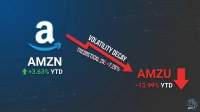
Even if distributions were stable, AAPD’s price erosion undermines any income thesis. The fund has lost 10.82% over the past year, and since inception in August 2022 is down nearly 40% — a direct consequence of Apple’s powerful long-term upward trend. Daily rebalancing compounds this structural headwind: in volatile markets, the fund bleeds value on both up and down days through a mechanism known as volatility decay, making long-term holding increasingly costly.
Verdict
AAPD’s distributions have declined steadily in response to falling interest rates, with no structural mechanism to reverse that trend without a significant rate increase. The fund’s prospectus states it is designed for short-term use, and the NAV erosion data shows income received has been more than offset by price losses over the measured periods.
Contact [email protected] for any questions or corrections.
Austin Smith is a financial publisher with over two decades of experience as an investor, analyst, and advisor. He covers stocks, ETFs, Artificial intelligence and personal finance for 24/7 Wall St. Previously, he spent over a decade at The Motley Fool as a senior editor for Fool.com, portfolio advisor for Millionacres, and launched The Ascent to help reader take control of their personal finances.
His work has been featured on Fool.com, NPR, CNBC, USA Today, Yahoo Finance, MSN, AOL, Marketwatch, and many other publications. He is as an advisor to private companies, and co-hosts The AI Investor Podcast with Eric Bleeker.
When not looking for investment opportunities, he can be found skiing, running, or playing soccer with his children. Learn more about Austin's investment approach here.