Retirees Are Sleeping Well With These 3 Low-Volatility ETFs
After decades of hard work and diligent saving, you want to sleep well in your Golden Years. A few threats can keep you up at night: inflation quietly erodes purchasing power once a regular paycheck stops, and an unexpected market…


After decades of hard work and diligent saving, you want to sleep well in your Golden Years. Two forces in particular can keep you up at night. Inflation quietly erodes purchasing power once a regular paycheck stops arriving, and a sudden market downturn can throw a carefully built portfolio into a tailspin. Finding income that holds steady through both is the central challenge of retirement investing.
One answer many retirees have embraced is dividend exchange-traded funds. These diversified portfolios track established indexes, pay regular income, and spread risk across a broad mix of stocks rather than concentrating it in any single name. The catch is that dividend ETFs vary enormously in quality and design, and not every high-yield fund is built to hold up when markets get rough.
Reliable income and steady capital preservation both matter at this stage of life. The strongest dividend ETFs for retirees pair high-quality, high-dividend stocks with meaningful downside resilience and low expenses, so that more of the return actually reaches the investor. Those three qualities, taken together, are what separates a genuinely defensive income fund from one that simply carries an attractive headline yield without the durability to sustain it.
With that framework in mind, here are three ETFs worth a closer look for retirees seeking a little more peace of mind.
Invesco S&P 500 High Dividend Low Volatility ETF (SPHD)
Risk-averse retirees looking for a balance between income and capital preservation may find a strong fit in Invesco S&P 500 High Dividend Low Volatility ETF (NYSEARCA:SPHD). The fund targets financially stable S&P 500 companies that pay above-average dividends, then screens out the most volatile names to reduce risk and sidestep potential value traps.
The income case is compelling on several fronts. SPHD has paid monthly distributions without interruption since its October 2012 launch, and its 30-day SEC yield stands at approximately 4.8%. On a $400,000 investment, that yield translates to roughly $1,600 a month in income. The fund carries an expense ratio of 0.30%, rebalances its portfolio of approximately 50 securities twice a year in January and July, and assets under management stand at approximately $3.4 billion. That asset base reflects a steady niche following among income-focused investors who specifically want the low-volatility screen layered on top of the dividend filter.
SPHD concentrates heavily in defensive sectors, which tend to maintain strong cash flows even during periods of market turbulence. That tilt comes at a predictable cost in strong bull markets: the fund holds minimal technology exposure and has historically lagged when AI-driven growth stocks command market leadership. For retirees whose primary goal is reliable income with limited drawdown, that trade-off can make sense as part of a broadly diversified portfolio.
Here is a breakdown of its sector holdings.
- Real estate: 21.86%
- Consumer staples: 16.50%
- Utilities: 14.05%
- Health care: 12.99%
- Financials: 12.66%
- Energy: 9.87%
- Communication services: 7.13%
- Industrials: 2.84%
- Materials: 2.10%
Schwab US Dividend Equity ETF (SCHD)
Retirees seeking a low-cost, high-quality dividend ETF with meaningful downside cushion will find a strong candidate in Schwab US Dividend Equity ETF (NYSEARCA:SCHD). The fund screens for high-dividend-paying companies with strong fundamentals relative to their peers, with particular attention to cash flow and return on equity. It tracks the Dow Jones US Dividend 100 Index and holds 102 stocks. That quality filter is designed to identify companies capable of sustaining and growing dividends across full market cycles, a particularly important characteristic for retirees who may spend two or three decades drawing income from their portfolios.
SCHD is one of the lowest-cost ETFs in the dividend space, carrying an expense ratio of just 0.06%. Its trailing 12-month yield sits at approximately 3.1%, meaning a $400,000 investment could generate around $1,033 a month. The fund has grown into one of the largest dividend ETFs in the world, with assets under management of approximately $108 billion. It is also worth noting that Schwab executed a 3-for-1 share split on SCHD effective October 10, 2024, making the fund more accessible at a lower per-share price without changing the underlying economics for existing holders.
The income story goes beyond yield. SCHD is on pace for its 15th consecutive year of dividend increases in 2026, backed by a five-year annualized dividend growth rate of 7.5% and a 10-year average growth rate of 10.2%. That compounding trajectory is a meaningful built-in hedge against inflation for retirees drawing income over a long time horizon. After a difficult stretch when megacap technology stocks dominated market gains from 2023 through 2025, SCHD has staged a dramatic recovery in 2026, posting a year-to-date total return of approximately 25% through mid-October as market leadership broadened well beyond the growth names that once overshadowed it. The fund’s distributions are paid quarterly, and its heaviest concentrations remain in defensive sectors, as the portfolio breakdown below shows.
- Energy: 19.88%
- Consumer Staples: 18.50%
- Health Care: 16.20%
- Industrials: 12.10%
- Financials: 9.68%
- Consumer Discretionary: 8.47%
- Information Technology: 8.20%
- Communication Services: 4.27%
- Materials: 2.66%
- Utilities: 0.04%
ProShares S&P 500 Dividend Aristocrats ETF (NOBL)
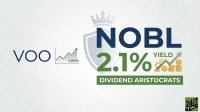
ProShares S&P 500 Dividend Aristocrats ETF (NYSEARCA:NOBL) takes a fundamentally different approach by focusing on so-called Dividend Aristocrats. The fund tracks an equal-weighted index of S&P 500 companies that have raised their dividends every single year for at least 25 consecutive years. That long, unbroken track record of distribution growth can give retirees a meaningful degree of confidence that income will keep flowing through market cycles. NOBL held 69 qualifying companies per the index methodology as of June 30, 2026, with net assets of approximately $11.2 billion. ProShares also executed a 2-for-1 forward share split on NOBL effective May 28, 2026, halving the per-share price without altering the value of any investor’s holding.
NOBL’s 12-month dividend yield stands at approximately 2.1%, placing it at the more modest end of the income spectrum compared with SPHD and SCHD. A $400,000 investment at that yield level generates roughly $700 a month. What the fund may lack in immediate yield it compensates for with consistency: the Dividend Aristocrats have a documented history of growing distributions over time, providing a natural hedge against inflation risk over a long retirement. The fund’s expense ratio is 0.35%. Historically, NOBL has also delivered lower volatility than the broad S&P 500 while capturing a meaningful portion of gains in rising markets, and its equal-weight construction means no single holding can dominate the portfolio in either direction.
The fund’s heaviest concentrations are in consumer staples and industrials, as the sector breakdown below illustrates.
- Consumer Defensive: 23.32%
- Industrials: 20.74%
- Financial Services: 12.98%
- Health Care: 10.79%
- Basic Materials: 9.72%
- Utilities: 5.62%
- Consumer Cyclical: 5.39%
- Real Estate: 4.52%
- Technology: 4.39%
- Energy: 2.54%
Editor’s note: This pass corrected SPHD’s AUM from approximately $4 billion to approximately $3.4 billion and its yield from 4.67% to approximately 4.8%, per current data. SCHD’s AUM was updated to approximately $108 billion, its holding count to 102 stocks, its trailing yield to approximately 3.1%, and its year-to-date total return to approximately 25% through mid-October 2026. NOBL’s 12-month dividend yield was corrected from 2.49% (an index-level figure) to approximately 2.1% per the fund’s own reported 12-month yield, with the corresponding monthly income estimate revised from $830 to approximately $700 on a $400,000 investment, and AUM updated to approximately $11.2 billion.
Contact [email protected] for any questions or corrections.
Javier Simon is a contributor for 24/7 Wall St. His work has appeared on major financial publications like Fox Business, The Motley Fool, Money Magazine, and more. He’s experienced in covering a range of personal finance topics including retirement planning, investing, taxes, student loans, and mortgages. He’s also versed in writing in-depth reviews of brokerage and fintech products. Javier earned his bachelor’s degree in multimedia journalism from SUNY Plattsburgh. That’s where he first embarked on his journey into journalism as a staff writer for the award-winning newspaper Cardinal Points. His first professional gig in the world of personal finance was as a staff writer for the fintech company SmartAsset. There, he became a Certified Educator in Personal Finance (CEPF) and led a project producing high-ranking reviews of 529 college savings plans sponsored by different states.