Income Investors Skip VOO’s 1.09% Yield And Choose NOBL’s 68 Dividend Aristocrats Paying Twice As Much
While Vanguard 500 Index Fund ETF Shares (NASDAQ:VOO) dominates the most popular ETF rankings with $1.5 trillion in assets and an industry leading 0.03% expense ratio, income investors should consider ProShares S&P 500Dividend Aristocrats ETF (NYSEARCA:NOBL) for superior cash flow.…

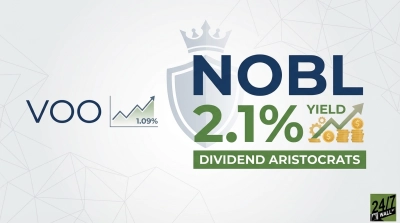
While Vanguard 500 Index Fund ETF Shares (NASDAQ:VOO) dominates the most popular ETF rankings with $1.5 trillion in assets and an industry leading 0.03% expense ratio, income investors should consider ProShares S&P 500Dividend Aristocrats ETF (NYSEARCA:NOBL) for superior cash flow. NOBL tracks 68 companies with 25+ consecutive years of dividend increases, yielding 2.1% versus VOO’s 1.09%—nearly double the income.
How NOBL Generates Income
NOBL generates income exclusively from dividends paid by 68 blue-chip Dividend Aristocrats with proven records of raising dividends through multiple economic cycles. The ETF uses equal-weighting methodology, with holdings ranging from 1.2% to 2.1%, preventing over-concentration while maximizing exposure to consistent dividend payers across defensive sectors including Industrials (22.5%) and Consumer Staples (20.9%).
Dividend Safety Analysis: Top Holdings
The sustainability of NOBL’s dividend depends on its largest positions:
- Albemarle Corporation (2.06% weighting) presents the most risk with negative earnings of -$1.59 per share due to cyclical lithium pricing pressures. Despite this, the company maintains its $1.62 annual payout, exemplifying the Aristocrat commitment to maintaining dividends through temporary headwinds.
- Caterpillar (1.68% weighting) demonstrates aristocrat quality with 46.3% return on equity, 14.3% profit margin, and $5.84 annual dividend supported by $19.49 in earnings. CAT’s 30% payout ratio provides substantial safety margin, while $64.7 billion in revenue grew 9.5% year-over-year.
- Johnson & Johnson (1.51% weighting) offers 2.37% yield with 74% payout ratio—elevated but manageable given its 27.3% profit margin and diversified healthcare portfolio. With 60+ years of consecutive dividend increases, JNJ’s aristocrat pedigree is unmatched.
- Walmart (1.56% weighting) and Procter & Gamble (1.33% weighting) feature conservative payout ratios of 32% and 60% respectively. Both generate substantial free cash flow from recession-resistant businesses, supporting reliable dividend growth.
The VOO Comparison
VOO’s 1.09% yield reflects its tech-heavy composition, with 36% in Information Technology. While mega-caps like Nvidia (8.47%), Apple (6.88%), and Microsoft (6.60%) drive capital appreciation, many pay minimal or no dividends. VOO’s top 10 holdings represent 40% of the portfolio, creating concentration risk that NOBL’s equal-weighting avoids.
For retirees or income investors, NOBL’s 2.1% yield provides meaningful quarterly cash flow while defensive sector tilt reduces volatility. The trade-off is NOBL’s 0.35% expense ratio versus VOO’s 0.03%, costing an additional $320 annually per $100,000 invested.
Consider SCHD as an Alternative
Income investors should also evaluate Schwab U.S. Dividend Equity ETF (NASDAQ:SCHD), which offers 3.8% yield—the highest among quality dividend ETFs. SCHD tracks 100 high-dividend-yielding U.S. stocks screened for financial strength, with only 0.06% expense ratio. The fund emphasizes cash flow generation and dividend sustainability rather than consecutive increase streaks, resulting in higher current income. With $71.2 billion in assets and top holdings including Cisco (4.72%), Merck (4.63%), and AbbVie (4.23%), SCHD provides another path to reliable dividend income with superior yield versus both NOBL and VOO.
Contact [email protected] for any questions or corrections.
I am a long time investor and student of business, and believe finding good companies that can become great investments is the best game on earth. After 20 years of writing and researching the public markets it is clear that individuals have never had more tools and information to take control of their financial lives. From ETFs and $0 commissions to cryptos and prediction markets there has never been a greater democratization of access to investing.
I write to help people understand the investments available to them so they can make the best choice for their portfolio, whether they're starting out or looking for income in retirement.