Hasbro and Whirlpool: Two Iconic American Brands Reinventing Themselves Under Pressure
Hasbro (NASDAQ: HAS | HAS Price Prediction) and Whirlpool (NYSE: WHR) just reported earnings that tell two very different reinvention stories. Hasbro crushed estimates and proved its pivot to digital IP is working. Whirlpool missed on both lines and is…

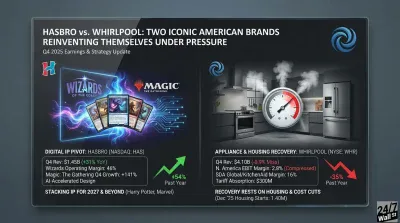
Hasbro (NASDAQ: HAS | HAS Price Prediction) and Whirlpool (NYSE: WHR) just reported earnings that tell two very different reinvention stories. Hasbro crushed estimates and proved its pivot to digital IP is working. Whirlpool missed on both lines and is betting its recovery on housing, cost cuts, and a promotional environment that finally seems to be calming down.
Magic Cards Carry Hasbro. Appliance Margins Punish Whirlpool.
Hasbro’s Q4 result was not a mild beat. Revenue came in at $1.45 billion, up 31% year-over-year, beating estimates by over 14%. The engine behind it is Magic: The Gathering, which grew 141% in Q4 alone and nearly 60% for the full year. The Wizards of the Coast segment ran at a 46% operating margin for the full year, extraordinary for a consumer brand. CEO Chris Cocks framed it well:
“We returned the company to growth, engaged one billion fans, secured new partnerships, and made progress in our evolution into a digital-first play and IP company.”
Chris Cocks, CEO of Hasbro
Whirlpool’s quarter looked nothing like that. Q4 revenue of $4.10 billion missed estimates by 3.76%, and North America EBIT margin compressed to just 2.8%, down nearly 4 points year-over-year. Asian competitors flooded U.S. shelves with pre-tariff inventory, forcing Whirlpool into a brutal promotional cycle it consciously chose not to fully match.
| Business Driver | Hasbro | Whirlpool |
|---|---|---|
| Q4 Revenue Growth | +31% | -0.9% |
| Core Margin Story | Wizards at 46% operating margin | North America at 2.8% EBIT |
| Key Growth Driver | Magic: The Gathering IP | SDA Global / KitchenAid |
One Is Selling IP. The Other Is Selling Appliances in a Price War.
Hasbro is effectively becoming a high-margin IP licensing and gaming company that still sells toys. The Harry Potter toy license ahead of the 2027 HBO series and upcoming Marvel and TMNT Magic sets show a company stacking IP catalysts years in advance. AI is being deployed across design and supply chain, with Cocks claiming an 80% reduction in time from concept to physical prototype.
Whirlpool is fighting a different battle. Its U.S. manufacturing footprint became a cost burden in 2025 when competitors pre-loaded inventory. CEO Marc Bitzer noted that Whirlpool absorbed roughly $300 million of tariffs in 2025 while the industry did not yet move on pricing. The bright spot is SDA Global, where KitchenAid delivered approximately 10% growth and a 16% full-year EBIT margin. That segment looks like Whirlpool’s version of Wizards: smaller, higher-margin, and pointing toward what the business could become.
Housing Data and Harry Potter Will Tell the Story in 2026
Whirlpool’s recovery thesis rests on housing. Housing starts hit 1.40 million annualized units in December 2025, which is in the healthy range, but existing home sales remain near multi-decade lows. Bitzer explicitly said discretionary demand upside has not been factored into 2026 guidance, meaning any housing rebound is pure optionality. The key question is whether promotional intensity stays calm through the spring selling season.
For Hasbro, the Q4 Magic comp becomes a real challenge. The CFO flagged that most 2026 growth comes in the first three quarters, with Q4 facing a massive comparison. The Harry Potter and Disney slates give Consumer Products a real shot at reversing its full-year 4% revenue decline from 2025.
Two Very Different Trajectories
Hasbro’s stock is up 54% over the past year while Whirlpool has fallen nearly 35% over the same period. That gap reflects business trajectories, not just sentiment. Hasbro has a proven, high-margin growth engine in Wizards and a deep IP pipeline building toward 2027. Whirlpool has a credible recovery story, but one that depends on external factors it cannot fully control.
Contact [email protected] for any questions or corrections.
I write to invest, and I invest to spend more time with nature. Usually all at the same time. I'm a retired equities guy who saw a recession or four, and lives for what comes out of the other side of them.
I cover stocks across the board cause even though I feel like I've seen it all, there's always another way out there to make, and lose money. I want to help you do more of the former, and none of the latter. Making money with friends is my oxygen.
Let's go!