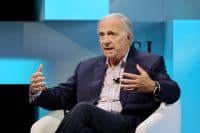
Jim Cramer Now Says 70% Stocks for Anyone 60 to 70. “I Know That’s Higher Than What I’ve Usually Said”

This post may contain links from our sponsors and affiliates, and Flywheel Publishing may receive compensation for actions taken through them.

Jim Cramer told a Mad Money caller last week that people in their 60s should keep most of their money in stocks, and more than he has recommended before.
The caller, Shane from Alabama, asked whether the 60/40 rule, 60% stocks and 40% bonds, is still the foundation of a balanced portfolio. Cramer answered: “When you're 60-70, I still think that's young, and I think you should have 70% stock. I know that's higher than what I've usually said, but I just think that you're not going to get the return from bonds.”
“I am betting that people are going to have a long life, hopefully a happy life,” he said on the November 13 show. “So we're buying and keeping a lot of stock right almost to the end.”
What 70% means in dollars
Take a 65-year-old with $800,000 saved. Here is how much sits in stocks under Cramer's number and two common alternatives, and what the stock part alone would have lost in two recent drops of the S&P 500, measured with the SPDR S&P 500 ETF (SPY):
- 70% stocks (Cramer): $560,000 in stocks. In the 2022 bear market (a 25.4% drop from peak to low) that part would have lost $142,019. In the drop since the October 6 record (6.0% so far) it is down $33,531.
- 60% stocks (60/40): $480,000 in stocks. In the 2022 bear market (a 25.4% drop from peak to low) that part would have lost $121,731. In the drop since the October 6 record (6.0% so far) it is down $28,741.
- 35% stocks (your age in bonds): $280,000 in stocks. In the 2022 bear market (a 25.4% drop from peak to low) that part would have lost $71,010. In the drop since the October 6 record (6.0% so far) it is down $16,766.
The gap between Cramer's 70% and a 60/40 mix in a 2022-size drop is $20,288 on this portfolio. In early 2020 the S&P 500 fell 34.1% in about five weeks.
These figures leave out dividends and whatever the bond side did. In 2022, bonds fell too.
Why he moved
Cramer gave two reasons in his answer: people are living longer, so money has to last more years, and he doesn't expect bonds to deliver the returns retirees want. “I want you to be thinking about living long, and I think you'll live longer,” he told the caller.
The older rule of thumb of holding your age in bonds would put that 65-year-old at 35% stocks, half of Cramer's number.
Who it fits
A higher stock share works best for money you won't touch for years. Money you plan to spend in the next few years has to come from somewhere when stocks are down, which is why many retirees keep that part in cash or bonds and hold stocks with the rest.
Contact [email protected] for any questions or corrections.
I've been writing about stocks and personal finance for 20+ years. I believe all great companies are tech companies in the long run, and I invest accordingly.