How $200 Oil Impacts Your Stocks and Your Wallet
Oil is sitting at $96 a barrel as of March 13, 2026, up from $71 just ten days ago. The Iran war has effectively closed the Strait of Hormuz, through which roughly 20% of the world’s daily oil supply flows.…


Oil is sitting at $96 a barrel as of March 13, 2026, up from $71 just ten days ago. The Iran war has effectively closed the Strait of Hormuz, through which roughly 20% of the world’s daily oil supply flows. Analysts and the Financial Times are now openly discussing a path to $200 crude. Stifel noted as recently as March 6 that $200 oil is “no longer unthinkable.” That’s not a headline to scroll past if you own retail stocks or a household budget.
Here’s what the data shows about retail exposure and consumer spending.
The Stocks Most at Risk
1. Target (TGT)
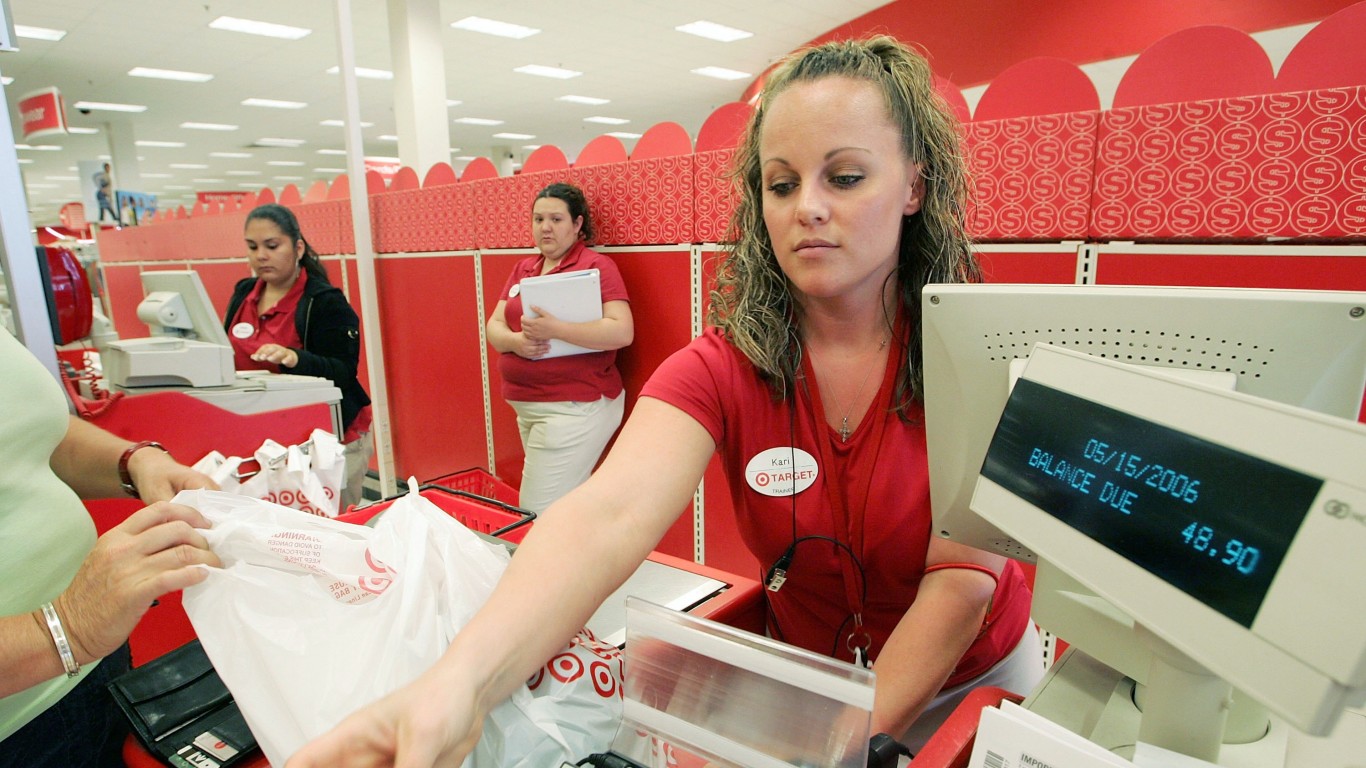
Target (NYSE:TGT | TGT Price Prediction) is the most exposed large-cap retailer in this scenario. The problem isn’t just transportation costs — it’s the product mix. Target’s revenue skews heavily toward discretionary categories: apparel at $4.10B, home furnishings at $4.82B, and hardlines at $6.02B in the most recent fiscal year. When gas eats deeper into household budgets, those are the first categories cut. Target is already down 3.83% over the past week, and comparable store sales fell 3.9% last quarter. Wolfe Research has flagged Target as among the largest war losers, per a CNBC report from March 13, 2026 by Laya Neelakandan. With a beta of 1.1 and four strong sell ratings from analysts, the downside case is real.
2. Five Below (FIVE)
Five Below (NASDAQ:FIVE) looks like a trade-down beneficiary on the surface, but the reality is more complicated. Its merchandise is heavily import-dependent, with significant China sourcing exposure. An oil shock that disrupts global shipping raises freight costs on the very goods Five Below needs to keep prices at $5 and under. the teen and tween demographic it serves is among the most discretionary in retail. The stock is down 2% this week despite a strong YTD run. If $200 oil materializes, import cost headwinds and consumer pullback create a squeeze from both ends.
3. Dollar General (DG)
Dollar General (NYSE:DG) serves primarily lower-income, rural consumers — the exact demographic hit hardest when pump prices spike. The stock is already down 7.23% this week and 7.04% over the past month. UBS analysts, as cited in the March 13 CNBC piece, note that lower-income shoppers will face tighter budgets and may reduce spending even at dollar stores. Dollar General’s ~21,000 locations are spread across rural America, meaning its replenishment logistics are fuel-cost-intensive. The trade-down thesis is real, but the cost structure works against it at $200 oil.
The Stocks With More Resilience
4. Walmart (WMT)
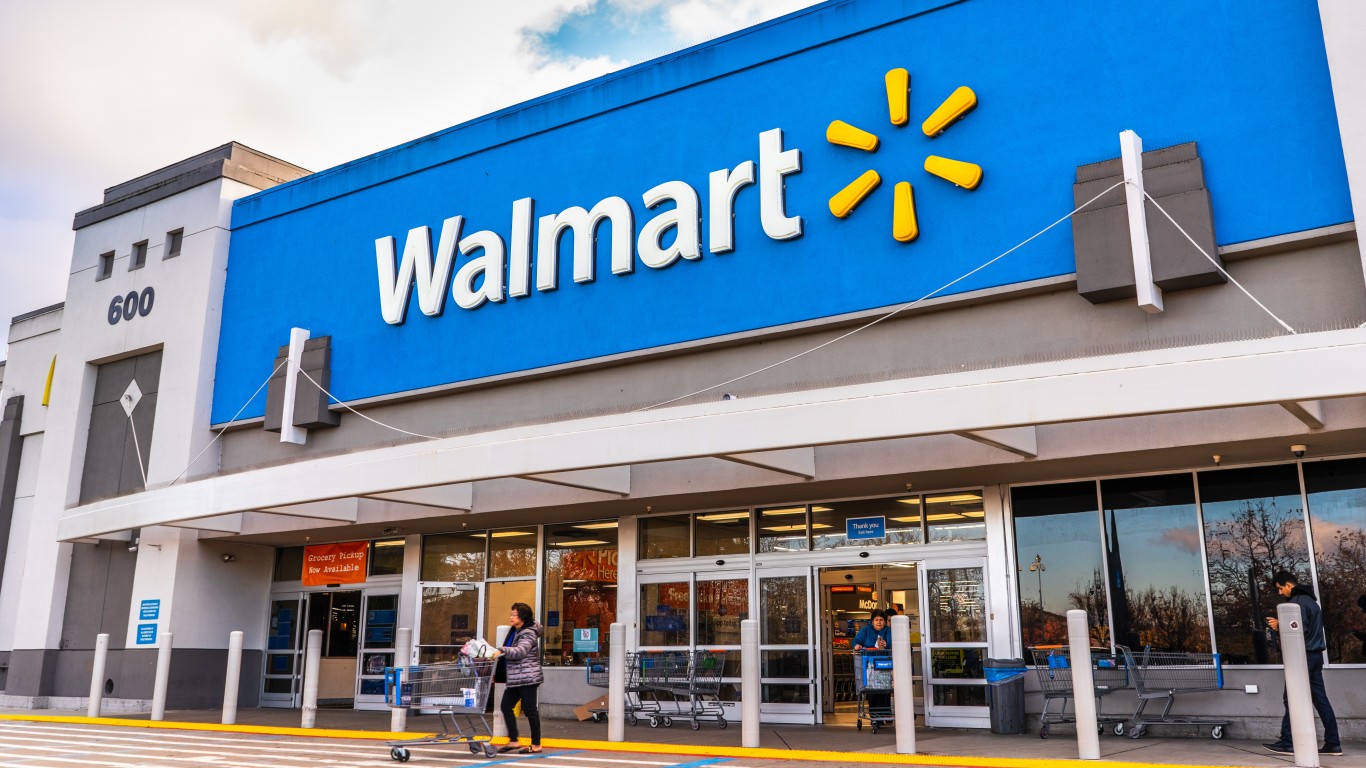
Walmart (NYSE:WMT) is the clearest trade-down beneficiary here. The stock is up 12.49% year-to-date, and Coresight Research President Max Kahn expects value retailers to benefit as consumers trade down, per the March 13 CNBC report. Walmart has already been gaining share across all income tiers, including upper-income households, and its scale gives it negotiating leverage on logistics costs that smaller retailers don’t have. The risk is real: Walmart operates a massive private fleet, and fuel is a direct cost. But when budgets tighten, consumers still need to eat, and Walmart wins that dynamic. Analysts carry a consensus target of $135.90, with 30 buy ratings and only one sell.
5. Costco (COST)
Costco (NASDAQ:COST) has a structural advantage most overlook in an oil shock: its gas stations. When pump prices surge, Costco’s stations consistently undercut competitors, driving warehouse traffic. UBS and Wolfe Research both cite this price leadership as a key competitive advantage, per the March 13 CNBC report. The stock is up 16.51% YTD and trades just above $1,000. Its membership renewal rate sits at 89.7%, and paid memberships reached 82.1 million. The higher-income membership base is also less sensitive to energy cost pressures than the Dollar General or Five Below customer. Analysts carry a consensus target of $1,067.
What $200 Oil Means for Your Wallet
Gas is currently about 4% of average household spending. At $200 oil, that figure could approach 8%, effectively doubling the energy drag on every American family’s budget. For context, CPI hit 9.1% in June 2022 when oil spiked following the Ukraine war. That spike peaked at roughly $115 a barrel. A move to $200 would be entirely uncharted territory.
The disruption isn’t limited to gas. The Strait of Hormuz closure is also disrupting fertilizers, metals, and LNG, with Qatar shutting down gas liquefaction operations. Grocery prices are expected to follow. Consumer sentiment is already at 56.4, deep in pessimistic territory. The household savings rate has declined from 6.2% in early 2024 to 4.0% in Q4 2025, leaving consumers with less cushion to absorb a shock of this magnitude.
The K-shaped economy dynamic makes this especially uneven. Higher-income households will adjust but absorb the hit. Lower-income households — the core Dollar General and Five Below customer — face compounding pressure with no buffer. And Iran’s new supreme leader Mojtaba Khamenei stated on March 12, 2026 that the Strait closure should continue as a “tool to pressure the enemy”, suggesting this isn’t a short-term disruption that resolves in a few weeks.
The market is already sorting winners from losers. Walmart and Costco are outperforming. Target and Dollar General are sliding. Those divergences have been widening. The question isn’t whether oil will disrupt retail. It already is. The divergence between trade-down winners and discretionary losers is already visible in the price action, and analysts expect it to widen if oil continues its climb toward $200.
Contact [email protected] for any questions or corrections.
I've been writing about stocks and personal finance for 20+ years. I believe all great companies are tech companies in the long run, and I invest accordingly.