




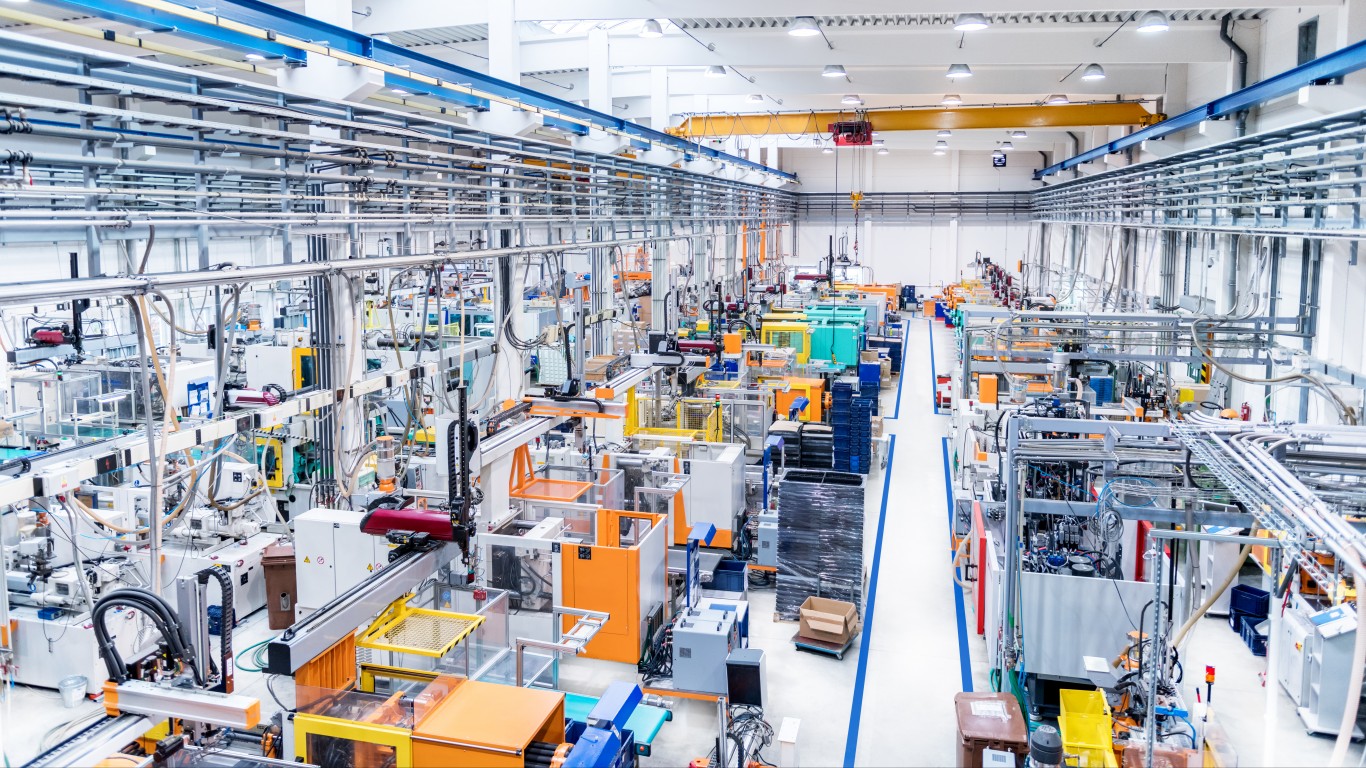
Not every great industrial stock trades at a household name. Some of the most consistent compounders are hiding in plain sight, doing unglamorous work like printing labels, sorting mail, or pressing metal into premium credit cards. These three stocks operate in niches most investors overlook. We ranked them on revenue growth, earnings quality, margin expansion, cash flow generation, and forward positioning.
#3: Pitney Bowes
Pitney Bowes (NYSE:PBI) is a turnaround story, not a growth story. The company runs two segments: SendTech, which handles mailing equipment and related services, and Presort, which processes physical mail for businesses. Both are structurally declining. SendTech posted $317.9M in Q4 2025 revenue, down 6% year-over-year, while Presort came in at $159.7M, down 11%.
What makes PBI interesting is the cash flow machine underneath the shrinking top line. Full-year 2025 free cash flow hit $358.3M, up 128.57% year-over-year. Operating cash flow reached $383.3M, up 67.24%. Management deployed that cash aggressively. repurchasing $378M in shares for the full year and reducing diluted share count from 182M to 158M.
New CEO Kurt Wolf was direct about what went wrong:
“The early-year decision to maintain high pricing for Presort resulted in profitable business walking out the door, based on the belief that we have a premium service that justifies a higher price. While it is true we offer a premium service… customers largely buy based on price.”
That candor comes alongside a Q4 adjusted EPS of $0.45 versus the $0.39 estimate, a 15% beat. The forward picture includes a Phase 2 strategic review expected by end of Q2 2026, evaluating all alternatives to standalone value creation. At a forward P/E of around 7x, the market is pricing in continued decline. The strategic review outcome will be a key catalyst to monitor.
The risks are real: negative shareholders equity of $802M and structural mail volume declines aren’t going away. Pitney Bowes presents complexity and a longer timeline for any thesis to play out.
#2: CompoSecure
CompoSecure (NASDAQ:CMPO), now rebranded as GPGI following its merger with Husky Technologies, sits at a fascinating inflection point. The original business makes premium metal payment cards, a niche where metal cards represent less than 1% of all cards globally yet the market is growing steadily. Q4 2025 organic revenue growth came in at 17%, with gross margins expanding to 55.7% from 52.1% a year earlier.
Card program wins keep stacking up: Wells Fargo Autograph, Bilt, and the Citi American Airlines Centennial card all came on board. The recurring revenue model is sticky, with roughly 75% of revenue tied to card replacement cycles.
The Husky merger creates a combined entity with a combined enterprise value of approximately $7.4B and 2026 pro forma adjusted EBITDA guidance of $620M to $650M. CEO Dave Cote set the tone:
“We are confident in the strong underlying fundamentals for both businesses and are well positioned to deliver best-in-class top line growth, margin expansion, and healthy free cash flow generation in 2026.”
GAAP net income for full-year 2025 was -$136M due to warrant and earnout revaluations, which obscures underlying operating performance. Post-merger leverage runs around 3.5x. The stock has also sold off sharply, down roughly 31% over the past month. High upside, but not for the faint of heart.
#1: Brady Corporation
Brady Corporation (NYSE:BRC) wins this list because it just keeps growing. The Milwaukee-based company makes identification and safety products, including industrial labels, printers, and workplace safety systems, sold to manufacturers worldwide.
Q2 fiscal 2026 marked Brady’s 20th consecutive quarter of organic sales growth. Revenue came in at $384.14M, beating estimates by 1.46% and growing 7.7% year-over-year. Gross margins expanded to 50.6% from 49.3% in the prior year, and operating income jumped 21.38% year-over-year to $62.19M.
Asia is the growth engine right now. Asia organic growth hit 14.2% in Q2 and 11.9% in Q1, well ahead of the broader business. Management is investing to sustain it: R&D spending reached 6.3% of sales in Q2, up from 5.2% a year earlier. The latest product, the i4311 industrial label printer with LabelSense technology, is the kind of incremental innovation that quietly widens Brady’s moat with manufacturing customers.
CEO Russell Shaller on the quarter:
“This quarter marks Brady’s 20th consecutive quarter of organic sales growth, alongside a significant improvement in segment profit within both our Americas & Asia and Europe & Australia regions.”
Brady raised full-year adjusted EPS guidance to $4.95 to $5.15, the second raise of the fiscal year. The balance sheet is clean: net cash of $97.8M and shareholders equity of $1.31B. Brady has also raised its dividend for 30 consecutive years, a track record that only comes from genuine operational discipline.
The Verdict
These three companies show how different “niche industrial” can look. Pitney Bowes is a cash flow story wrapped in a shrinking business, with the strategic review outcome a key catalyst to monitor. CompoSecure combines high-growth characteristics with high complexity around the metal card niche and a transformative merger. Brady simply keeps executing, raising guidance, expanding margins, and compounding quietly. Among the three, Brady’s consistency and fundamentals set the standard against which the others are measured.













 Top Gaining Stocks
 Top Losing Stocks