NVIDIA Is Unstoppable after a $68.1b Quarter, and A Moat That Won’t Stop Growing,
NVIDIA (NASDAQ:NVDA | NVDA Price Prediction) is generating revenue at a pace that most companies never reach in a lifetime, and the fundamental machinery driving that growth is accelerating, not plateauing. With Q4 FY2026 revenue of $68.13 billion, up 73.2%…


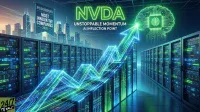
NVIDIA (NASDAQ:NVDA | NVDA Price Prediction) is generating revenue at a pace that most companies never reach in a lifetime, and the fundamental machinery driving that growth is accelerating, not plateauing. With Q4 FY2026 revenue of $68.13 billion, up 73.2% year-over-year, this is not a company riding a wave. It is the wave.
Pillar One: The Earnings Catalyst That Resets Expectations
NVIDIA’s most recent quarter was not a modest beat. Non-GAAP EPS came in at $1.62 against a consensus estimate of $1.52, a 6.58% beat, while Data Center revenue hit $62.31 billion, up 75% year-over-year. The number that deserves more attention: Data Center Networking revenue surged 263% year-over-year to $10.98 billion, driven by NVLink fabric ramp for GB200 and GB300 systems. That is not a product line growing at the edge of the business. That is the infrastructure backbone of AI computing, and it is exploding. Free cash flow for the quarter reached $34.90 billion, with operating cash flow up 117.63% year-over-year. These are not the numbers of a company near its ceiling.
Pillar Two: The Forward Driver Is Already Locked In
NVIDIA guided Q1 FY2027 revenue to approximately $78.0 billion, plus or minus 2%, and that guidance explicitly excludes any Data Center compute revenue from China. The demand pipeline underneath that number is staggering. CEO Jensen Huang stated at GTC 2026 that the company sees $1 trillion in orders for Blackwell and Vera Rubin through 2027. Partnerships with Meta, Anthropic, OpenAI, CoreWeave, AWS, Google Cloud, Microsoft Azure, and Oracle represent committed, multi-year infrastructure spending. CoreWeave alone is targeting more than 5 gigawatts of AI factory buildout by 2030. The revenue pipeline is not speculative. It is contracted.
Pillar Three: The Structural Moat Gets Deeper Every Quarter
The Blackwell architecture is dominant across hyperscalers and enterprise customers alike, but the real structural advantage is NVLink. By weaving compute and networking into a single full-stack platform, NVIDIA has made switching costs prohibitive. The Vera Rubin platform, already announced, promises up to a 10x reduction in inference token cost versus Blackwell. As Huang put it, “Grace Blackwell with NVLink is the king of inference today, delivering an order-of-magnitude lower cost per token, and Vera Rubin will extend that leadership even further.” NVIDIA is not defending a position. It is extending it before competitors can close the current gap. Shareholders’ equity nearly doubled year-over-year to $157.29 billion, and NVIDIA still holds $58.5 billion in remaining share repurchase authorization.
The One Risk Worth Naming
China export controls are real. NVIDIA assumed zero Data Center compute revenue from China in its Q1 FY2027 guidance, and it absorbed $4.5 billion in H20-related charges in Q1 FY2026. That is a real headwind. But the guidance already prices it out, and the demand from U.S. hyperscalers, European cloud providers, and enterprise AI deployments more than compensates. A company guiding to $78 billion in a single quarter while excluding its second-largest historical market is demonstrating, not hiding, the breadth of its demand base.
Valuation and Analyst Outlook
NVIDIA trades at a forward P/E of 23x against 95% of analysts rating it a buy or strong buy and a consensus analyst price target of $268.43 versus a current price of $178.13. The agentic AI inflection represents a multi-year capital spending cycle, and NVIDIA has positioned itself as a primary infrastructure supplier across hyperscalers and enterprise customers.
Contact [email protected] for any questions or corrections.
I am a long time investor and student of business, and believe finding good companies that can become great investments is the best game on earth. After 20 years of writing and researching the public markets it is clear that individuals have never had more tools and information to take control of their financial lives. From ETFs and $0 commissions to cryptos and prediction markets there has never been a greater democratization of access to investing.
I write to help people understand the investments available to them so they can make the best choice for their portfolio, whether they're starting out or looking for income in retirement.