Intel vs AMD: Which is a Better Long-Term Buy?
Intel (NASDAQ:INTC | INTC Price Prediction) and Advanced Micro Devices (NASDAQ:AMD) both closed fiscal year 2025 with Q4 earnings that tell very different stories. Intel is fighting to rebuild credibility around its manufacturing ambitions and AI positioning while AMD is…

Intel (NASDAQ:INTC | INTC Price Prediction) and Advanced Micro Devices (NASDAQ:AMD) both closed fiscal year 2025 with Q4 earnings that tell very different stories. Intel is fighting to rebuild credibility around its manufacturing ambitions and AI positioning while AMD is executing at pace, turning a once-niche challenger into a genuine data center powerhouse.
Two Chipmakers, Two Very Different Quarters
Intel’s Q4 revenue came in at $13.67B, beating the $13.39B estimate by 2.14%, but fell 4.1% year over year. The Data Center and AI segment grew 9% to $4.74B, offset by the Client Computing Group, which declined 8% to $8.19B. The foundry business posted a $2.51B operating loss in Q4 alone.
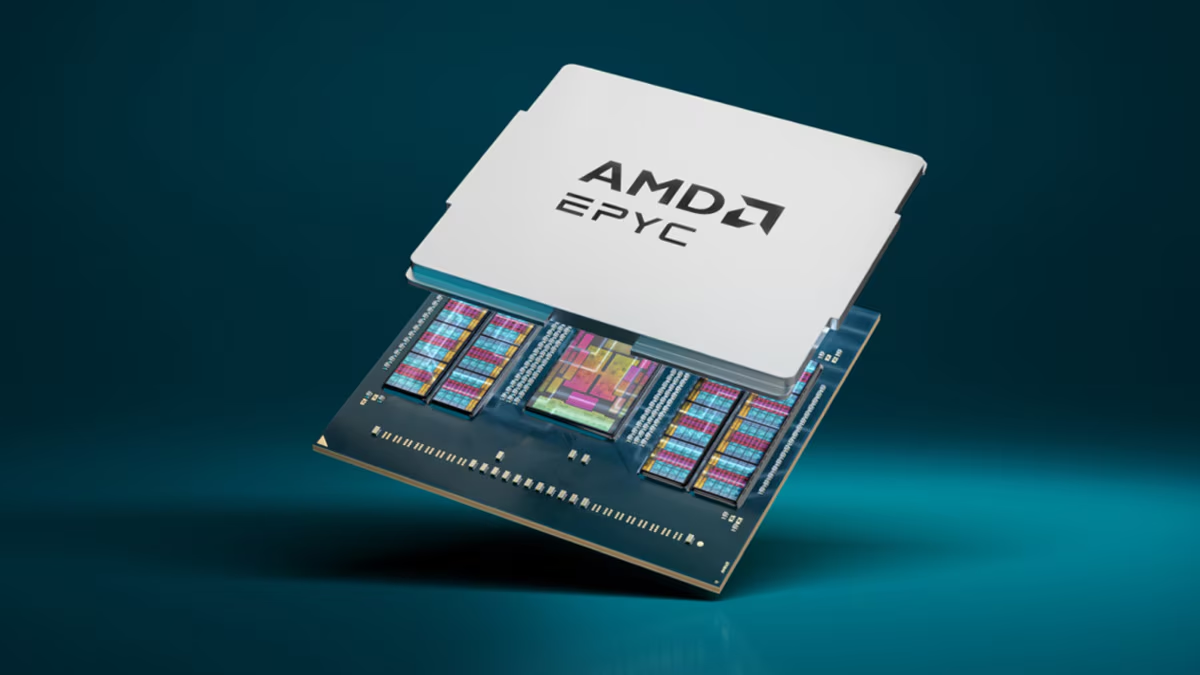
AMD’s quarter stood out on its own merits. Q4 revenue reached $10.27B, beating estimates by 5.64% and rising 34.1% year over year. Its Data Center segment hit a record $5.38B, up 39% year over year, powered by EPYC server processors and Instinct GPU shipments. The Client segment grew 34% to $3.10B. Lisa Su called 2025 “a defining year for AMD, with record revenue and earnings driven by strong execution and broad-based demand for our high-performance and AI platforms.”
| Business Driver | Intel (Q4 FY2025) | AMD (Q4 FY2025) |
|---|---|---|
| Total Revenue | $13.67B | $10.27B |
| Revenue YoY Growth | -4.1% | +34.1% |
| Data Center Revenue | $4.74B (+9%) | $5.38B (+39%) |
| Q4 Net Income | -$591M | $1.51B |
| Non-GAAP Gross Margin | ~34-40% | ~55-57% |
Manufacturing Ambition vs. Fabless Precision
Intel carries the full burden of an integrated device manufacturer, spending $4.02B in Q4 capital expenditures building out Intel 18A, its most advanced U.S.-manufactured process node. That bet could be transformative if external foundry customers materialize, but it costs enormously today. AMD spent just $222M in Q4 capex as a fabless company, relying on Taiwan Semiconductor Manufacturing (NYSE:TSM) while directing resources toward product design.
Intel’s 18A ambitions are real. The first client SoCs built on 18A, branded Core Ultra Series 3, are expected to power 200-plus OEM designs. NVIDIA (NASDAQ:NVDA)’s $5.0B equity investment adds credibility. But Q1 2026 guidance reveals a near-term squeeze: revenue is expected between $11.7B and $12.7B, with non-GAAP EPS of $0.00, as supply sits at its tightest level before improving in Q2.
AMD enters 2026 with no such constraint. Q1 2026 guidance calls for approximately $9.8B in revenue, implying roughly 32% year-over-year growth. The Helios rack-scale platform, the Instinct MI350 and MI400 GPU roadmap, and a partnership with OpenAI covering 6 gigawatts of GPU deployment suggest the AI infrastructure opportunity continues expanding.

Watch Intel’s Foundry Path and AMD’s China Exposure
For Intel, the pivotal 2026 question is whether Intel 18A attracts enough external customers to justify foundry losses. The company has flagged a potential pause on Intel 14A if no external customer is secured. Headcount has dropped from 108,900 to 85,100, and operating expense is being trimmed to approximately $16.0B in 2026 from $16.5B in 2025. Execution discipline is improving, but the margin profile remains fragile.
AMD’s risk centers on export controls. U.S. restrictions on the Instinct MI308 GPU resulted in approximately $440M in net inventory charges across FY2025, and China sales remain under ongoing license review. Q1 2026 guidance includes roughly $100M in MI308 China sales, a figure that could shrink if policy tightens.
Why AMD Leads for Long-Term Conviction
AMD’s full-year FY2025 free cash flow of $5.52B, up 129% year over year reflects a business generating real returns at scale. Analysts carry an average price target of $289.61, with 33 buy ratings and zero sell ratings. The stock trades at a premium, but the growth rate justifies scrutiny rather than dismissal.
Intel remains a genuine turnaround candidate. INTC has gained nearly 28% year to date in 2026, and the analyst consensus target of $47.11 suggests the stock is roughly fairly valued. If 18A gains traction and foundry losses narrow, the upside could be substantial — though execution milestones will determine the timeline. For investors who prefer demonstrated momentum over turnaround optionality, AMD is the cleaner long-term hold today.
Contact [email protected] for any questions or corrections.
Vandita Jadeja is a financial publisher with over a decade of experience writing about financial topics, including investment, savings, retirement, insurance and banking. Vandita is a Chartered Accountant who loves to debunk financial concepts for readers.
Her work has appeared on sites that include The Motley Fool, InvestorPlace, and Benzinga. She covers investing and focuses on stock picks and price prediction for 24/7 Wall St.
When not looking for the next stock investment opportunity, she can be found traveling, reading, chasing sunsets and enjoying her iced latte.