




Electric vehicle giant Tesla (NASDAQ:TSLA | TSLA Price Prediction) closed out 2025 with a quarter revealing a company under pressure while building for a different future. BYD (OTC:BYDDF) entered 2026 with its own contradictions: the world’s largest EV seller by volume is grappling with a domestic sales slump while betting on breakthrough charging technology. The two companies define opposite ends of the global EV story.
Tesla Leans on Energy and Software. BYD Leans on Volume and Technology.
Tesla’s Q4 2025 revenue came in at $24.9 billion, down 3.1% year-over-year, and vehicle deliveries fell 16% to 418,227 units. Those numbers look soft until you examine what else is happening inside the business.
Energy Generation and Storage revenue hit $3.84 billion, up 25% year-over-year, with a record 14.2 GWh deployed in Q4. Services and Other revenue grew 18% to $3.37 billion. These two segments are increasingly the margin story.
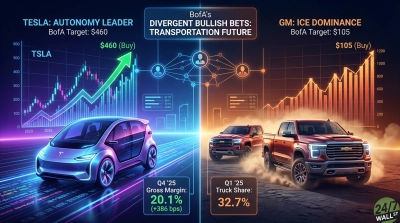
Gross margin expanded 386 basis points to 20.1%, even with fewer cars sold, signaling real cost discipline. Active Full Self Driving subscriptions grew 38% year-over-year to 1.1 million, and the robotaxi service that launched in Austin during Q2 2025 has since expanded toward other major cities. Tesla is monetizing software in a way no other automaker currently can.
BYD’s picture is more complicated. The company delivered 4.54 million passenger vehicles in 2025, a 6.94% increase from 2024, making it the world’s largest EV seller by volume. But momentum has reversed sharply.
BYD’s February 2026 sales dropped 41.1% from a year earlier, the sixth consecutive month of decline and the steepest fall since the COVID-19 pandemic in 2020. Domestic China sales in February fell 65% year-over-year to 89,590 vehicles, even as overseas shipments held up with 100,600 units exported that month.
| Business Driver | Tesla | BYD |
|---|---|---|
| 2025 Deliveries | 418,227 (Q4), down 16% YoY | 4.54M full year, +6.94% YoY |
| Growth Engine Beyond Cars | Energy storage, FSD subscriptions | Overseas exports, flash charging tech |
| Key 2026 Product Catalyst | Cybercab, Optimus robot, Tesla Semi | Blade Battery 2.0, Flash Charging network |
| Key Vulnerability | Delivery declines, brand headwinds in Europe | Domestic China demand collapse, margin pressure |
Autonomy and Energy vs. Charging Speed and Export Growth
Tesla’s strategic pivot is unmistakable. Operating expenses surged 39% year-over-year in 2025, driven by AI infrastructure, FSD development, and the Optimus humanoid robot program. Tesla committed roughly $2 billion to xAI’s Series E and is expanding its Cortex 2 AI training facility at Gigafactory Texas, deliberately compressing near-term profits to build capabilities traditional automakers cannot replicate quickly.
BYD unveiled its Blade Battery 2.0 system, capable of charging from 10% to 70% in five minutes when paired with its new 1.5-megawatt Flash Charging infrastructure in early March 2026.
The technology uses lithium iron phosphate chemistry, cheaper to produce than nickel-based alternatives, and removes one of the last psychological barriers to EV adoption. The catch is infrastructure dependency: the ultra-fast charging times only work with BYD’s proprietary Flash Chargers, creating a closed ecosystem requiring significant capital to scale globally.
On valuation, the gap is stark. Tesla trades at a trailing P/E of roughly 357x and a forward P/E near 175x, pricing in enormous future optionality from robotaxi, energy, and AI.
Tesla shares are down 14.18% year-to-date in 2026, while BYDDF has gained 11.52% over the same period. BYD’s OTC-listed shares trade at a fraction of Tesla’s multiples, reflecting both its lower-margin volume model and the risks of investing in a foreign-listed Chinese company.
Different Catalysts, Different Risks in 2026
For Tesla, the critical 2026 catalyst is the Cybercab production ramp. Volume production is scheduled to begin in 2026, and the robotaxi expansion from Austin to Dallas, Houston, Phoenix, and Miami will test whether FSD performs reliably at commercial scale.
For BYD, domestic recovery matters enormously. BYD lowered its 2025 sales target by 16% to 4.6 million units amid weakening Chinese demand, and early 2026 data suggests the pressure has not eased.
The analyst consensus sits at 17 Hold ratings versus 16 Buy ratings, reflecting genuine uncertainty about timing. If Cybercab ramps smoothly and FSD subscriptions keep growing, that valuation will be tested against execution by year-end.
BYD offers exposure to real volume at scale and aggressive technology investment, alongside the complexity of an OTC-listed Chinese company. The domestic sales decline is a real risk. But BYDDF’s five-year return of 90.43% shows the stock has rewarded patience before. The two stocks serve entirely different portfolio roles.












 Top Gaining Stocks

 Top Losing Stocks