





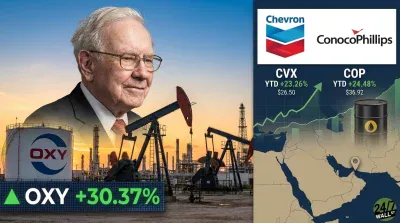
Occidental Petroleum (NYSE:OXY) has climbed 58% year-to-date, moving from $40.92 at the end of 2025 to $64.36 as of March 26. If you watched from the sidelines, the question is obvious: Is there anything left, or did you miss it?
Valuation: Stretched, But Not Without Reason
OXY carries a premium valuation. The stock trades at a trailing P/E of 47x and a forward P/E of 20x, only one of which is elevated for an energy producer whose earnings fluctuate with commodity prices. The consensus analyst price target sits at $58.42, already below where shares trade today. Most of Wall Street is in Hold territory, with 16 analysts rating it Hold, 5 Buy, and 4 Sell or Strong Sell.
The valuation picture gets more nuanced when you factor in structural changes. The sale of OxyChem to Berkshire Hathaway, which closed January 2, 2026 allowed Occidental to cut principal debt by $5.8 billion since mid-December 2025, bringing total principal debt to $15.0 billion. That deleveraging is real and durable, changing the equity’s risk profile in ways trailing earnings multiples only partially capture. Wells Fargo issued a double upgrade to Overweight with a $69 price target, and Piper Sandler followed with an Overweight rating and a $66 target.
Forward Catalyst: Oil Prices Are Doing the Heavy Lifting
The most important variable for OXY is WTI crude. Oil recently spiked to $98.71 per barrel on March 20 before pulling back to $89.33 on March 23, compared to roughly $70 per barrel a year ago. For Occidental, this matters more than for many peers given the company’s cost structure.
Occidental’s breakeven price to generate positive net present value on a well-by-well basis sits around $38 per barrel, and 84% of its total resource base breaks even below $50 per barrel. At current WTI levels, the spread between breakeven and realized price is wide. Higher realized prices per barrel flow directly into revenue with relatively fixed production costs, which means expanded profit margins and substantially higher free cash flow at elevated oil prices. Full-year 2025 operating cash flow came in at $10.532 billion, generated in an environment where Q4 realized crude averaged only $59.22 per barrel. With WTI running materially higher, cash generation improves significantly.
The risk is that current oil prices may not hold. If WTI settles back toward $70 to $75 per barrel, the margin expansion story compresses. Occidental’s earnings, though, are not showing signs of pressure: Q4 2025 adjusted EPS of $0.31 handily beat by $0.13 Wall Street’s estimates, the fourth earnings beat in the past year, a data point worth taking seriously.
Risk and Entry: Where Does the Downside Live?
The stock’s beta of 0.35 suggests lower volatility relative to the broader market, but that metric understates OXY’s true sensitivity to crude prices. The 50-day moving average sits at $49.14, nearly 25% below the current price, which illustrates how far and fast the stock has moved. A meaningful crude price reversal could close that gap quickly.
On the positive side, the quarterly dividend was raised 8% to $0.26 per share, with a payment date of April 15, 2026, providing some income support. Permian production set a record at 800 Mboed in Q3 2025, and the company achieved an organic reserves replacement ratio of 107%, signaling the asset base is growing.
The Verdict
At $65, OXY is priced for an oil price environment that may already be peaking. The structural improvements from the OxyChem sale and debt reduction are real, but the consensus analyst target is below the current price, though the forward P/E of 20x leaves plenty of room for crude to still surprise. For a retirement-focused investor entering today, the asymmetry is overall unfavorable: upside depends on oil prices staying elevated, while downside is a reversion toward moving averages if crude pulls back to the $70 to $75 range. A pullback toward the $55 to $58 range would bring the stock closer to the consensus analyst price target and reduce the valuation risk tied to elevated crude prices.










 Top Gaining Stocks
 Top Losing Stocks