Why JDIV is a riskier than normal dividend growth ETF
JPMorgan Dividend Leaders ETF (NYSEARCA:JDIV) launched in September 2024 with a straightforward pitch: a global portfolio of stocks growing their dividends faster than the broader market. Dividend growth investing has a strong long-term track record, and global diversification sounds like…

This post may contain links from our sponsors and affiliates, and Flywheel Publishing may receive compensation for actions taken through them.
JPMorgan Dividend Leaders ETF (NYSEARCA:JDIV) launched in September 2024 with a straightforward pitch: a global portfolio of stocks growing their dividends faster than the broader market. Dividend growth investing has a strong long-term track record, and global diversification sounds like a sensible way to capture income from multiple economies at once.
Two structural features make JDIV meaningfully riskier than a typical dividend growth ETF, and both deserve careful attention.
The Fund Pays Like a Growth ETF, Not a Dividend One
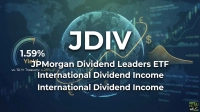
JDIV’s current yield is 1.59%. The 10-year Treasury currently yields 4.33%, meaning investors accept roughly one-third the income of a risk-free government bond to own this fund. For a product named “Dividend Leaders,” that gap demands explanation.
The explanation is in the holdings. The three largest positions are Taiwan Semiconductor at 6.3%, Microsoft at 4%, and Broadcom at 2.8%. These are quality companies, but they are technology growth stocks that happen to pay dividends. Most investors picture classic income anchors when they hear “dividend leaders,” and these holdings tell a different story. The Information Technology sector represents 19.6% of the fund, nearly as large as the top sector, Financials, at 21.7%.
The distribution history makes the income risk concrete. JDIV paid $0.35988 per share in June 2025, then $0.16771 in September 2025, then $0.11728 in March 2025, and most recently $0.13323 in March 2026. Those swings make income planning difficult for anyone relying on predictable cash flow. An investor who bought expecting the June 2025 distribution as a baseline would have received less than 37 cents on that dollar in the most recent quarter.
The fund’s 0.47% expense ratio compounds the income problem. Compared to the 0.06% charged by SCHD, a well-established U.S. dividend ETF, JDIV’s fee structure consumes a large portion of the already modest yield before investors see a dollar.
A $9.9 Million Fund With an 18-Month History
The second risk is structural: JDIV may not survive long enough to deliver on its strategy.
The fund holds $9.9 million in net assets. Fund companies typically need assets in the range of $50 million to $100 million to run an ETF economically. Below that threshold, expense ratio revenue does not cover operational costs, and the fund becomes a candidate for closure. JPMorgan has closed a dividend ETF carrying the same JDIV ticker before. A prior version was liquidated in 2022, making this the second attempt at the concept.
A fund closure returns assets at NAV, but it is disruptive. Investors face a forced taxable event, potential bid-ask spread losses if they sell before closure, and the friction of rebuilding a position elsewhere. For a long-term dividend growth strategy, forced liquidation at an inopportune moment is a real cost.
The fund’s 75% annual portfolio turnover adds another layer. That level of trading activity in a fund this small creates meaningful transaction costs relative to assets and reduces tax efficiency for investors holding in taxable accounts.
What to Monitor
Two indicators are worth tracking quarterly. First, watch the fund’s total net assets on JPMorgan’s official fact sheet, updated monthly. If assets remain below $25 million after 18 to 24 months of operation, the closure risk is real and rising. Second, review each quarterly distribution announcement. Consistent payout growth would validate the dividend growth thesis. Continued volatility in distribution amounts, like the swings seen from March 2025 through March 2026, signals that the fund’s income stream is not yet stable.
The 10-year Treasury yield, currently at 4.33% and up 0.30% over the past month, is also worth watching. As long as risk-free rates stay well above JDIV’s yield, the fund faces a persistent headwind in attracting income-focused capital, which makes the asset growth problem harder to solve.
JDIV’s global dividend growth approach is a legitimate strategy with real merit over a long time horizon. The fund is up about 11% over the past year, which is respectable. The real risks center on whether this particular fund will be around long enough to prove the strategy right, and whether investors expecting meaningful income will get what they came for.
Contact [email protected] for any questions or corrections.
After 15 years on Wall Street with 7 of them as Director of Corporate and Municipal Bond Trading for a NYSE member firm, I started my own project and corporate finance consultancy. Much of the work involves writing business plans, presentations, white papers and marketing materials for companies seeking budgetary allocations for spinoffs and new initiatives or for raising capital for expansion or startup companies and entrepreneurs. On financial topics, I have been published under my own byline at The Motley Fool, 247wallst.com, DealFlow Events’ Healthcare Services Investment Newsletter and The Microcap Newsletter, among others. Additionally, I have done freelance ghostwriting writing and editing for several financial websites, such as Seeking Alpha and Shmoop Financial. I have also written and been published on a variety of other topics from music, audiophile sound and film to musical instrument history, martial arts, and current events. Publications include Copper Magazine, Fidelity (Germany), Blasting News, Inside Kung-Fu, and other periodicals.