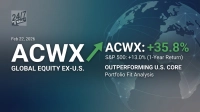
ACWI’s 18.3% Run Beat the S&P 500, But the 10-Year Story Is More Complicated
Most investors who want global equity exposure end up holding two or three separate funds: one for the U.S., one for international developed markets, and sometimes a third for emerging markets. iShares MSCI All Country World Fund (NYSEARCA:ACWI) collapses that…


Most investors who want global equity exposure end up holding two or three separate funds: one for the U.S., one for international developed markets, and sometimes a third for emerging markets. iShares MSCI All Country World Fund (NYSEARCA:ACWI) collapses that entire structure into a single ticker, tracking the MSCI All Country World Index across approximately 47 countries and 2,900 stocks. The question worth asking is whether that simplicity comes at a cost.
One Fund, One Job: Global Equity Core
ACWI is designed as a foundational equity holding. It covers large- and mid-capitalization stocks across both developed and emerging markets, making it a reasonable candidate for the equity sleeve of any long-term portfolio. For investors who want broad market participation without managing multiple funds or rebalancing across regions, this is the intended use case.
The return engine is straightforward: equity ownership in global businesses. ACWI earns through the earnings growth and capital appreciation of its underlying holdings, plus a modest income component from dividends. The fund carries a 1.2% dividend yield and an expense ratio of 0.32%, which is low enough to avoid meaningfully eroding compounding over time. Portfolio turnover sits at just 3%, confirming its passive, buy-and-hold character.
The fund has $29.2 billion in net assets and has been running since March 26, 2008, giving it an 18-year track record through multiple market cycles.
What You Actually Own
Despite its global branding, ACWI is heavily anchored in U.S. mega-cap technology. Information Technology is the largest sector at 20.8% of the fund, and the top five holdings — NVIDIA, Microsoft, Apple, Amazon, and Meta — collectively represent roughly 14.8% of total weight. Investors who already hold an S&P 500 fund will find meaningful overlap here.
The international exposure does exist and matters. The fund holds companies like Tencent, ASML, SAP, and Nestlé, along with positions across Japanese, European, and emerging market equities. But the U.S. concentration means ACWI behaves more like a U.S.-tilted global fund than a balanced world portfolio.
Does the Strategy Deliver?
Over the past year, ACWI returned 18.3%, outpacing the S&P 500’s 14.1% over the same period. That outperformance reflects international markets pulling their weight, which is exactly the diversification argument in action.
Zoom out to five years and the picture reverses. ACWI returned 59.6% over five years versus 65.9% for the S&P 500. Over ten years, the gap widens further: ACWI gained 205.6% while the S&P 500 returned 223.4%. The cost of global diversification, during a decade of U.S. dominance, has been real but not catastrophic.
The Real Tradeoffs
- U.S. concentration undermines the diversification pitch. With U.S. mega-cap tech dominating the top holdings, an investor hoping for meaningful insulation from a domestic downturn will find ACWI only partially delivers. A sharp correction in large-cap U.S. technology would pull this fund down substantially, even with the international exposure. The current VIX near 27 reflects exactly that kind of elevated uncertainty.
- International exposure adds currency and political risk. Holding equities denominated in euros, yen, yuan, and other currencies means returns are partially driven by exchange rate movements, not just business performance. Emerging market allocations introduce additional volatility that pure U.S. funds avoid.
- The 10-year return gap is worth understanding. Choosing ACWI over a U.S.-only fund means accepting that when American equities outperform globally, you will lag. Over the past decade, that trade cost investors roughly 18 percentage points compared to the S&P 500. Future decades may look different, but investors should enter with clear expectations.
ACWI functions as a core equity holding for investors who want genuine global diversification in a single, low-cost fund and who understand they are accepting modest underperformance during U.S.-led bull markets in exchange for broader exposure when the rest of the world leads.
Contact [email protected] for any questions or corrections.
I am a long time investor and student of business, and believe finding good companies that can become great investments is the best game on earth. After 20 years of writing and researching the public markets it is clear that individuals have never had more tools and information to take control of their financial lives. From ETFs and $0 commissions to cryptos and prediction markets there has never been a greater democratization of access to investing.
I write to help people understand the investments available to them so they can make the best choice for their portfolio, whether they're starting out or looking for income in retirement.