





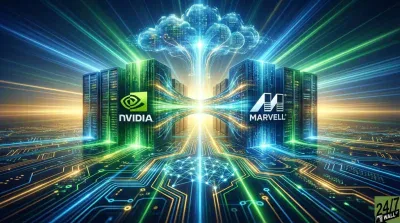
NVIDIA (NASDAQ:NVDA | NVDA Price Prediction) dropped a catalyst on March 31 that reordered the AI infrastructure investment conversation: a $2 billion direct investment in Marvell Technology (NASDAQ:MRVL) paired with a deeper NVLink Fusion ecosystem expansion. The move validates NVIDIA’s strategy of opening its NVLink fabric to third-party silicon, turning a proprietary interconnect into a platform other chipmakers can build on. The question for investors is which companies beyond NVIDIA capture the most incremental revenue from this buildout.
NVIDIA’s networking business tells the story clearly. Data Center Networking revenue reached $10.98 billion in Q4 FY2026, up 263% year over year, driven by the NVLink fabric ramp for GB200 and GB300 systems. That acceleration has direct revenue implications for the four ecosystem partners below.
1. Marvell Technology (MRVL)
Marvell Technology is the most direct beneficiary. The $2 billion NVIDIA investment structurally endorses Marvell’s role in next-generation AI infrastructure, specifically its custom silicon and optical interconnect capabilities. Data center revenue reached $1.518 billion in Q3 FY2026, representing 73% of total revenue and growing 38% year over year. Custom AI design activity is at an all-time high, with over 50 new opportunities across more than 10 customers. The Celestial AI acquisition adds photonic fabric technology that directly addresses optical interconnect demands within NVLink Fusion architecture. Full-year FY2026 revenue growth is forecast to exceed 40%, and management raised its data center growth outlook for the following fiscal year. Reddit sentiment hit a bullish score of 78 on March 31 as the NVIDIA investment broke. Analyst consensus target sits at $120.50, with 33 buy ratings and zero sell ratings. Marvell’s stock rose 12.68% on March 31, the largest single-day move in the peer group.
2. Broadcom (AVGO)
Broadcom (NASDAQ:AVGO) occupies a complementary position through its custom AI accelerators and Ethernet AI switching portfolio. NVLink Fusion enables Broadcom XPUs to connect directly to the NVIDIA NVLink fabric, expanding the addressable market for its hyperscaler-focused custom silicon. AI chip revenue reached $8.40 billion in Q1 FY2026, up 106% year over year, above forecast. Q2 FY2026 guidance calls for approximately $22.0 billion in total revenue with AI semiconductor revenue of $10.7 billion. CEO Hock Tan has set a goal of exceeding $100 billion in AI sales by 2027. The stock carries a trailing P/E of 58x and an analyst consensus target of $471.55 against a current price near $307. The year-to-date pullback of -15.05% has compressed the valuation relative to the analyst consensus target.
3. Arista Networks (ANET)
Arista Networks (NYSE:ANET) benefits through its ESUN (Ethernet for Scale-Up Networks) collaboration, which sits directly within the NVLink Fusion open ecosystem framework. As NVIDIA opens its fabric to third-party silicon, Ethernet-based scale-up networking becomes a viable alternative path, and Arista’s Etherlink AI networking platform is positioned to capture that demand. FY2025 revenue reached $9.01 billion, up 28.6% year over year, with Q1 2026 guidance of approximately $2.6 billion. Non-GAAP operating margin of 47.5% in Q4 reflects strong operating leverage. The analyst consensus target of $177.74 implies meaningful upside from the current price near $122. A year-to-date decline of -11.37% has compressed the valuation despite sustained fundamental momentum. Tariff and export control risks remain the primary near-term overhangs.
4. Astera Labs (ALAB)
Astera Labs (NASDAQ:ALAB) is the highest-beta play in the group. Its Scorpio fabric switches and Aries PCIe/CXL retimers are directly integrated into the NVIDIA Blackwell ecosystem, and NVLink Fusion’s expansion to third-party ASICs increases demand for the connectivity chips Astera supplies. Q3 FY2025 revenue grew 103.9% year over year to $230.6 million, with non-GAAP EPS of $0.49 beating the $0.39 estimate by 25.61%. The company demonstrated the first end-to-end PCIe 6 interoperability with NVIDIA Blackwell GPUs and holds a board seat on the UALink 200G 1.0 specification. Analyst consensus target of $206.75 sits well above the current price near $107 following a year-to-date decline of -39.73%. The valuation gap between the current price and analyst consensus target is wide, contingent on sustained hyperscaler capex commitments; customer concentration remains a key risk.
5. NVIDIA (NVDA)
NVIDIA anchors the ecosystem and remains the primary financial beneficiary of NVLink Fusion adoption. Q4 FY2026 revenue reached $68.13 billion, up 73.2% year over year, with Q1 FY2027 guidance of approximately $78.0 billion. Free cash flow for FY2026 totaled $96.58 billion. Jensen Huang described the platform as “Grace Blackwell with NVLink is the king of inference today, delivering an order-of-magnitude lower cost per token.” The analyst consensus target of $268.22 from 60 buy ratings implies substantial upside from the current price near $172. The year-to-date decline of -11.43% has compressed the multiple despite accelerating fundamentals, and the $58.5 billion remaining buyback authorization provides a capital return floor.
Conclusion
NVLink Fusion converts a proprietary interconnect into an open architecture pulling in custom silicon, optical interconnect, and networking suppliers. The common thread across all five names is data center infrastructure exposure at a moment when hyperscaler capex commitments remain firm. Primary risks include customer concentration, export restrictions limiting China revenue, and hyperscaler in-house silicon development. Investors should monitor quarterly data center segment trends, design win announcements, and hyperscaler capex guidance as the key forward indicators for this group.












 Top Gaining Stocks
 Top Losing Stocks