Retirees Love This $578 Billion ETF, But Switching to These 2 Could Boost Income by 40%
Vanguard Total Stock Market ETF (NYSEARCA:VTI) holds roughly $2.1 trillion in assets and has earned its place in millions of retirement portfolios. The appeal is straightforward: one fund, the entire U.S. equity market, a 0.03% expense ratio, and a 25-year…


Vanguard Total Stock Market ETF (NYSEARCA:VTI) holds roughly $2.1 trillion in assets and has earned its place in millions of retirement portfolios. The appeal is straightforward: one fund, the entire U.S. equity market, a 0.03% expense ratio, and a 25-year track record. The problem for retirees living off their portfolios is that VTI’s income engine runs lean. Its dividend yield sits around 1.1%, which on a $500,000 portfolio translates to roughly $5,500 per year before taxes.
Two funds offer a different trade: tilt toward dividend-paying companies, accept a modest value bias, and collect meaningfully more income without abandoning equity market exposure. Capital Group Dividend Value ETF (NYSEARCA:CGDV) and JPMorgan Dividend Leaders ETF (NYSEARCA:JDIV) both yield more than VTI while holding recognizable, high-quality businesses. Whether the income trade-off is worth the structural differences depends on what a retiree actually needs from their equity sleeve.
VTI: Total Market Exposure With a Growth Tilt
VTI tracks the entire investable U.S. equity market, which sounds like pure diversification until you look at what that actually means today. Information technology represents 31.8% of the portfolio, with Apple, Nvidia, and Microsoft alone accounting for roughly 18% of total assets. That concentration has rewarded long-term holders handsomely: VTI returned nearly 25% over the past year and more than 222% over the past decade.
The income story is less compelling. VTI paid around $0.91 in Q3 2025, around $0.95 in Q4 2025, and nearly $1.00 in Q1 2026. Quarterly distributions are real and growing, but the yield remains low because the fund holds so many growth-oriented companies that retain earnings rather than distribute them. For a retiree who needs their portfolio to generate spendable cash, that 1.1% yield requires either selling shares or accepting a smaller income stream than dividend-focused alternatives provide.
CGDV: Active Management Hunting for Dividend Value
Capital Group’s approach to dividend investing differs from a simple screen for high-yield stocks. CGDV uses Capital Group’s multi-manager structure, meaning multiple portfolio managers independently run sleeves of the fund, each applying their own analysis. The result is a portfolio that blends dividend discipline with genuine growth awareness rather than simply chasing the highest-yielding names.
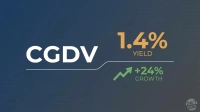
The fund’s 1.31% dividend yield beats VTI’s, and the portfolio construction explains why. The top holdings include RTX Corp at 4.4%, Applied Materials at 4.2%, Carrier Global at 3.6%, and Philip Morris International at 2.4%. These are businesses with established cash flows and histories of returning capital to shareholders. The fund still holds Microsoft and Nvidia, but at lower weights than VTI, reducing the drag from low-yielding mega-cap tech.
CGDV’s recent dividend payments show a building trend. The fund paid around $0.11 in Q1 2025, $0.13 in Q2, $0.14 in Q3, and $0.19 in Q4, with $0.11 already distributed in Q1 2026. On the total return side, CGDV gained 31% over the past year and is up nearly 3% year-to-date, both figures ahead of VTI over the same windows.
The tradeoff is cost and concentration. CGDV’s 0.33% expense ratio is higher than VTI’s near-zero cost, and the active multi-manager structure means investors are paying for Capital Group’s stock selection. Over long periods, that fee gap compounds. The fund also has $31 billion in assets, giving it solid liquidity, but its track record only extends to February 2022, a shorter history than most retirees would prefer for a core holding.
JDIV: Global Dividend Leaders With International Reach
JPMorgan’s fund takes the dividend-growth concept global. JDIV targets companies with a higher dividend yield and faster dividend growth than the MSCI All Country World Index, casting a net across developed and emerging markets rather than limiting itself to U.S. names. The geographic split runs 51.1% North America, 29.8% EMEA, 11.5% Asia ex-Japan, and 5.5% Japan.
Top holdings include Taiwan Semiconductor at 6.3%, Microsoft at 4%, Broadcom at 2.8%, NextEra Energy at 2.7%, and Trane Technologies at 2.5%. The international names, including Safran, Shell, and various Asian financial institutions, provide exposure that neither VTI nor CGDV offers.
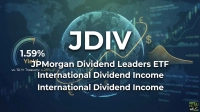
JDIV’s 1.59% dividend yield is the highest of the three. Its recent distributions reflect the global dividend calendar: around $0.36 paid in June 2025, around $0.17 in September 2025, and two December 2025 payments totaling roughly $0.51. The fund returned 23% over the past year and is up nearly 3% year-to-date.
The currency exposure is the primary risk retirees need to understand. Holdings span British pounds, euros, Japanese yen, Singapore dollars, and South Korean won, among others. When the dollar strengthens, the translated value of those dividends shrinks. JDIV does not appear to hedge these exposures, which means income and returns can diverge from U.S.-only funds during periods of dollar strength. The fund also launched in September 2024 and holds only $9.9 million in assets, making it the youngest and smallest fund on this list by a wide margin. Liquidity and track record are legitimate concerns for anyone considering it as a meaningful portfolio allocation.
The Income Comparison and How to Think About Blending
With the 10-year Treasury yielding around 4%, retirees have real fixed-income competition for their equity income dollars. That context matters when evaluating whether the yield difference between VTI and these dividend funds is worth the structural trade-offs.
On a $500,000 equity allocation, VTI’s 1.1% yield generates roughly $5,500 annually. As an illustration, a hypothetical blend allocating half to VTI, a quarter to CGDV, and a quarter to JDIV would weight the portfolio toward yields of 1.31% and 1.59% on the dividend sleeves, pushing blended income higher than VTI alone. The yield differential between VTI alone and a dividend-tilted blend can produce a meaningful income increase, though actual results depend on distribution timing, share price movements, and currency effects on JDIV.
Retirees who prioritize total market exposure and are comfortable reinvesting or selling shares for income will find VTI’s structure fits that approach. Those who want their equity sleeve to generate more spendable cash without abandoning quality will find CGDV’s track record, asset base, and active management discipline relevant to that goal. JDIV adds international diversification and the highest yield of the three, but carries currency volatility and a fund history still in its early stages.
Contact [email protected] for any questions or corrections.
Austin Smith is a financial publisher with over two decades of experience as an investor, analyst, and advisor. He covers stocks, ETFs, Artificial intelligence and personal finance for 24/7 Wall St. Previously, he spent over a decade at The Motley Fool as a senior editor for Fool.com, portfolio advisor for Millionacres, and launched The Ascent to help reader take control of their personal finances.
His work has been featured on Fool.com, NPR, CNBC, USA Today, Yahoo Finance, MSN, AOL, Marketwatch, and many other publications. He is as an advisor to private companies, and co-hosts The AI Investor Podcast with Eric Bleeker.
When not looking for investment opportunities, he can be found skiing, running, or playing soccer with his children. Learn more about Austin's investment approach here.