





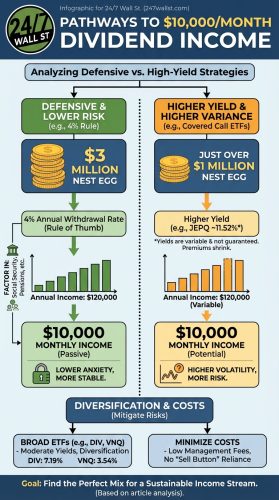
Replacing a $70,000 salary with dividend income alone requires a specific portfolio size, and the required portfolio size is larger than most people expect. At a 3.39% yield from SCHD, the portfolio required to generate $70,000 per year before taxes runs into the millions, and the exact figure shifts depending on which fund you choose. That number shifts depending on which ETF you choose, but the range across these three funds is narrower than the marketing suggests.
This question dominates dividend investing communities. The tension is common: an investor in their early 40s targeting income replacement within a decade may find their savings rate leaves them hundreds of thousands of dollars short of the required portfolio size. Getting the portfolio size right matters more than which of these three funds you pick.
The Portfolio Size Problem Nobody Talks About
The 10-year Treasury currently yields 4.31%, essentially risk-free. All three dividend ETFs yield less than that, meaning you are accepting equity volatility for a lower current income stream than Treasuries offer. The reason to do it anyway is dividend growth over time, which Treasuries cannot provide.
The yield gap matters enormously for the $70k target. Here is where each fund stands:
- Schwab U.S. Dividend Equity ETF (NYSEARCA:SCHD): 3.39% yield, 0.06% expense ratio, $85.9 billion in assets. The most popular choice in this category, with a heavy tilt toward Consumer Staples (19.5%), Healthcare (18.9%), and Energy (16.5%). The required portfolio at this yield runs well above $2.1 million to generate $70,000 annually.
- Vanguard High Dividend Yield Index Fund ETF Shares (NYSEARCA:VYM): 2.29% yield, 0.04% expense ratio, $92.3 billion in assets. VYM’s yield is the lowest of the three, meaning the required portfolio to hit $70,000 in annual income is the largest of the three funds. The tradeoff is broader diversification across 600+ holdings and a long track record dating to November 10, 2006.
- Fidelity High Dividend ETF (NYSEARCA:FDVV): 2.59% yield, 0.15% expense ratio, $8.9 billion in assets. FDVV sits between the other two on yield but carries the highest expense ratio. Its portfolio is unusual for a dividend fund: Information Technology represents 24.9% of the portfolio, with top holdings including NVIDIA at 6.39%, Apple at 5.68%, and Microsoft at 4.35%.
SCHD’s Dividend History Reveals a Wrinkle
SCHD paid $0.2569 per share in March 2026, its most recent distribution. The fund underwent a share split in 2024, which explains why quarterly per-share payments now appear lower than the $0.8241 highs seen in 2022 and 2023. Income per dollar invested has remained more consistent than the raw per-share figures suggest.
VYM’s recent quarterly payments have been more stable: $0.8617 in March 2026, $0.9474 in December 2025, $0.8417 in September 2025, and $0.8617 in June 2025. FDVV paid $0.44 per share in March 2026, consistent with its recent quarterly range of $0.377 to $0.447.
Three Paths to $70,000 in Annual Dividend Income
SCHD offers the highest yield of the three alongside a sector mix oriented toward dividend growth. Its sector mix of mature, cash-generating businesses has historically produced consistent payout increases. The fund has paid dividends every quarter since its October 2011 inception and has returned about 14% over the past year, meaning total return has supplemented income meaningfully.
VYM suits investors who prioritize stability and breadth over yield optimization. The fund’s 11% annual portfolio turnover is the lowest of the three, which tends to produce more tax-efficient outcomes in taxable accounts. The cost is needing a larger portfolio to hit the same income target.
FDVV is the only fund of the three with meaningful technology exposure, making it distinct from a pure income vehicle. The heavy NVIDIA, Apple, and Microsoft weighting means this fund behaves more like a blend fund than a pure income vehicle. Its five-year return of roughly 83% reflects that growth tilt, but the higher 0.15% expense ratio erodes more dividend income than the other two funds.
The One Mistake That Derails Most Dividend Income Plans
The common error is targeting yield without accounting for taxes. Qualified dividends from these ETFs are taxed at capital gains rates, topping out at 20% for high earners, plus the 3.8% net investment income tax. To net $70,000 after federal taxes, someone in the 15% qualified dividend bracket needs to generate closer to $82,000 in gross dividend income, which pushes the required portfolio size meaningfully higher than the headline yield calculation suggests. A savings rate would leave them $800,000 short of the target if the portfolio size is miscalculated.
Rate cuts over the past year have helped dividend stocks compete against cash. With the 10-year Treasury still at 4.31%, the income case for these ETFs rests almost entirely on dividend growth over time. Build the portfolio size calculation around net income after taxes, not the headline yield, and the target number becomes much clearer.










 Top Gaining Stocks
 Top Losing Stocks