




Energy prices surged above $100 per barrel in April 2026, with WTI crude sitting at $100.72, near the 96.7th percentile of its 12-month range. For income investors, that backdrop matters because it directly supports the cash generation that funds dividends at major integrated oil companies and refiners.
The 10-year Treasury yields just 4.26% — a reasonable but uninspiring risk-free rate. Energy dividend stocks offer something bonds cannot: the potential for growing income over time, backed by assets that benefit from commodity prices driving inflation. The three energy names below span integrated oil majors and downstream refining, drawing income from both upstream production and the margin spread between crude and refined products.
We screened our 24/7 Wall St. dividend equity research database for stocks that pay massive dividends. Combined, these three companies can generate over $1,400 a year in passive annual income if you invest $16,667 in each stock at the time of this writing.

Marathon Petroleum
- Yield: 1.79%
- Shares for $16,667: 74.73
- Annual Passive Income: $299
Marathon Petroleum (NYSE:MPC) is the largest petroleum refiner in the United States, operating refining, marketing, and transportation assets headquartered in Findlay, Ohio.
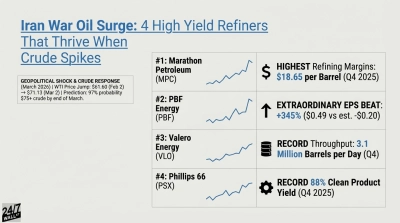
The company converts crude oil into gasoline, diesel, and other refined products, capturing margin on the spread between input costs and output prices. That crack spread drove a strong Q4 2025 refining margin of $18.65 per barrel with crude utilization of 95% and throughput of 3 million barrels per day.
Marathon’s dividend has grown steadily, rising from $0.91 per quarter in 2025 to $1 per quarter in Q1 2026. A key structural income driver is MPLX, the company’s midstream MLP, which provides $2.8 billion in annualized distributions back to Marathon.
That steady midstream cash flow provides an income floor less sensitive to refining margins than the core business. The company returned $4.5 billion to shareholders in FY2025, and institutional investors hold 77.14% of shares outstanding.
Exxon Mobil
- Yield: 2.76%
- Shares for $16,667: 111.85
- Annual Passive Income: $461
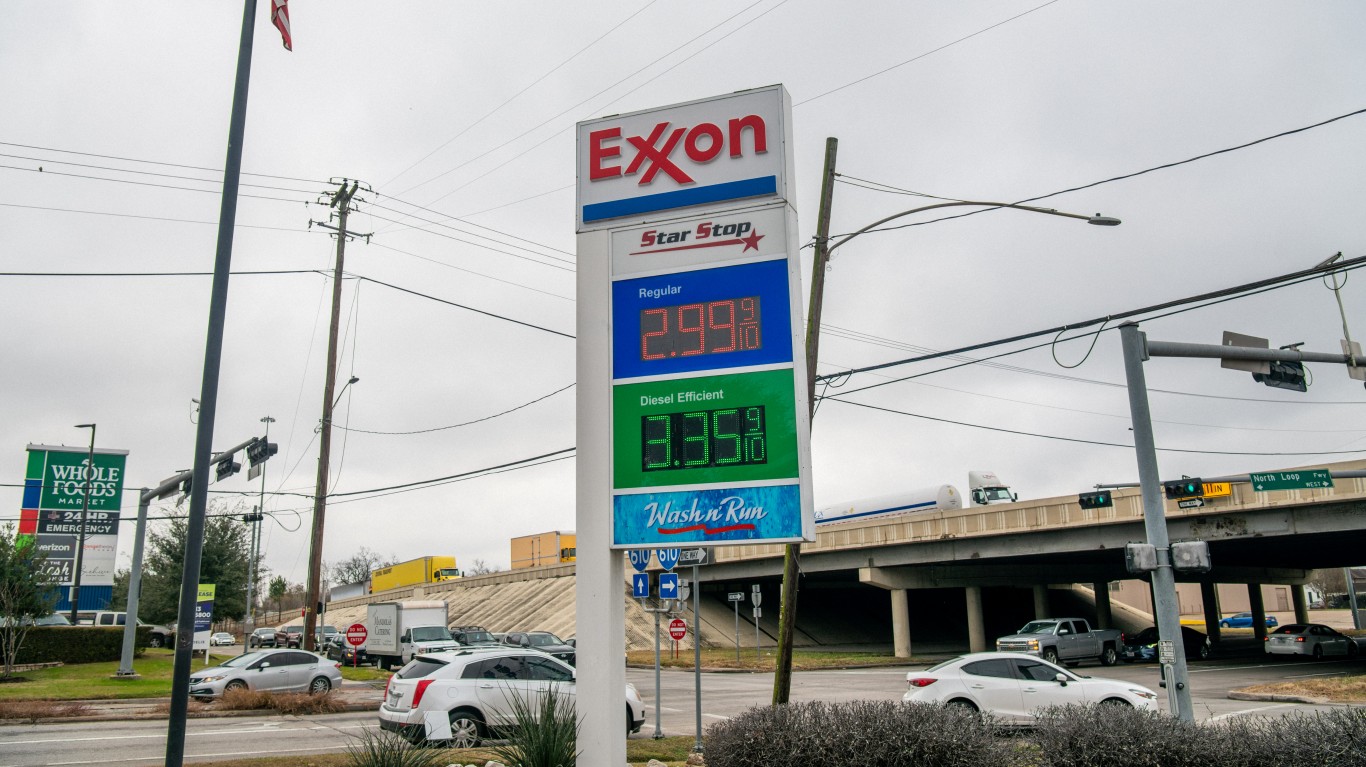
Exxon Mobil (NYSE:XOM | XOM Price Prediction) is one of the world’s largest integrated energy companies, with operations spanning upstream exploration and production, downstream refining, and chemicals.
The company posted record production of 4.7 million barrels of oil equivalent per day in FY2025, anchored by its Permian Basin operations at a record 1.8 million BOED and its Guyana offshore assets. Structural cost savings have reached $15.1 billion cumulatively since 2019, protecting dividends through commodity cycles.
Exxon’s dividend track record is one of the most durable in the S&P 500. The company has raised its annual dividend for 43 consecutive years, including a 4% increase announced in Q4 2025 that brought the quarterly payment to $1.03 per share.
The company also runs a $20 billion share repurchase program through 2026, further compounding shareholder returns. Institutional investors hold 67.59% of shares, and the analyst consensus target is $162.71.

Chevron
- Yield: 3.57%
- Shares for $16,667: 90.14
- Annual Passive Income: $642
Chevron (NYSE:CVX) is a fully integrated multinational energy company active in more than 180 countries, with operations covering exploration and production, refining, chemicals, and power generation.
The company delivered record production of 3,723 thousand barrels of oil equivalent per day in FY2025, up 12% year over year following the Hess acquisition. Key growth assets include the Permian Basin at 1 million BOE per day, the Tengizchevroil project in Kazakhstan, and the Yellowtail development offshore Guyana.
Chevron has raised its dividend for 39 consecutive years, the most recent being a 4% increase that pushed the quarterly payment to $1.78 per share. The company returned $27.1 billion to shareholders in 2025 and generated record FY operating cash flow of $33.9 billion.
Management is targeting $3 to $4 billion in structural cost reductions by end of 2026, which should further support dividend coverage. Institutional investors hold 68.04% of shares, and the analyst consensus target is $207.96.
The bottom line
Combined, these three positions generate $1,401 in annual passive income on a $50,001 investment — a blended yield of 2.80%. Chevron contributes $642, Exxon Mobil adds $461, and Marathon Petroleum rounds out the portfolio with $299.
Energy dividend stocks generate cash flow tied to real commodity production, not financial engineering, while remaining fully liquid on any trading day.
Reinvesting quarterly payments accelerates compounding in a way rental property cannot replicate. For investors who want income that keeps pace with energy prices rather than tracking a fixed bond coupon, these three names deliver a straightforward, measurable answer.












 Top Gaining Stocks
 Top Losing Stocks