Alphabet Is About to Overtake Nvidia as the World’s Biggest Company
The Number Alphabet (NASDAQ:GOOG | GOOG Price Prediction) carries a market capitalization of $4.81 trillion, second only to NVIDIA (NASDAQ:NVDA) at $5.05 trillion as of May 7, 2026. The Class C shares closed at $395.14 on May 6, 2026, brushing…

The Number
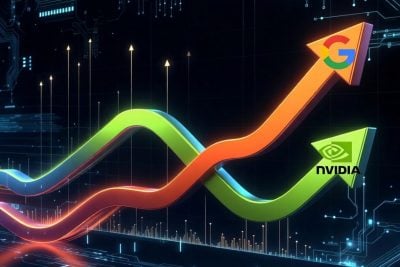
Alphabet (NASDAQ:GOOG | GOOG Price Prediction) carries a market capitalization of $4.81 trillion, second only to NVIDIA (NASDAQ:NVDA) at $5.05 trillion as of May 7, 2026. The Class C shares closed at $395.14 on May 6, 2026, brushing against a 52-week high of $396.38. The figure is the live valuation derived from price and total Alphabet shares outstanding, not a reported earnings line.
What It Means
The repricing rests on Q1 FY2026 results filed April 29, 2026. Revenue reached $109.90 billion, up 21.8% year over year and beating the $107.03 billion estimate by 2.67%. EPS landed at $5.11 versus the $2.63 consensus, a 94.10% beat. Net income hit $62.58 billion, including $36.91 billion in unrealized equity gains. Operating income reached $39.70 billion at a 36.1% operating margin. Google Cloud revenue grew 63% to $20.03 billion, with backlog over $460 billion. Capital expenditure more than doubled to $35.67 billion, and the dividend rose 5% to $0.22 per share quarterly.
Market Reaction
GOOG gained 13.77% in the week ending May 6, 2026, on top of a 32.75% one-month run, a 26.01% year-to-date advance, and a 140.01% one-year return. NVIDIA closed at $207.83, down 0.68% on the week, up 17% on the month, and up 11.44% year to date. The divergence narrowed the market-cap gap during a stretch where NVIDIA traded sideways.


Strategic Outlook
The $460 billion cloud backlog plus the doubled capex line signal a long-duration AI infrastructure commitment funded without compressing margin. Operating margin held at 36.1% while spending accelerated. Prediction markets remain cautious on the leadership question. Polymarket assigns a 23.5% probability to Alphabet ranking first on May 31, 2026, rising to 29.5% by December 31, 2026. The same markets price 77% odds Alphabet finishes May in second place. Analyst consensus target sits at $398.06, with 47 buys, 13 strong buys, 6 holds, and zero sell ratings. The trailing P/E of 30 and forward P/E of 28 sit well below NVIDIA’s 42 trailing multiple, leaving room for further multiple expansion if cloud growth holds.
Bottom Line
The $4.81 trillion valuation puts Alphabet in a two-stock megacap tier with NVIDIA. The next visible catalyst is NVIDIA’s fiscal Q1 2027 report, which the company has guided to roughly $78.0 billion in revenue. A clean beat would extend NVIDIA’s lead at the top. A softer print, paired with continued cloud-backlog conversion at Alphabet, would be the most direct path to closing the remaining gap. For now, prediction markets, analyst price targets, and recent price action all point to a tightening race rather than a decided one.
Contact [email protected] for any questions or corrections.
After two decades of patrolling the dark corners of suburbia as a police officer, Rich Duprey hung up his badge and gun to begin writing full time about stocks and investing. For the past 20 years, he’s been cruising the markets looking for companies to lock up as long-term holdings in a portfolio while writing extensively on the broad sectors of consumer goods, technology, and industrials. Because his experience isn’t from the typical financial analyst track, Rich is able to break down complex topics into understandable and useful action points for the average investor. His writings have appeared on The Motley Fool, InvestorPlace, Yahoo! Finance, Money Morning, and, of course, 24/7 Wall St. He has been featured in both U.S. and international publications, including MarketWatch, Financial Times, Forbes, Fast Company, and USA Today.