8 Months Ago, Trump Called Elon Musk “Susceptible” on China — Now He’s Riding Shotgun on Air Force One
The market’s relationship with China has become a balancing act investors can’t ignore. Apple (NASDAQ:AAPL | AAPL Price Prediction) still depends on Chinese manufacturing. Nvidia (NASDAQ:NVDA) desperately wants to break back into China to capitalize on demand for AI chips.…


The market’s relationship with China has become a balancing act investors can’t ignore. Apple (NASDAQ:AAPL | AAPL Price Prediction) still depends on Chinese manufacturing. Nvidia (NASDAQ:NVDA) desperately wants to break back into China to capitalize on demand for AI chips. Tesla (NASDAQ:TSLA) counts on China for both production and vehicle sales. Yet Washington keeps tightening restrictions on trade, technology, and national security.
That’s what made President Donald Trump’s latest China trip so fascinating. Not because corporate executives joined him — they have accompanied him before on trips to Saudi Arabia and India — but rather because only two executives reportedly flew aboard Air Force One with Trump himself: Tesla CEO Elon Musk and Nvidia CEO Jensen Huang.
Eight months ago, Trump publicly questioned whether Musk could be trusted when dealing with China. Today, Musk appears closer to the administration than ever. For Tesla investors, that shift carries a message that goes far beyond optics.
From Public Criticism to Presidential Access
Trump’s criticism of Musk last year wasn’t subtle. Amid questions about whether Musk received briefings on U.S. military plans for a potential war with China, Trump pushed back and said because of his extensive business dealings in China, he would be “susceptible” to pressure from Beijing.
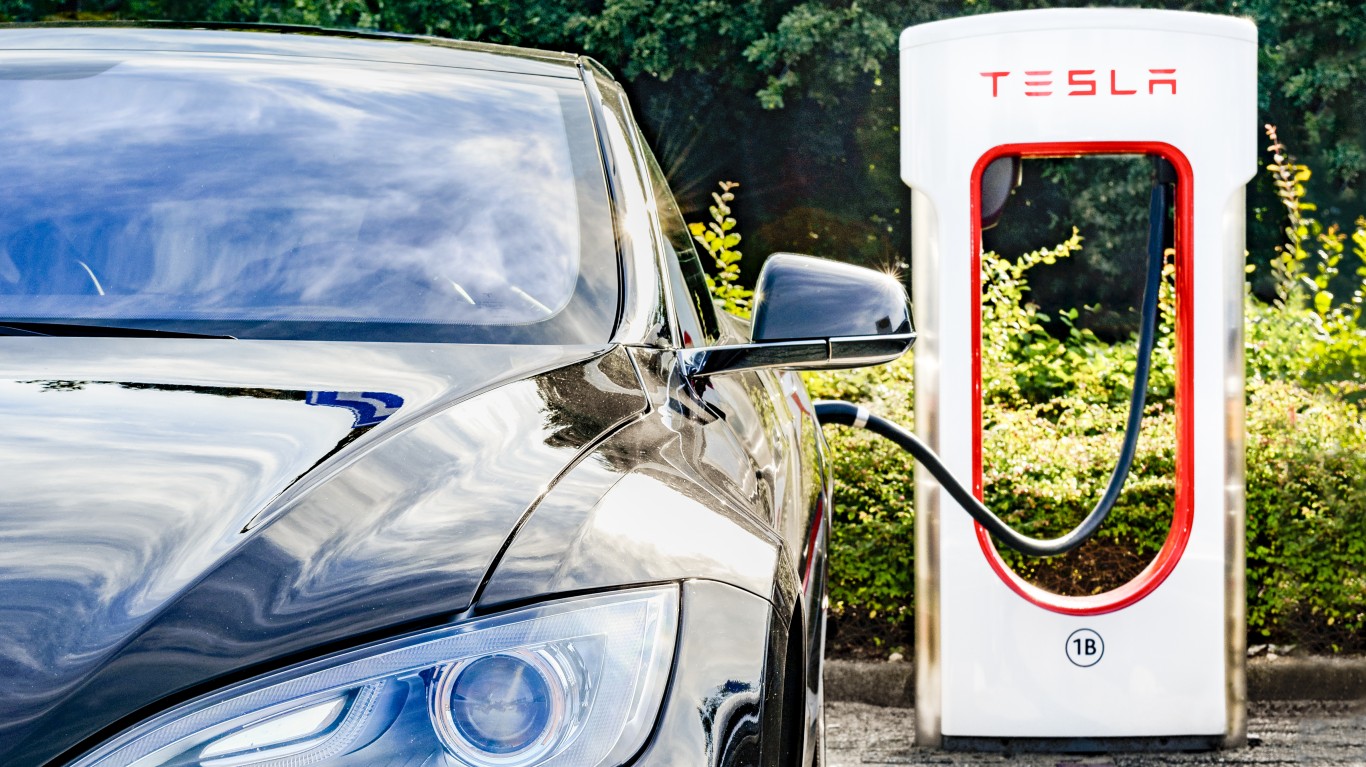
That wasn’t random political theater. It reflected a genuine concern shared across Washington. Tesla generated roughly 22% of its revenue from China in 2025, while its Shanghai Gigafactory remains Tesla’s largest production hub globally, capable of producing more than 950,000 vehicles annually. China also supplies a large portion of the battery materials critical to Tesla’s supply chain.
In short, Tesla needs China — badly.
Trump’s warning suggested Musk could face conflicting incentives. On one side sits U.S. national policy. On the other sits Tesla’s commercial dependence on Beijing. For a politician who has repeatedly framed China as America’s top economic competitor, that dependency mattered.
Granted, Trump has criticized plenty of CEOs over the years. But Musk was different because he simultaneously operates in electric vehicles, artificial intelligence, satellites, robotics, social media, and defense-adjacent technologies through companies like SpaceX and xAI.
In short, Musk isn’t just another CEO anymore. He is American infrastructure.
Why This China Trip Matters for Tesla
Fast-forward to today, and the relationship looks entirely different. Trump’s China delegation reportedly focused heavily on business and technology partnerships. Nvidia’s Jensen Huang made sense as an attendee because Nvidia sits at the center of the AI arms race. The company’s data center revenue surged 75% year over year last quarter to $62.3 billion.
But Musk’s inclusion may have carried even more symbolism. Tesla’s position in China has weakened over the past year. The China Passenger Car Association reported Tesla’s Chinese vehicle sales declined against rising competition from domestic automakers like BYD, which delivered more than 4.6 million vehicles globally in 2025. BYD’s aggressive pricing strategy has squeezed Tesla’s margins across Asia.
At the same time, Tesla’s market share inside China’s EV market has narrowed while local brands expanded. Companies like NIO (NYSE:NIO), XPeng (NYSE:XPEV), and Huawei-backed EV ventures continue rolling out cheaper models tailored specifically for Chinese consumers.
That backdrop makes Musk’s Air Force One appearance noteworthy. Proximity matters in politics and investors understand that. CEOs spend millions lobbying Washington because access can shape regulation, tariffs, export rules, and procurement opportunities.
Being one of only two executives aboard Air Force One suggests Trump now sees Musk less as a vulnerability and more as an asset.
That doesn’t mean Washington suddenly trusts China. Far from it. It likely means Trump believes Musk can help negotiate economic outcomes favorable to U.S. interests while preserving Tesla’s strategic importance abroad.
The Relationship Has Always Been Transactional
The Musk-Trump relationship has never been ideological. It has been practical.
During Trump’s first presidency, Musk served briefly on two White House advisory councils before resigning after the U.S. withdrew from the Paris Climate Accord. Later, Musk criticized government spending and certain labor policies while also benefiting from federal contracts tied to SpaceX.
Then came the sharp turn. After Musk acquired X, formerly Twitter, the two men gradually aligned on issues involving free speech, regulation, artificial intelligence, and manufacturing policy. Musk also became increasingly vocal about immigration reform focused on high-skilled labor and domestic production competitiveness.
Surprisingly, both men ultimately arrived at similar conclusions on one major issue: America needs to win the technology race.
Elon Musk and Donald Trump Relationship Timeline
| Date | Event | What Happened |
| 2016 | Pre-election criticism | Elon Musk supports Hillary Clinton and criticizes Donald Trump, saying he “doesn’t seem to have the character that reflects well on the United States.” |
| Jan. 2017 | Advisory councils | Musk joins Trump’s Strategic & Policy Forum and manufacturing jobs initiative shortly after Trump enters the White House. |
| Feb. 2017 | First tensions emerge | Musk remains on Trump’s advisory councils even after Uber Technologies (NYSE:UBER) CEO Travis Kalanick resigned over Trump’s immigration executive order. |
| Jun. 2017 | Paris accord split | Trump withdraws the U.S. from the Paris Climate Accord. Musk resigns from all advisory councils, posting: “Climate change is real. Leaving Paris is not good for America or the world.” |
| 2020 | Cautious thaw | Trump praises Musk during a SpaceX launch event, calling him “one of our great brains.” Despite the praise, Musk votes for Joe Biden. |
| May 2022 | Political shift rightward | Musk says he can “no longer support” Democrats and announces he intends to vote Republican going forward. |
| Jul. 2022 | Public feud erupts | Trump calls Musk a “bullshit artist.” Musk responds that Trump is too old and that it is “time to hang up his hat.” Musk instead backs Ron DeSantis for 2024. |
| Jul. 2024 | Full endorsement | Following the assassination attempt in Butler, Pennsylvania, Musk fully endorses Trump, launches a pro-Trump super PAC, and hosts Trump on X for a livestream viewed by roughly 1.3 million people. |
| Oct. 2024 | Campaign trail alliance | Musk appears onstage with Trump at a rally in Butler, Pennsylvania, while reportedly spending tens of millions supporting Trump’s campaign effort. |
| Nov. 2024 | Election victory | Trump wins the presidential election and praises Musk during his victory speech: “A star is born — Elon!” Musk is later appointed to co-lead the newly created “Department of Government Efficiency,” widely shortened to DOGE. |
| Jan. 2025 | Inauguration-era closeness | Musk receives a front-row seat at Trump’s inauguration, attends Cabinet meetings, travels aboard Air Force One, and publicly declares that he loves Trump. |
| Jan.–May 2025 | DOGE era | DOGE pushes sweeping federal workforce reductions and agency restructuring efforts. Trump repeatedly praises Musk as “tremendously successful.” When Musk exits DOGE in May, Trump presents him with a ceremonial gold key. |
| Jun. 2025 | Second major falling-out | Musk attacks Trump’s “One Big Beautiful Bill,” arguing it would expand the federal deficit. The two exchange insults publicly. Trump says Musk “went CRAZY,” while Musk claims: “Without me, Trump would have lost the election.” |
| Sep. 2025 | Tentative reconciliation | At a memorial for Charlie Kirk in Glendale, Ariz., Musk and Trump appear together publicly for the first time since their feud. They shake hands, and Musk later posts on X: “For Charlie.” |
| May 2026 | Air Force One moment | Musk becomes one of only two executives — alongside Jensen Huang — invited to fly aboard Air Force One during Trump’s business-focused trip to China, signaling a renewed strategic alliance between the two men. |
That helps explain why Musk and Huang were the two executives closest to Trump during a China-centered business mission. One dominates AI chips. The other controls EV infrastructure, satellite communications, robotics, and autonomous driving technology.
Those are not ordinary industries. They’re strategic leverage points.
Key Takeaway
When all is said and done, Musk riding aboard Air Force One with Trump sends a message investors should not ignore.
Eight months ago, Trump openly questioned whether Musk’s China exposure made him compromised. Today, he appears willing to place Musk at the center of America’s business diplomacy with Beijing.
That doesn’t eliminate Tesla’s risks in China. Competition remains fierce, pricing pressure persists, and geopolitical tensions could still escalate. But it does suggest Musk retains enormous political and economic influence in Washington despite those concerns.
For Tesla shareholders, though, that influence matters. Access matters. Relationships matter. And in any case, being invited onto Air Force One is not something presidents do accidentally.
Contact [email protected] for any questions or corrections.
After two decades of patrolling the dark corners of suburbia as a police officer, Rich Duprey hung up his badge and gun to begin writing full time about stocks and investing. For the past 20 years, he’s been cruising the markets looking for companies to lock up as long-term holdings in a portfolio while writing extensively on the broad sectors of consumer goods, technology, and industrials. Because his experience isn’t from the typical financial analyst track, Rich is able to break down complex topics into understandable and useful action points for the average investor. His writings have appeared on The Motley Fool, InvestorPlace, Yahoo! Finance, Money Morning, and, of course, 24/7 Wall St. He has been featured in both U.S. and international publications, including MarketWatch, Financial Times, Forbes, Fast Company, and USA Today.