Trump Brought 17 CEOs to China. Only Two Got Seats on Air Force One: Elon Musk and Jensen Huang
President Trump’s delegation to Beijing this week included 17 American chief executives. Fifteen flew commercial or on corporate jets. Two boarded Air Force One: Tesla (NASDAQ:TSLA | TSLA Price Prediction) CEO Elon Musk and NVIDIA (NASDAQ:NVDA) CEO Jensen Huang. Huang…

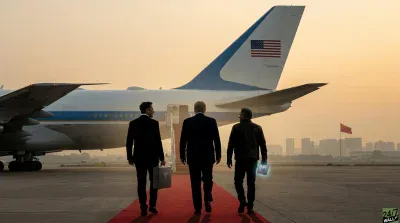
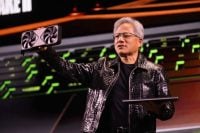
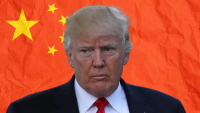
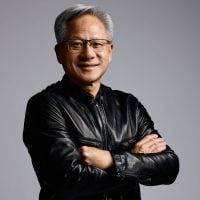
President Trump’s delegation to Beijing this week included 17 American chief executives. Fifteen flew commercial or on corporate jets. Two boarded Air Force One: Tesla (NASDAQ:TSLA | TSLA Price Prediction) CEO Elon Musk and NVIDIA (NASDAQ:NVDA) CEO Jensen Huang. Huang was a late addition, joining the plane during a refueling stop in Alaska after nearly a year of lobbying Washington and Beijing to ease AI chip export restrictions. The two running the companies most exposed to the US-China technology rivalry, with a combined market capitalization north of $7 trillion, got the seats next to the President.
The Visible Win
The market noticed. NVIDIA closed Wednesday at $225.83, up 9% on the week and 19% over the past month. Tesla rallied 12% in five sessions to $445.27. Polymarket gave NVDA a 81% probability of closing up Thursday and a 97% probability of beating earnings next week.
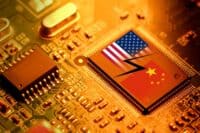
The why-now is sharper for Huang. NVIDIA’s Q1 FY27 guidance of roughly $78 billion in revenue explicitly assumes zero data center compute revenue from China, after a $4.5 billion H20 charge earlier in the year wiped out that channel. China once accounted for roughly 25% of NVIDIA revenue, and analysts have floated a $50 billion opportunity if restrictions thaw. Washington has already cleared H200 exports to about ten Chinese firms, including Alibaba, Tencent, ByteDance, and JD.com, though deliveries have stalled on review caution. Huang called the meetings “one of the most important summits in human history.”
Musk’s stake is operationally existential. Tesla’s Shanghai Gigafactory is its largest production hub, FSD regulatory approval in China is pending, and rare-earth and battery supply chains run through Beijing’s permission. Xi Jinping told the delegation that China’s door would “only open wider” for foreign business. For two CEOs at the President’s elbow, that sentence is worth real money.
The Hidden Cost
US trade policy toward its largest geopolitical rival is now negotiated through two private relationships. The other 15 CEOs, names like Boeing, Apple, and major banks, are second-tier petitioners. Their shareholders get a different product than NVDA and TSLA holders. Polymarket has no dedicated market on Tesla winning FSD approval in China, no market on tariff relief for autos, no market on chip licensing outcomes. Crowds price what is decided in visible rooms. These rooms have curtains.
Policy outcomes used to flow through institutional process: Commerce reviews, USTR consultations, Treasury sign-offs. Increasingly they flow through proximity. Huang spent a year working that channel and got his seat in Anchorage. It worked because it had to, his China revenue line is binary.
Who Pays, and What to Watch
The bill lands in three places. Competitors without access (AMD on chips, Ford and GM on autos, every cloud hyperscaler not named in an export license) absorb the asymmetry. US strategic AI posture, which the export controls were designed to protect, bends to whichever CEO has the President’s ear that quarter. The principle that trade policy serves broad national interest takes another hit.
Watch for concrete signals: Commerce Department licensing announcements on Blackwell and H200 shipments over the next 60 days, and any China FSD approval filing from Tesla before the second-quarter earnings report. If those land, the Air Force One seat paid for itself many times over. If they don’t, Huang’s “most important summit” language will age into a different artifact.


Contact [email protected] for any questions or corrections.
Joel South covers large-cap stocks, dividend investing, and major market trends, with a focus on earnings analysis, valuation, and turning complex data into actionable insights for investors.
He brings more than 15 years of experience as an investor and financial journalist, including 12 years at The Motley Fool, where he served as an investment analyst, Bureau Chief, and later led the Fool.com investing news desk. He has also co-hosted an investing podcast and appeared across TV and radio discussing market trends.