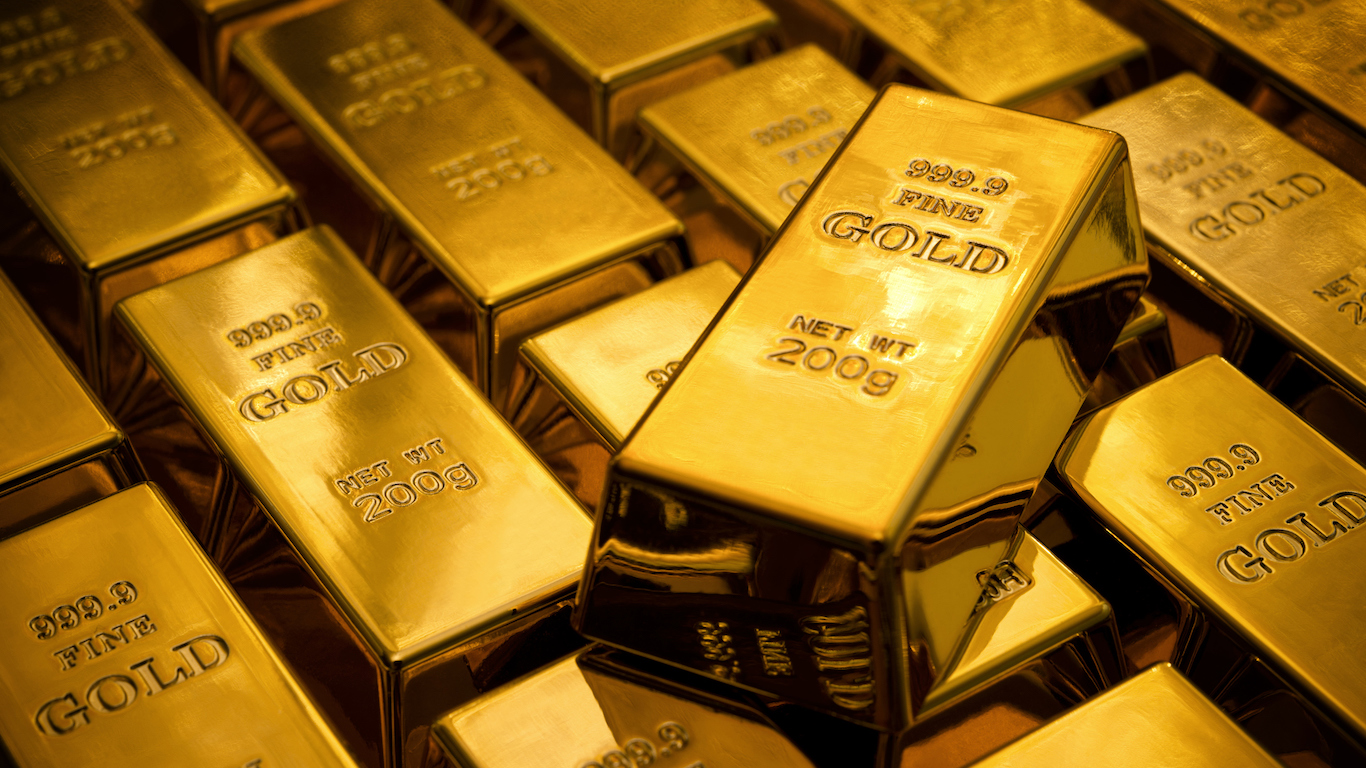
Central Banks Are Snapping Up Gold, ETF Investors Are Just Waking Up: The Best Gold ETFs to Own Before It Hits $5,000
Gold trades at $427 per share on the SPDR Gold Trust (NYSEARCA: GLD), up roughly 46% over the past 12 months, and the next psychological waypoint is $5,000 an ounce. The setup is unusual: central banks have been quietly accumulating…


Gold trades at $427 per share on the SPDR Gold Trust (NYSEARCA: GLD), up roughly 46% over the past 12 months, and the next psychological waypoint is $5,000 an ounce. The setup is unusual: central banks have been quietly accumulating bullion for years while Western exchange-traded fund (ETF) investors mostly sat out the rally. That is starting to change, and the three funds investors will use to express the trade are SPDR Gold Trust, iShares Gold Trust (NYSEARCA: IAU), and SPDR Gold MiniShares Trust (NYSEARCA: GLDM).
All three are physically backed trusts holding vaulted bullion, so they track spot gold closely minus fees. The differences are expense ratio, share-price granularity, and liquidity profile. Pick the wrong one for your use case and you give up real basis points over a multi-year hold.
The Smart Money Has Been Buying for Years
Central banks are the structural bid under this market. Emerging-market monetary authorities have been replacing dollar reserves with bullion since 2022, a pace that accelerated after the freeze of Russian foreign reserves demonstrated the political risk embedded in Treasury holdings. China, Poland, India, Turkey, and Singapore have been the most consistent buyers, and the World Gold Council’s quarterly surveys have shown reserve managers projecting further allocation increases.
The macro backdrop helps. The Federal Reserve has cut 75 basis points over the past six months, with the upper bound now at 3.75% after holding for five months. The Consumer Price Index is running at 332.4 on the FRED index, in the 91st percentile of its 12-month range. Inflation has not gone away, and real yields on the 10-year TIPS sit around 2%, a level high by recent standards but still well inside the band where gold has historically compounded.
The Hot Money Is Just Waking Up
Retail and institutional ETF investors are a different story. Through much of 2025, Western gold ETF holdings barely budged even as prices ran. That gap is the tell: the rally has been built on bullion bars moving into central bank vaults in Beijing, Warsaw, and Mumbai, not into trust holdings in London and New York.
The flow shift is now visible. The SPDR Gold Trust, iShares Gold Trust, and SPDR Gold MiniShares Trust are up 7% to 8% year to date. The convergence thesis is simple: if Western ETF demand layers on top of the central bank bid that already exists, $5,000 stops being a ceiling and starts being support. The smart money built the floor. The hot money may be about to build the staircase.
SPDR Gold Trust: The Institutional Standard
The SPDR Gold Trust is the deepest, most liquid gold vehicle in the world, and that is exactly why it belongs on this list. Sponsored by State Street and the World Gold Council, it carries an expense ratio of 0.40% (gross 0.99% per the summary prospectus; the net management fee has long been set at the standard 0.40% rate). For traders, hedge funds, and anyone running options against the position, the SPDR fund is the only choice. Bid-ask spreads stay tight even in stressed markets, and the options chain is liquid enough to construct collars, calendars, and covered calls without sacrificing edge.
The fund holds nothing but bullion vaulted in London. Shares trade near $427, which suits institutions sizing positions in dollar terms but creates friction for small buy-and-hold accounts trying to dollar-cost average. The tradeoff is straightforward: you pay the highest fee of the three to get the deepest liquidity. If you are not trading, you are paying for a feature you do not use.
iShares Gold Trust: The Balanced Choice
The iShares Gold Trust is BlackRock’s answer to the SPDR fund, and it has been the retail favorite for a decade for one reason: the expense ratio is 0.25%, materially less than what GLD charges. The trust holds 100% gold bullion, benchmarks the same LBMA Gold Price PM, and carries net assets of $72.3 billion and has been operating since January 2005, giving it a long operational track record.
Share price is the other practical difference. The iShares trust trades around $88, which makes fractional allocation in retirement accounts considerably easier than wrestling with the SPDR fund’s larger share size. One-year performance has been about 46%, essentially identical to the SPDR trust as expected from two physically backed trusts tracking the same benchmark. The tradeoff: options liquidity is real but thinner than GLD’s, so derivatives traders will still prefer the State Street fund.
SPDR Gold MiniShares: The Buy-and-Hold Workhorse
The SPDR Gold MiniShares Trust is the contrarian pick on this list, and for long-term holders it may be the best of the three. State Street Global Advisors designed it explicitly to address GLD’s two retail weaknesses: cost and share-price size. The expense ratio is the lowest of the three physically backed gold trusts featured here, and shares trade at about $92, low enough to slot into automated monthly contributions without fractional-share friction.
Performance tells the same story as its siblings. The MiniShares trust has returned roughly 46% over the past year and about 151% over five years. Since launch it has compounded at a similar pace to IAU and GLD, with the fee gap quietly accruing in shareholders’ favor over multi-year holds. The tradeoff is depth: the MiniShares trust’s secondary-market liquidity and options market are noticeably shallower. If you need to move $50 million in an afternoon, look elsewhere. If you are accumulating quietly for 10 years, the lower fee compounds into real money.
Matching the Vehicle to the Use Case
Choosing the right one is easy once the actual use case is separated from just recognizing a big brand name. Traders, options writers, and institutions sizing tactical positions tend to gravitate to the SPDR Gold Trust because liquidity is the feature they actually need. Long-term core allocators who also want a developed options market often go with the iShares Gold Trust, which strikes the balance between cost and tradability. Cost-conscious buy-and-hold investors building a multi-decade bullion sleeve in an IRA frequently favor the MiniShares trust and accept the lower trading depth because they will not be trading.
The bigger point holds across all three. If ETF flows continue to layer on top of the central bank bid that has been doing the heavy lifting since 2022, the path to $5,000 stops looking like a stretch and starts looking like the base case. The smart money has already voted. What happens next depends on how quickly the rest of the room follows.
Contact [email protected] for any questions or corrections.
Trey has been an editor and author at 24/7 Wall St. for more than a decade, where he has published thousands of articles analyzing corporate earnings, dividend stocks, short interest, insider buying, private equity, and market trends. His comprehensive coverage spans the full spectrum of financial markets, from blue-chip stalwarts to emerging growth companies.
Beyond 24/7 Wall St., Trey has created and edited financial content for Benzinga and AOL's BloggingStocks, contributing additional hundreds of articles to the investment community.
Trey's editorial expertise extends across multiple publishing environments. He served as production editor at Dearborn Financial Publishing and development editor at Kaplan, where he helped shape financial education materials. Earlier in his career, he worked as a writer-producer at SVE. His freelance editing portfolio includes work for prestigious clients such as Sage Publications, Rand McNally, the Institute for Supply Management, the American Library Association, Eggplant Literary Productions, and Spiegel.
Outside of financial journalism, Trey writes fiction and has been an active member of the writing community for years, moderating workshop sessions at regional conventions.