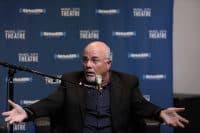
Dave Ramsey on Why Index Funds vs. Mutual Funds Misses the Real Point About Building Wealth
Dylan from New Mexico asked Dave Ramsey a fair question on a recent episode of The Ramsey Show: if active funds rarely beat the index, why bother with Ramsey’s four-fund split across small-cap, mid-cap, large-cap, and international? Ramsey’s answer cut…

This post may contain links from our sponsors and affiliates, and Flywheel Publishing may receive compensation for actions taken through them.

Dylan from New Mexico asked Dave Ramsey a fair question on a recent episode of The Ramsey Show: if active funds rarely beat the index, why bother with Ramsey’s four-fund split across small-cap, mid-cap, large-cap, and international? Ramsey’s answer cut past the math and landed on something most investors underweight: their own behavior.
The Behavior Argument
Ramsey’s central point was blunt. “100% of the people that invest end up with more money than those that don’t. Every time. And that’s the number you need to concentrate on,” he said. He framed the index-versus-active debate as a distraction from the harder problem: “people who invest in slightly substandard mutual funds way outperform those who never invest.”
The savings data supports that framing. The U.S. personal savings rate slid from 4.5% in January 2026 to 3.9% in February, then to 3.6% in March, before dropping further to 2.6% in April, according to the Bureau of Economic Analysis. May brought a partial recovery to 3.0%, boosted partly by one-time government farm-relief payments, before June settled back to 2.7%. Americans are earning more and saving less, with per capita disposable income continuing to climb even as the fraction set aside keeps shrinking.
Consumer sentiment has compounded the problem. The University of Michigan’s index hit an all-time low of 44.8 in May 2026, driven largely by surging gasoline prices tied to the Iran conflict. It recovered to 49.5 in June and then jumped to a five-month high of 55.2 in July, prompting some cautious optimism that the worst had passed. That optimism proved short-lived: the August 2026 preliminary reading dropped back to 51.0, snapping two consecutive months of improvement and coming in well below economists’ expectations of 54.5. Year-ahead inflation expectations ticked up to 4.3% in August from 4.2% in July, both readings still substantially above the pre-conflict level of 3.4% recorded in February. Only 8% of consumers now expect their income growth to outpace inflation over the next year. Pessimism, in other words, remains the easy excuse to skip the 401(k) contribution.
The Academic Case for Indexing Is Real
Ramsey did not dispute the research. “Individual mutual funds in the growth mutual fund sector, less than half of them beat the S&P,” he acknowledged, crediting Vanguard founder John Bogle for building the first S&P index fund on that insight. The latest data from S&P Global’s SPIVA Year-End 2025 Scorecard sharpens the point: 79% of all active large-cap U.S. equity funds underperformed the S&P 500 in 2025, the fourth-worst showing in the study’s 25-year history. Stretched over 15 years, not a single one of 22 U.S. equity fund categories had a majority of active managers outperform their benchmarks. Extend the window to 20 years and the picture is starker still: roughly 92% of domestic funds trailed their benchmarks over that span.
A counter-argument worth noting has emerged from a 2026 study sponsored by the Investment Adviser Association. That research challenged SPIVA’s methodology, arguing that the scorecard’s treatment of closed or merged funds as automatic underperformers overstates how badly active management fares. When the researchers weighted results by fund assets and tracked performance only for a fund’s actual lifespan, the asset-weighted underperformance rate over 20 years fell from 92% to roughly 55%, close to a coin flip. S&P Dow Jones Indices defended its approach, noting that SPIVA deliberately measures the proportion of funds that underperform rather than the proportion of assets, giving a clear view of manager performance independent of fund size. The two studies are answering slightly different questions, and investors can weigh both readings accordingly.
The cost gap reinforces the headwind regardless of which study one favors. The Vanguard 500 Index Fund Admiral Shares (VFIAX) carries an expense ratio of 0.04%, and SPDR S&P 500 ETF Trust (NYSEARCA:SPY) sits at 0.0945%, confirmed by State Street’s own fund page. Active funds routinely charge ten to twenty times that, creating a compounding performance hurdle that becomes harder to clear as time horizons lengthen. SPY now holds approximately $795 billion in assets, a scale that reflects decades of investor preference for low-cost passive exposure.
The returns have rewarded patient holders. SPY is up roughly 314% over the past ten years and about 85% over the past five. The trailing twelve-month total return through mid-August 2026 stands near 14.5%. Current figures are available directly through State Street’s SPY fact sheet.
Ramsey’s Four-Fund Tilt
His own portfolio holds four mutual funds across small-cap, mid-cap, large-cap, and international, with co-host Rachel Cruze noting that the 25% international slice provides ballast: “If you look at the S&P 500 and it’s down in a given year, the international fund usually is up.” Ramsey claims his selections have outperformed their benchmarks, though he declines to name them publicly. The international diversification argument earned extra credibility in 2025, when the MSCI All Country World ex-USA index gained 29.2% compared to the S&P 500’s 16.39% return, a gap of nearly 13 percentage points in U.S. dollar terms. A weakening dollar, European fiscal stimulus, and AI-driven gains across Asian chipmakers and tech companies all contributed to that spread.
What to Watch
Ramsey closed with a concession most index advocates will welcome: “If you don’t want to do that and you just want to put it in the S&P, you’re gonna end up with a lot of money. And we’ll be happy for you. We’re not mad at you.” On the millionaires he has studied, he noted: “They just said, ‘Oh, I got a 401(k) at work and I’m gonna put some money in a growth stock mutual fund and now I’m a millionaire.'” The fund label mattered less than the automatic contribution that funded it for three decades.
That is the core of Ramsey’s argument: the vehicle is secondary to the discipline of getting in and staying in. The point holds whether markets are calm or, as in mid-2026, rattled by geopolitical shocks, record-low consumer confidence readings, and a personal savings rate that bounced between 2.6% and 3.0% across the spring before settling back to 2.7% in June. The August sentiment drop to 51.0 suggests the consumer mood has not decisively turned, and behavioral inertia remains the biggest obstacle to building the kind of wealth Ramsey describes.
Editor’s note: The April 2026 personal savings rate was corrected to 2.6% (from the previously stated 3.0%), with June 2026 added at 2.7%, per Bureau of Economic Analysis data. University of Michigan consumer sentiment was updated to include the July 2026 final reading of 55.2 and the August 2026 preliminary reading of 51.0, with year-ahead inflation expectations revised to 4.3% for August. SPY assets under management were updated to approximately $795 billion as of mid-August 2026.
Contact [email protected] for any questions or corrections.
Don Lair writes about options income, dividend strategy, and the kind of boring-but-durable investing that actually funds retirement. He's the founder of FITools.com, an independent contributor to 24/7 Wall St., and a former writer for The Motley Fool.