Jim Cramer’s P/E Ratio Rule for Finding the Next Nvidia. Look Two Years Out, Not This Year.
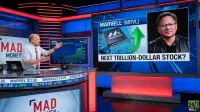
Jim Cramer is back to first principles. On the May 22, 2026 episode of Mad Money, a caller asked which price-to-earnings ratio actually matters when sizing up a stock. Current year? Forward? PEG? His answer doubles as a screening rule…


Jim Cramer is back to first principles. On the May 22, 2026 episode of Mad Money, a caller asked which price-to-earnings ratio actually matters when sizing up a stock. Current year? Forward? PEG? His answer doubles as a screening rule for anyone hunting the next NVIDIA.
“I am going to say very, I’m a very traditionalist, uh, when it comes to evaluating stocks. I want you to do the P/E ratio both next year and the year after. I don’t care that much about this year in any given year. I care about what’s called the out-years because I want to be able to be in a stock like NVIDIA because it has very good out-year, even though it looks expensive near term.”
That framing is the whole ball game for high-growth compounders. Trailing multiples punish the very companies whose earnings are scaling fastest. Cramer’s fix: discount the noise of the current fiscal year and underwrite the business at the multiple it will trade on once two more years of compounding roll through the income statement.
NVIDIA: The Case Study Cramer Cites
NVIDIA (NASDAQ:NVDA | NVDA Price Prediction) is the textbook example of why the trailing multiple can mislead. The stock trades at a trailing P/E of 33 against a forward P/E of around 25. That gap reflects the math of accelerating earnings rather than multiple expansion.
Look at the EPS trajectory. FY2024 full-year EPS came in around $2.61. FY2025 reached $4.05. The company reported Q1 FY2027 non-GAAP EPS of $1.87, beating the $1.77 consensus, on revenue growth of 85.2% year over year. Management guided Q2 FY2027 revenue to $91.0 billion, plus or minus 2%. That cadence is what Cramer means by “good out-years.”
Now layer on the demand signal. Jensen Huang told investors that “the buildout of AI factories, the largest infrastructure expansion in human history, is accelerating at extraordinary speed.” Data Center revenue hit $75.25 billion, up 92% year over year, with Data Center Networking up 199%. Total supply commitments stand at $119.0 billion, a forward indicator of the order book backing those out-year estimates. Details are in the company’s Q1 FY27 8-K filing.
The capital return signal matters too. NVIDIA approved a new $80 billion share repurchase authorization in May 2026 and raised the quarterly dividend from $0.01 to $0.25 per share. Buybacks at this scale shrink the share count and lift forward EPS mechanically, compressing the out-year multiple further.
Applying the Rule to Find the Next One
Cramer’s traditionalist test has three legs when you screen for NVIDIA-like setups:
- Earnings acceleration, not just growth. The forward P/E should drop meaningfully versus trailing because next year and the year after are materially higher.
- A beat-and-raise pattern. NVIDIA has posted positive earnings surprises ranging from 3% to 12% over the last ten quarters. Estimates lag reality in genuine secular winners.
- Best-of-breed positioning. Cramer’s coda: “Don’t be afraid to pay up for best-of-breed stocks, and once you find them, don’t let the bears scare you away.”
Wall Street is aligned with the thesis. The Street carries 10 strong buy, 48 buy, 2 hold, and 1 sell ratings, with an average price target of $295.69, against a May 27 price of $212.19. The stock is up 63.69% over the past year.


What to Watch Next
The next test for Cramer’s framework arrives with NVIDIA’s August 19, 2026 earnings report. Blackwell 300 is ramping and the Vera Rubin platform is on deck. China remains the swing factor, with no Data Center compute revenue from China assumed in Q2 guidance. Any thaw is upside not currently in consensus.
Cramer’s closing line is the one investors should tape to the monitor: “Patience is virtue. Giving up on value is a sin.” Out-year earnings are how patience gets paid.
Contact [email protected] for any questions or corrections.
I've spent more than 15 years inside enterprise software, working alongside the finance, sales operations, and HR leaders who run the revenue engines at some of the largest tech companies in the country.
My day job is helping enterprise executives make smarter decisions about retention, compensation, and growth. These are the same operational levers that show up in every earnings report investors actually read. That perspective shapes my writing for 24/7 Wall St.
The headline numbers are easy. The interesting stuff is underneath: how companies make money, what executives are worried about, and what any of it means for the person checking their 401(k) on a Sunday afternoon. I write about personal finance and business as someone who has spent her career inside the rooms where these decisions get made.