OMAH Delivers 15% Returns While Berkshire Stock Drops 5%: The Buffett ETF Retirees Overlook
Retirees who admire Warren Buffett face a recurring frustration: Berkshire Hathaway (NYSE:BRK-B | BRK-B Price Prediction) pays no dividend, so owning the stock means watching the compounding happen on paper while no cash hits the brokerage account. The VistaShares Target…

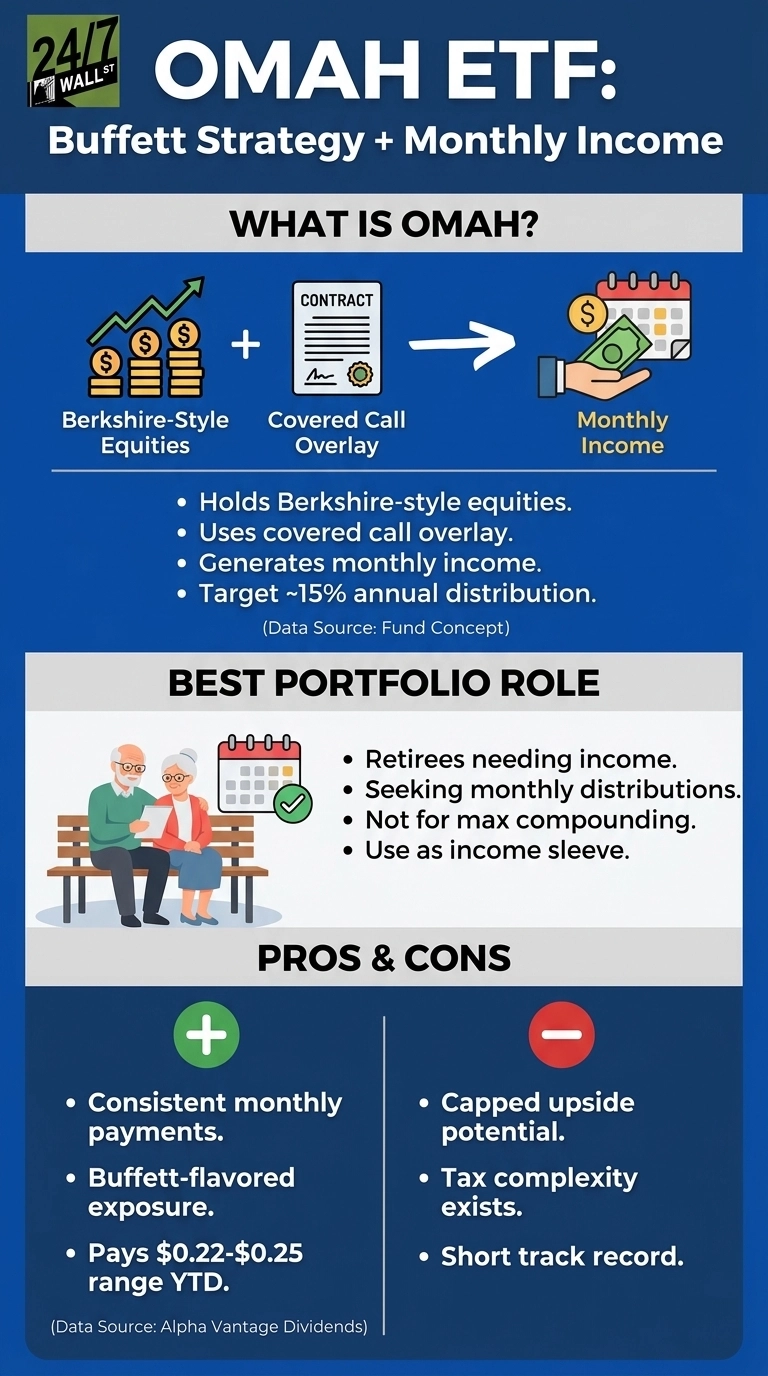
Retirees who admire Warren Buffett face a recurring frustration: Berkshire Hathaway (NYSE:BRK-B | BRK-B Price Prediction) pays no dividend, so owning the stock means watching the compounding happen on paper while no cash hits the brokerage account. The VistaShares Target 15 Berkshire Select Income ETF (NYSEARCA:OMAH) was built to plug that gap. OMAH holds a basket modeled after Berkshire’s publicly disclosed equity portfolio and writes covered calls on top of it, aiming to convert Buffett-style exposure into monthly distribution checks. The fund is small and only about two years old, which is why most retirees still scroll past OMAH when screening for income.
What the fund is actually doing
At its core, OMAH is an actively managed ETF holding roughly 21 positions drawn from Berkshire Hathaway itself and the largest stakes in its 13F filings, including Apple (NASDAQ:AAPL) and Bank of America (NYSE:BAC), as well as other Buffett staples. The expense ratio is 0.95%, well above a plain index fund but in line with other covered call products.
This specialized investment engine relies on two distinct components. The core equity sleeve captures direct upside from Warren Buffett’s signature stock picks, while a programmatic covered-call overlay systematically sells short-term options against those core holdings to extract cash premium. Those recurring options gains directly bankroll the fund’s monthly shareholder distributions. Its stated mandate targets a 15% annualized yield, which converts a $50,000 principal position into roughly $7,500 in annual liquidity, distributed as 12 scheduled payments.
Does the income show up?
This steady monthly distribution cadence remains entirely unbroken. OMAH successfully distributed $0.23225 per share in April 2026, $0.22688 during March, and $0.23088 for February, sustaining a highly consistent payout sequence that fluctuated tightly between $0.22 and $0.25 throughout the prior year. Annualized against a prevailing $19 market price, this operational clip perfectly meets the fund’s advertised double-digit yield target, though savvy allocators should anticipate that a meaningful portion of these distributions will be classified as a return of capital rather than ordinary dividend income.
The comparison Buffett fans actually care about
Looking at the trailing twelve months, OMAH generated a solid 13% gain on underlying price appreciation alone, while stacking heavy monthly options distributions right on top. Underlying Berkshire Hathaway shares simultaneously decoupled and traveled backward: BRK.B equity dropped 5% over that exact one-year stretch and remains down roughly 3% year-to-date. This brief performance window hands an obvious victory to the specialized income vehicle.
The multi-year timeline predictably restores the advantage to the corporate parent. BRK.B stock has surged 70% over five years and 245% throughout the past decade, market regimes that OMAH simply did not exist to participate in. Because systematic covered-call overlays cap capital upside, whenever Berkshire enters its next major macro rally, OMAH investors will merely harvest the fixed premium while entirely sacrificing the profitable tail of that expansion. This trade represents the permanent operational cost of squeezing a monthly salary out of a historically zero-dividend compounder.
Tradeoffs to weigh
- NAV decay risk: In strongly trending markets, covered call funds often see their share price drift lower as called-away gains are surrendered. A 15% yield on a slowly eroding NAV is a different product than a 15% yield on a stable one.
- Tax complexity: Option premiums and return-of-capital distributions are taxed differently from qualified dividends. Holding OMAH in a taxable account requires careful review of the 1099 each year.
- Concentration and size: The fund mirrors a portfolio dominated by a few names. Apple alone is a meaningful position, and AAPL is up 52% over the past year, which lifted OMAH but also concentrates single-stock risk.
Who it fits
OMAH perfectly targets a retired individual who desires Buffett-inspired equity exposure, values an automated monthly deposit over maximized long-term wealth compounding, and remains completely comfortable sizing the position at 5% to 10% of a tactical income sleeve rather than anchoring it as a foundational holding. Investors carrying a 10-plus-year timeline who simply want the unadulterated capital production of Berkshire are typically far better served by holding BRK.B directly and systematically liquidating shares for cash flow as personal needs dictate. For a more highly diversified covered-call alternative tracking the S&P 500 universe, the JPMorgan Equity Premium Income ETF (NYSE:JEPI) delivers identical distribution mechanics without the concentrated Berkshire bias, while operating at a substantially lower annual expense ratio.
Contact [email protected] for any questions or corrections.
David Beren has been a Flywheel Publishing contributor since 2022. Writing for 24/7 Wall St. since 2023, David loves to write about topics of all shapes and sizes. As a technology expert, David focuses heavily on consumer electronics brands, automobiles, and general technology. He has previously written for LifeWire, formerly About.com. As a part-time freelance writer, David’s “day job” has been working on and leading social media for multiple Fortune 100 brands. David loves the flexibility of this field and its ability to reach customers exactly where they like to spend their time. Additionally, David previously published his own blog, TmoNews.com, which reached 3 million readers in its first year. In addition to freelance and social media work, David loves to spend time with his family and children and relive the glory days of video game consoles by playing any retro game console he can get his hands on.