QYLD’s 12% Yield Looks Generous, But Its 10 Year Total Return Tells a Harder Story
The Global X NASDAQ 100 Covered Call ETF (NASDAQ:QYLD) advertises a trailing distribution yield around 12%, which is roughly ten times what the broad market pays. That headline is what drew income-focused investors into QYLD when it launched in 2013,…


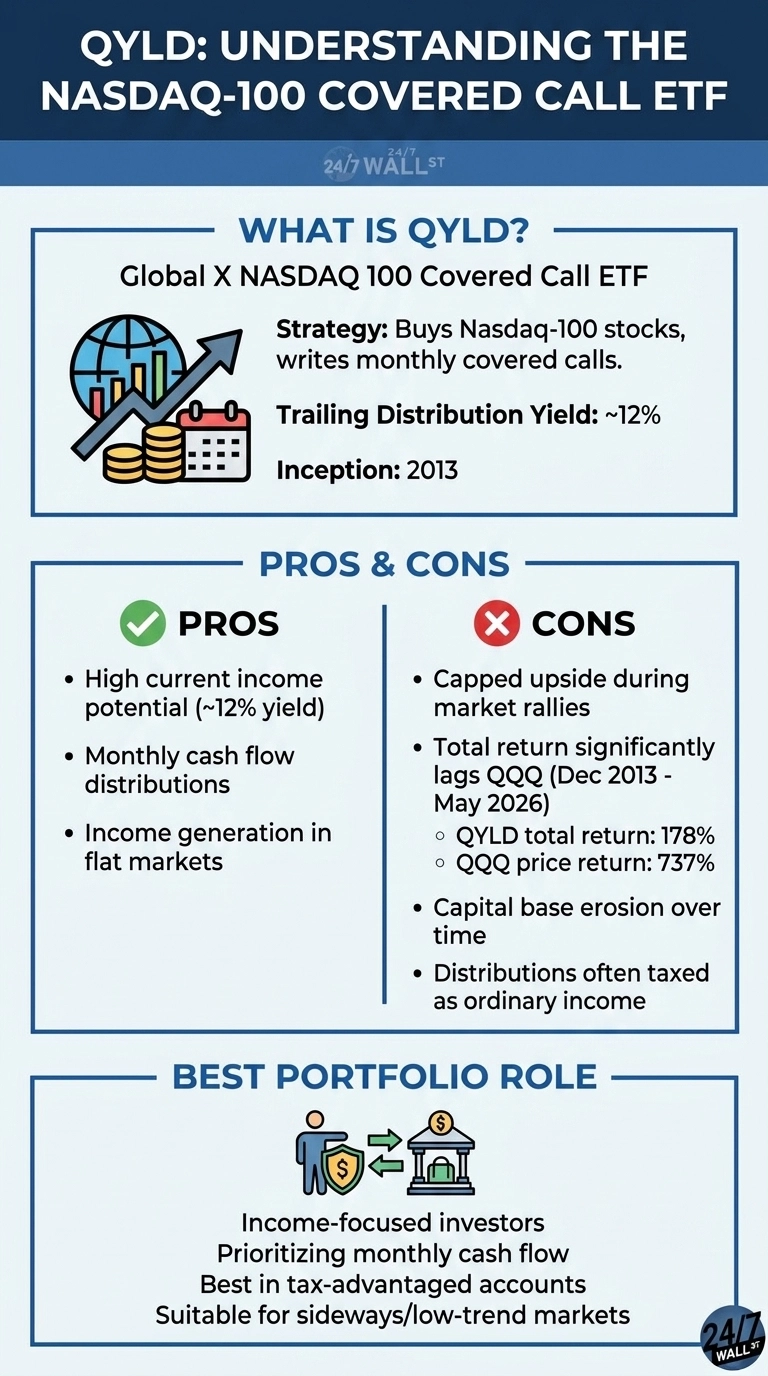
The Global X NASDAQ 100 Covered Call ETF (NASDAQ:QYLD) advertises a trailing distribution yield around 12%, which is roughly ten times what the broad market pays. That headline is what drew income-focused investors into QYLD when it launched in 2013, and it is still what keeps roughly $8.13 billion in assets parked there today. The harder question, and the one this article tests, is what a QYLD shareholder has actually earned compared with simply owning the underlying index.
What QYLD is built to do
QYLD mirrors the Nasdaq-100 and systematically sells at-the-money call options against its underlying equity basket each month, capturing premium income and routing the vast majority of it to shareholders via monthly checks. The entire architecture operates as a rigid, rules-based strategy, which anchors its core investor appeal by turning baseline equity volatility into scheduled cash flow. The vehicle levies a 0.60% annual expense ratio, manages 102 individual tech-heavy equities, and has distributed $2.1320 per share over the trailing 12-month period.
The massive structural drawback of writing rigid at-the-money options is that any monthly market appreciation above the strike price is surrendered entirely to the option buyer rather than to the fund. Throughout flat, range-bound, or slightly negative trading environments, that incoming premium cushion compounds beautifully. Conversely, during a roaring tech bull market powered by a few mega-cap growth giants, this hard ceiling on capital upside binds tightly almost every single month.
The reveal: a decade of capped upside
QYLD trades around $18 today, down meaningfully from its $25 launch price. Meanwhile, the Invesco QQQ Trust (NASDAQ:QQQ) has returned 737% on price alone since QYLD’s December 2013 inception, while QYLD’s total return, with distributions reinvested, stands at 178%.
The hypothetical retiree case sharpens the point. A $10,000 investment at QYLD’s launch produced roughly $14,000 in cumulative cash distributions, but the share count is now worth about $6,500. The combined total is near $20,500, against $30,000 or more from QQQ, even with periodic withdrawals. The cash flow felt steady while the capital base eroded.
The mega-caps in the index account for most of the gap. Apple and NVIDIA, two of the largest Nasdaq-100 weights, have posted multi-bagger gains since QYLD’s launch, and every monthly call written against those positions handed the gains above strike to someone else.
Three real tradeoffs
- Capped upside is a structural feature of the strategy. At-the-money calls give up everything above the strike each month, which is why QYLD lags whenever the index trends. QYLD has returned 44% over five years compared to QQQ’s 100% on the trailing window most income investors care about.
- Distributions drift lower over time. Monthly payouts have declined from a 2021 range of $0.188 to $0.233 to a 2026 range of $0.172 to $0.179 as volatility has compressed. The yield label stays fixed while the dollar payouts shrink.
- Tax treatment weighs on taxable accounts. Distributions are largely ordinary income or return of capital, which is why most analyses frame QYLD as best suited for tax-advantaged retirement accounts.
Where the alternatives sit
Two adjacent products address the same income need with different mechanics. The Global X Nasdaq 100 Covered Call & Growth ETF (QYLG) writes calls on half of its portfolio, returning 113% since September 2020 while leaving more upside intact. The JPMorgan Nasdaq Equity Premium Income ETF (NASDAQ:JEPQ) uses an actively managed equity-linked note structure at a 0.35% fee and has returned 83% since its May 2022 inception, with a similar income profile.
Who QYLD fits
QYLD is perfectly suited to an isolated investor who has explicitly determined that immediate monthly cash flow overrides comprehensive total return, anticipates a flat or directionless trading environment, and strictly shelters the asset in a tax-advantaged account. For anyone actively accumulating wealth, or any retiree whose financial survival depends on the underlying capital base expanding alongside automated distributions, a decade of performance data strongly advocates for pure QQQ exposure with programmatic share sales, QYLG, or JEPQ as vastly superior vehicles to extract yield from the Nasdaq-100 footprint.
Contact [email protected] for any questions or corrections.
David Beren has been a Flywheel Publishing contributor since 2022. Writing for 24/7 Wall St. since 2023, David loves to write about topics of all shapes and sizes. As a technology expert, David focuses heavily on consumer electronics brands, automobiles, and general technology. He has previously written for LifeWire, formerly About.com. As a part-time freelance writer, David’s “day job” has been working on and leading social media for multiple Fortune 100 brands. David loves the flexibility of this field and its ability to reach customers exactly where they like to spend their time. Additionally, David previously published his own blog, TmoNews.com, which reached 3 million readers in its first year. In addition to freelance and social media work, David loves to spend time with his family and children and relive the glory days of video game consoles by playing any retro game console he can get his hands on.