Oracle at $192: Buy, Sell or Hold?
At $192.08, Oracle (NYSE:ORCL | ORCL Price Prediction) screens favorably on backlog and valuation, with shares down sharply from last fall’s peak but sitting on an AI cloud backlog few peers can match. The market has repriced this stock twice…


At $192.08, Oracle (NYSE:ORCL | ORCL Price Prediction) screens favorably on backlog and valuation, with shares down sharply from last fall’s peak but sitting on an AI cloud backlog few peers can match. The market has repriced this stock twice in nine months, first as an AI infrastructure winner, then as a capex-bleeding hyperscaler-in-training.
Oracle sells database software, enterprise applications, and increasingly, raw GPU cloud capacity through Oracle Cloud Infrastructure. The legacy business still throws off cash, but the new story is AI compute, where Oracle has signed multi-billion-dollar deals including a $30 billion US government agreement.
Shares peaked at $302.14 in September 2025, bottomed at $153.97 in February, and have since clawed back.
Why the $553 Billion Backlog Anchors the Bull Case
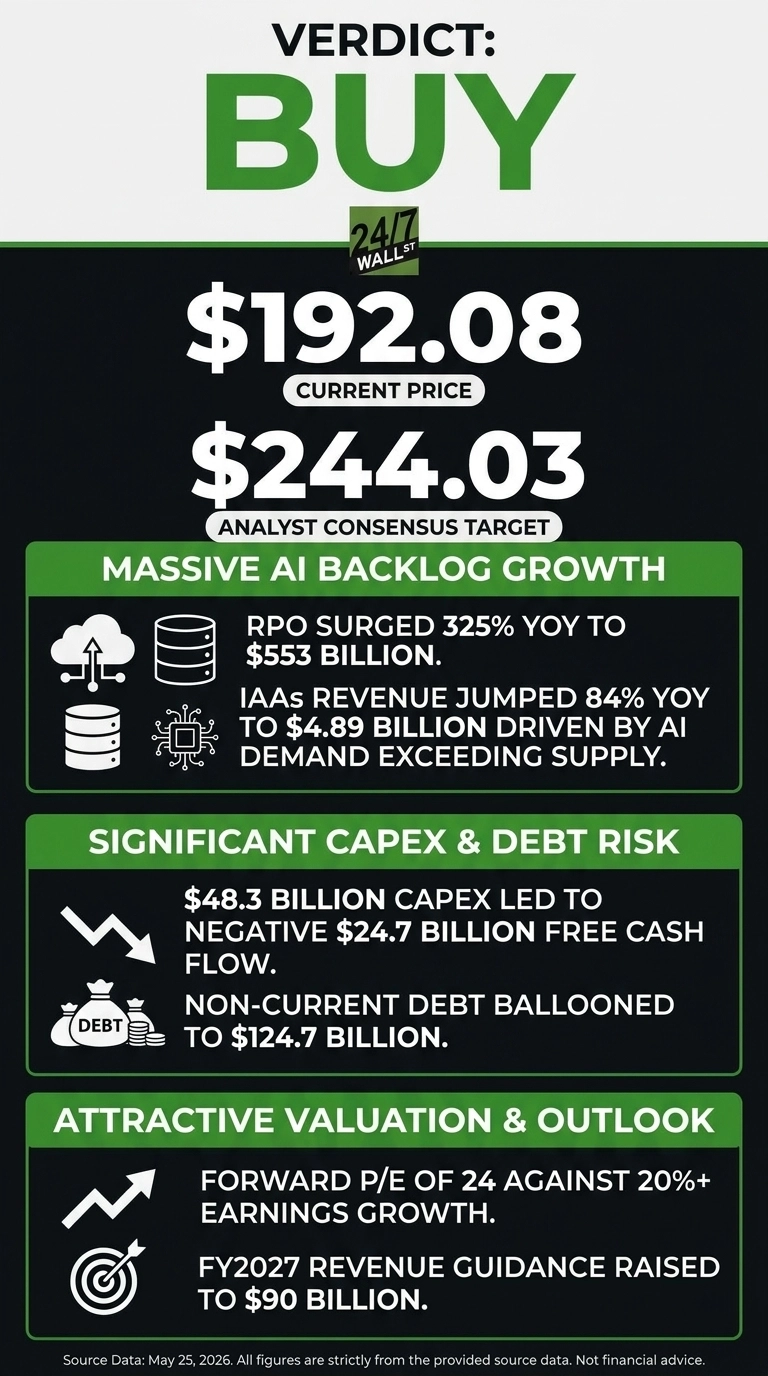
Q3 FY2026 was Oracle’s first quarter in 15-plus years with both organic revenue and non-GAAP EPS growing 20%+, posting $17.19 billion in revenue and $1.79 EPS. IaaS revenue jumped 84% YoY to $4.89 billion, with management saying AI demand still exceeds supply.
Remaining Performance Obligations hit $553 billion, up 325% YoY, much of it prepaid or backed by customer-supplied GPUs. Management raised FY2027 revenue guidance to $90 billion and projects OCI scaling to $144 billion by FY2030. Forward P/E at 24 looks cheap against that trajectory.

Why the Capex Bill Could Crush the Story
Trailing free cash flow is negative $24.7 billion, swamped by $48.3 billion in capex. Non-current debt has ballooned to $124.7 billion from $85.3 billion at fiscal year-end, with interest expense up 32% YoY to $1.18 billion. Oracle plans to raise up to $50 billion more in debt and equity.
Q2 FY2026 revenue missed by roughly 5% and shares slid 13% after the report. Customer concentration in AI hyperscalers is real, and Reddit sentiment recently flipped bearish on OpenAI exposure. If GPU pricing softens or one anchor contract slips, the backlog narrative gets re-rated fast.
The Patience Case Has Real Merit
Oracle sits below both its 50-day ($167.21) and 200-day ($207.98) moving averages, and prediction-market crowd sentiment registers neutral at 47.8. Q4 FY2026 results, due in June, will test whether RPO converts to reported revenue and whether margins hold against the capex bill. Waiting one quarter costs little if conviction wavers.
What the Numbers Actually Say
Oracle trades at $192.08, with a market cap near $552 billion. The 44 analysts covering the stock carry an average target of $244.03, implying roughly 27% upside, though targets are one input rather than a promise. The split: 7 Strong Buy, 28 Buy, 8 Hold, 1 Sell.
Trailing P/E is 34, forward P/E is 24, with quarterly earnings growing 24.5% YoY. Over the past year Oracle is up 23.32%, ahead of the S&P 500’s roughly 12% over the same window, even as the stock is down 0.85% YTD.
What the Setup at $192 Looks Like
At $192, the setup tilts constructive based on the data. Here is why.
The path runs through three near-term proof points: Q4 revenue landing in the guided 19-21% range, RPO continuing to grow, and the first signs of operating leverage as datacenters come online. Forward P/E of 24 against 20%+ earnings growth leaves room for multiple expansion if execution holds.
Risk/reward at $192 looks asymmetric. The model bear case lands at $206.68, the base case at $243.35, and the bull case reaches $349.91. Even the bear scenario produces a positive return.

What invalidates the thesis: an AI capex pause from hyperscale customers, a credit downgrade from rising debt loads, or RPO failing to convert into reported revenue.
Watch free cash flow and interest coverage quarterly. At a 27% discount to consensus target, with a backlog larger than Oracle’s current market cap and a 44% drawdown already absorbed, $192 is a level where AI infrastructure starts to screen as a value setup on the data.
Contact [email protected] for any questions or corrections.
Vandita Jadeja is a financial publisher with over a decade of experience writing about financial topics, including investment, savings, retirement, insurance and banking. Vandita is a Chartered Accountant who loves to debunk financial concepts for readers.
Her work has appeared on sites that include The Motley Fool, InvestorPlace, and Benzinga. She covers investing and focuses on stock picks and price prediction for 24/7 Wall St.
When not looking for the next stock investment opportunity, she can be found traveling, reading, chasing sunsets and enjoying her iced latte.