The AI Memory Shortage Is Just Getting Started and These 3 ETFs Own Every Layer of the Supply Chain
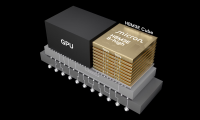
High-bandwidth memory has become the choke point in the AI buildout, as NVIDIA’s Blackwell accelerators rely on stacked DRAM modules that only three companies can produce at scale, and the order books for those modules are reportedly stretching past 2027.…

High-bandwidth memory has become the choke point in the AI buildout, as NVIDIA’s Blackwell accelerators rely on stacked DRAM modules that only three companies can produce at scale, and the order books for those modules are reportedly stretching past 2027. Investors trying to express that thesis through a single ticker have three obvious vehicles: the Roundhill Memory ETF (CBOE:DRAM), the iShares Semiconductor ETF (NASDAQ:SOXX), and the VanEck Semiconductor ETF (NASDAQ:SMH).
Each one takes a different cut at the same supply chain. DRAM is the only fund built specifically around memory makers, while SOXX spreads exposure across the broader semiconductor index while still carrying meaningful memory weight. SMH leans into the picks-and-shovels equipment vendors and the mega-cap chip designers buying their machines. The choice between them comes down to how directly an investor wants to underwrite the memory cycle itself versus the infrastructure scaling around it.
Why memory is the constraint right now
The HBM shortage is no longer a forecast, as SK Hynix has been described as sold out through 2026 and Micron through 2027, with hyperscalers locking in capacity years ahead of delivery. Micron’s most recent quarter showed what that demand looks like in financial terms: fiscal Q1 2026 revenue of $13.643 billion, up 57% year over year, with the Cloud Memory unit alone generating $5.284 billion at a 66% gross margin. Non-GAAP EPS came in at $4.78 against a $3.94 consensus.
CEO Sanjay Mehrotra framed the setup bluntly on the December call: “Our Q2 outlook reflects substantial records across revenue, gross margin, EPS and free cash flow, and we anticipate our business performance to continue strengthening through fiscal 2026.” The guided gross margin for the current quarter is 68%, a level the memory industry rarely sees outside peak cycles. That pricing power is the engine each of these ETFs is trying to capture.
DRAM: the only direct vehicle for the memory thesis
Roundhill’s memory ETF is the most concentrated expression of the trade. The fund holds nine names, and the top three, Samsung Electronics at 25%, SK hynix at 24%, and Micron at 24%, account for roughly 72% of assets. The remainder spans NAND and storage names, including Kioxia, Sandisk, Western Digital, Seagate, Nanya Technology, and Winbond. Geographic exposure is heavily weighted toward South Korea at roughly 49%, reflecting where the HBM3e capacity is actually located.
The investment mechanism here is incredibly straightforward and efficient. When global DRAM contract prices climb, and hyperscalers aggressively bid up high-bandwidth memory allocations, that massive revenue flows straight to the three dominant pure-plays anchoring this fund. There is absolutely zero dilution from logic chip designers or analog suppliers, whose distinct business cycles operate on completely different macroeconomic timelines. The product carries a 0.65% expense ratio, which is slightly higher than that of broad semiconductor sector funds but remains entirely standard for a specialized thematic vehicle.
The mechanism here is unusually clean. When DRAM contract prices rise, and HBM allocations are bid up, revenue flows directly to the three names that dominate this fund. There is no dilution from logic chip designers or analog suppliers whose business cycles run on different timing. The expense ratio is 0.65%, higher than the broad semi funds but not unusual for a thematic product.
SOXX: broad semi exposure with a memory tilt
The iShares Semiconductor ETF tracks the NYSE Semiconductor Index and provides investors with the entire U.S.-listed semiconductor complex in a single wrapper. Micron sits inside the fund alongside the GPU designers, fabless logic names, and equipment vendors, which means SOXX participates in the memory cycle without being defined by it. The expense ratio of 0.34% is among the lowest in the category.
That structure matters when the memory cycle eventually rolls over, as it always does. An investor who wants exposure to AI capex but does not want to bet specifically on contract DRAM pricing gets a smoother ride here. The fund has returned 87% year to date and 180% over the trailing year, capturing much of the same tailwind that has lifted memory names without the single-segment concentration.
The tradeoff is dilution of the thesis, and if the HBM shortage extends through 2027, as order books suggest, SOXX captures only a fraction of that upside because memory makers account for a modest slice of the portfolio. It is the broader semi bet, not the memory bet.
SMH: the equipment layer behind the capacity buildout
VanEck’s fund tracks the MarketVector US Listed Semiconductor 10% Capped Index and is market-cap weighted, resulting in a portfolio dominated by the largest names in the chain. Micron is the third-largest position at 9%, but the more interesting feature is the equipment exposure: ASML at 8%, Lam Research at 6%, and Applied Materials at 6%, combining to roughly 19% of assets in companies that sell the lithography, etch, and deposition tools needed to build out HBM capacity.
That is the picks-and-shovels angle. Samsung, SK Hynix, and Micron have collectively committed to multi-year capex programs to chase HBM demand, and Micron alone spent $15.857 billion on capital expenditures in fiscal 2025. Most of that money flows to a small group of equipment vendors with near-monopoly positions in their respective process steps. SMH is the cleanest large-cap ETF for accessing that flow alongside the chip designers themselves. The expense ratio is 0.35%, AUM is roughly $66.86 billion, and the fund has returned 65% year-to-date.
The tradeoff is concentration at the top, with names like AMD, Broadcom, Micron, TSMC, and NVIDIA collectively accounting for nearly half of the fund, so SMH behaves more like a mega-cap AI basket than a pure equipment play. Investors looking specifically for wafer fab equipment exposure may find the dilution frustrating.
Matching the fund to the thesis
The choice is about conviction and timing, as an investor who believes the HBM shortage extends deep into 2027 and wants the most direct exposure to memory pricing has one option that delivers it: DRAM, with the liquidity and concentration risks that come with it. SOXX is a good fit for an investor seeking broad AI semiconductor exposure and willing to accept that memory is one driver among many. SMH suits an investor who would rather own the equipment vendors and mega-cap designers benefiting from the capex cycle than underwrite the memory makers directly. The three funds represent different layers of the same supply chain, priced differently and behaving differently when the cycle turns.
Contact [email protected] for any questions or corrections.
David Beren has been a Flywheel Publishing contributor since 2022. Writing for 24/7 Wall St. since 2023, David loves to write about topics of all shapes and sizes. As a technology expert, David focuses heavily on consumer electronics brands, automobiles, and general technology. He has previously written for LifeWire, formerly About.com. As a part-time freelance writer, David’s “day job” has been working on and leading social media for multiple Fortune 100 brands. David loves the flexibility of this field and its ability to reach customers exactly where they like to spend their time. Additionally, David previously published his own blog, TmoNews.com, which reached 3 million readers in its first year. In addition to freelance and social media work, David loves to spend time with his family and children and relive the glory days of video game consoles by playing any retro game console he can get his hands on.