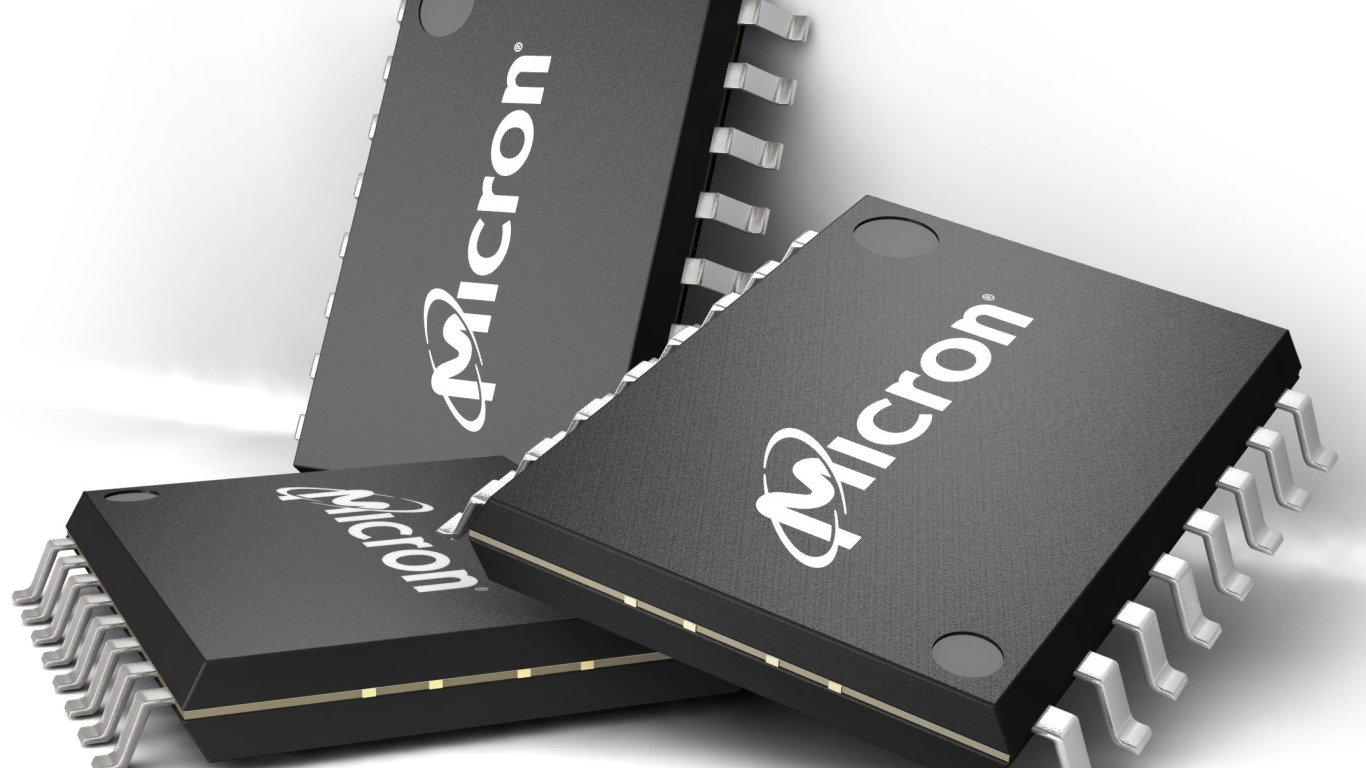
Bank of America Says the AI Memory Boom Isn’t Over: Why It Sees Micron’s Earnings Exploding 34% a Year
Micron's margins just hit levels the memory industry has never sustained, and Bank of America is betting they stay there long enough to turn today's skeptics into believers. Here is why that forecast is thrilling, dangerous, and worth taking seriously.

The semiconductor market has spent decades teaching investors the same lesson: memory booms eventually become memory busts. Supply catches up with demand, pricing falls, margins collapse, and yesterday’s earnings suddenly look like a mirage.
That history explains why investors continue to treat Micron Technology (NASDAQ:MU | MU Price Prediction) as a cyclical stock, even after AI has pushed its results into territory the company has never seen before. Micron generated $41.46 billion of revenue and an 85% gross margin in fiscal Q3 2026, versus 38% a year earlier.
Now Bank of America is asking investors to consider whether AI has broken that cycle.
BofA Sees a $236 EPS Micron
BofA Global Research sketches out a dramatically different future for Micron. Under its “SanDisk-like” assumptions, sales reach $377.3 billion by fiscal 2030, versus $280.5 billion in the consensus case.
| Fiscal 2030 | Consensus | BofA’s SNDK-like Case |
| Sales | $280.5 billion | $377.3 billion |
| Gross margin | 78.0% | 80.0% |
| EPS | $136.24 | $236.16 |
| FCF | $190.8B | $188.6B |
That implies a 30.7% sales CAGR and a 34.1% EPS CAGR through fiscal 2030. Yet the market values Micron at roughly 6x forward earnings on the consensus fiscal 2027 EPS estimate of $151.37 — pricing in an end to the memory party well before Micron gets comfortable. BofA thinks that’s backward.
The AI Memory Cycle Really Is Different This Time
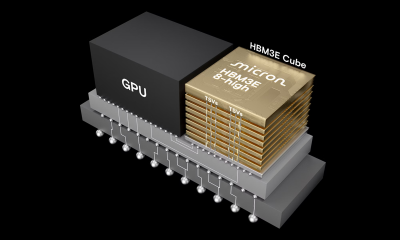
There’s a good reason to take the bullish case seriously. Micron’s fiscal Q3 DRAM revenue jumped 343% year over year to $31.3 billion, while NAND rose 361% to $9.9 billion. Consolidated gross margin hit 84.9%, with fiscal Q4 guidance around 86%.
High-bandwidth memory is central to this shift. Micron says HBM requires more than three times the wafer capacity per bit of conventional DRAM, and supply remains allocated — hyperscalers want more, but manufacturers can’t flood the market overnight. HBM4 is already shipping in volume, with HBM4E production expected in 2027.
Other tailwinds: enterprise SSDs are taking a growing share of NAND as AI data centers generate more data, and next-gen AI inference could demand entirely new memory types. Earlier this month, SK hynix (NASDAQ:SKHY) and Sandisk (NASDAQ:SNDK) unveiled the first High Bandwidth Flash specs — a category designed to sit between HBM and SSDs, offering up to 512GB and 3TB/s of bandwidth. That needn’t hurt Micron, but it shows how fast memory architecture is evolving, and why today’s winners shouldn’t be assumed to own every new category.
The EPS Forecast Could Be Aggressive
The bullish AI thesis is compelling; the bullish Micron forecast requires a leap. An 80% gross margin isn’t crazy today, but looks crazy as a structural assumption through 2030. Memory has historically been among the most cyclical semiconductor businesses, with normal-cycle margins often around 30% to 40%. Micron’s current 85% reflects an unusually tight market. The real question is what happens once competitors add capacity.
SK hynix remains formidable, while Samsung and potentially Chinese suppliers are also ramping up. If competition keeps pricing disciplined instead of letting Micron hold 80% margins indefinitely, earnings could land closer to consensus — which is why BofA’s $236.16 estimate deserves skepticism even if the broader thesis holds. Investors don’t need BofA’s most aggressive assumptions to find the story compelling: Micron is already producing record revenue, 85% margins, and $25.39 billion in quarterly operating cash flow.
Key Takeaway
BofA seems right about the direction but too aggressive about the destination. AI is changing memory economics by pulling demand toward HBM, advanced DRAM, enterprise SSDs, and potentially HBF, and long lead times could make supply responses slower than in past cycles. But $236 of EPS in 2030 requires Micron to become structurally different from the cyclical company investors have known for decades.
Still, the case doesn’t require believing an 80% margin lasts forever. At roughly 6x forward earnings, the market seems to be pricing in a return to much weaker economics — so it may be underestimating how long this boom lasts. I’d treat BofA’s analysis as the bull case, not the base case.
Contact [email protected] for any questions or corrections.
After two decades of patrolling the dark corners of suburbia as a police officer, Rich Duprey hung up his badge and gun to begin writing full time about stocks and investing. For the past 20 years, he’s been cruising the markets looking for companies to lock up as long-term holdings in a portfolio while writing extensively on the broad sectors of consumer goods, technology, and industrials. Because his experience isn’t from the typical financial analyst track, Rich is able to break down complex topics into understandable and useful action points for the average investor. His writings have appeared on The Motley Fool, InvestorPlace, Yahoo! Finance, Money Morning, and, of course, 24/7 Wall St. He has been featured in both U.S. and international publications, including MarketWatch, Financial Times, Forbes, Fast Company, and USA Today.

![The Micron Technology logo in blue is centered on a dark green background with lighter green grid lines and glowing green line and bar charts. A black box at the bottom displays white text: '129.49 +3.22 [2.55%]'. A '24/7 WALL ST' logo is in the top right corner.](https://247wallst.com/wp-content/uploads/2024/05/Postive-1-200x113.jpg)