




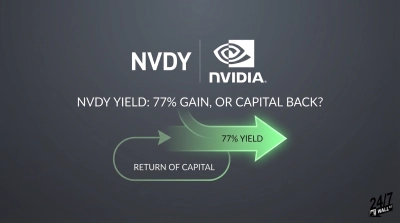
YieldMax NVDA Option Income Strategy ETF (NYSEARCA:NVDY) sells NVIDIA’s upside each month and returns the premium to shareholders as income. That trade has produced a headline distribution yield north of 50% and capped how much of NVIDIA’s gains shareholders keep. The biggest risk is that the strategy works exactly as designed at the worst moment in NVIDIA’s growth cycle.
What NVDY Is Actually Selling
NVDY holds 20.6% of net assets in U.S. Treasury securities as collateral, 11.5% in NVIDIA stock directly, and long and short call options on NVIDIA (NASDAQ:NVDA | NVDA Price Prediction) that build a synthetic long position. Against that exposure, the fund writes short-dated calls at strikes near the current NVDA price.
When NVIDIA moves sideways or grinds higher slowly, the short calls expire worthless or nearly so, NVDY pockets the premium, and shareholders collect weekly distributions. When NVIDIA rips, the short calls go deep in the money, the fund’s NAV gain caps at the strike, and upside above that strike goes to the call buyer. NVDY shareholders get a fraction of the headline NVDA move.
The Math of a Capped Position
Over the trailing year, NVIDIA returned 62%, climbing from $133 to $215. NVDY’s adjusted total return, including every weekly distribution reinvested, came in at 56%. In months where NVDA gained more than 10%, NVDY historically captured less than half that move, per YieldMax’s own performance pattern.
The structural cost shows up in the share price. NVDY trades around $14, well below its 2023 launch range, even after a year of double-digit total returns. Recent weekly payments ran from $0.0848 to $0.2072, versus monthly payments in 2024 that hit as high as $2.5630 per share. The yield is real, but the base shrinks when the cap bites.
Why This Cap Is Especially Costly Right Now
NVIDIA’s Q1 FY2027 report on May 20, 2026 showed revenue of $81.6 billion, up 85% year over year, with Data Center revenue at $75.2 billion and Q2 guidance of $91.0 billion. Revenue growth accelerated for four consecutive quarters, from 55.6% to 85.2%. CEO Jensen Huang called the AI buildout “the largest infrastructure expansion in human history”.
That fundamental backdrop tends to produce sharp, news-driven up moves, exactly the months where short calls do the most damage. An NVDY holder bought for income is unintentionally short the thesis that drew them to NVIDIA.
Tax Treatment Investors Often Miss
NVDY’s recent distributions are classified as 100% income, 0% return of capital. A holder in the 24% federal bracket hands back roughly a quarter of every distribution to taxes, while a direct NVDA holder would pay long-term capital gains rates on appreciation held over a year. Hold NVDY in an IRA and that asymmetry disappears. Hold it in a brokerage account and it is part of the real cost.
The Lower-Risk Alternative
JPMorgan Equity Premium Income ETF (NYSEARCA:JEPQ) holds NVIDIA at 7.9% of net assets alongside Apple, Alphabet, Microsoft and Amazon, and runs a covered-call overlay on NASDAQ-100 exposure at a 0.35% expense ratio versus NVDY’s 1.09%. The yield is lower, but so is the upside cap and concentration risk.
What to Watch
- NVDA implied volatility. When IV compresses below the mid-20s, premium income falls and distributions shrink mechanically.
- NVDY distribution amount versus the prior week. Declining weekly payouts signal the strategy is being squeezed by low volatility or assignment losses.
- The trailing 12-month total return gap between NVDY and NVDA. When the spread widens past 20 percentage points in NVDA’s favor, the opportunity cost becomes material.
The Verdict
NVDY is doing what it was built to do. The risk is misalignment with the investor. Anyone holding NVDY as a substitute for NVIDIA in a long-term AI thesis is paying for income they may not need by giving up the appreciation they wanted. Anyone holding NVDY as a yield sleeve inside a tax-advantaged account, sized appropriately, is using the tool as designed. The decision turns on which one the holder actually is.












 Top Gaining Stocks
 Top Losing Stocks