Pfizer vs Merck: Chasing High Yield vs Higher Returns
Pfizer (NYSE:PFE | PFE Price Prediction) and Merck (NYSE:MRK) both just closed earnings chapters that frame the 2026 dividend debate clearly. Pfizer wrapped fiscal 2025 with a $0.66 adjusted EPS Q4 beat. Merck followed with a Q1 2026 report dominated…

Pfizer (NYSE:PFE | PFE Price Prediction) and Merck (NYSE:MRK) both just closed earnings chapters that frame the 2026 dividend debate clearly. Pfizer wrapped fiscal 2025 with a $0.66 adjusted EPS Q4 beat. Merck followed with a Q1 2026 report dominated by a $9 billion Cidara acquisition charge. Two very different income stories for yield hunters.
One Pays You to Wait. One Pays You to Believe.
Pfizer is now a 6.58% yielder, distributing $9.8 billion in 2025 dividends at $1.72 per share. That payout sits on a $3.22 adjusted EPS base, so coverage looks comfortable even with COVID revenue fading. Non-COVID growth told the real story: Abrysvo jumped 136%, Eliquis added 10%, and oncology biosimilars surged 77%.

Merck pays a smaller yield of 2.74% on a $3.28 annual dividend, but the underlying business is growing faster. KEYTRUDA delivered $8.03 billion in Q1 2026, up 12%, while WINREVAIR rocketed 88% to $525 million. Animal Health added a steady 13%. The recent quarterly dividend bump from $0.81 to $0.85 signals confidence.

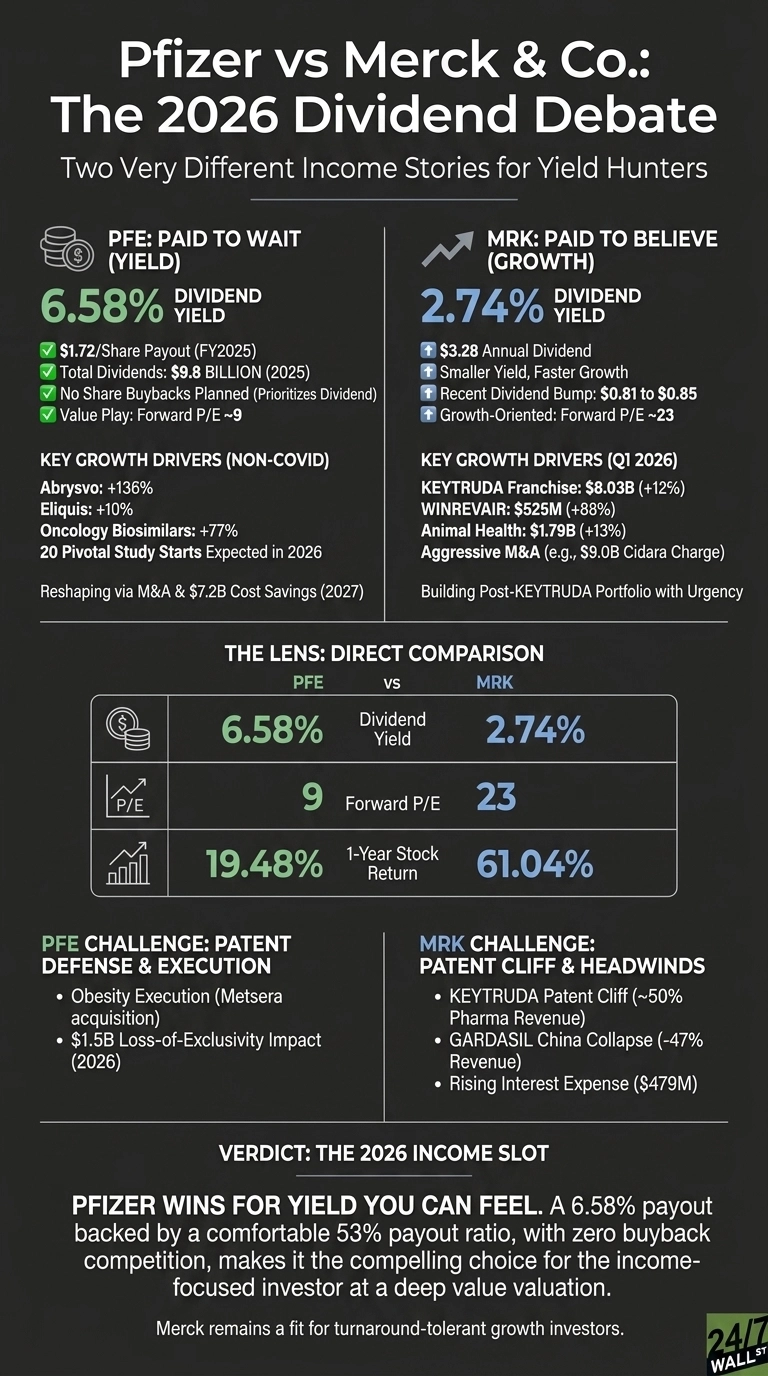
| Lens | Pfizer | Merck |
| Dividend Yield | 6.58% | 2.74% |
| Forward P/E | 9 | 23 |
| 1-Year Stock Return | 19.48% | 61.04% |
Yield Hunter vs. Pipeline Believer
Pfizer is reshaping itself through M&A. CEO Albert Bourla told investors “2026 will be an important year rich in key catalysts, including our expectation for approximately 20 key pivotal study starts”.
The $7 billion Metsera buy pushes Pfizer into obesity, and management is chasing $7.2 billion in net cost savings by 2027. Buybacks remain off the table, which I read as a clean signal that the dividend is the priority.
Merck is building a post-KEYTRUDA portfolio with urgency. The Cidara deal closed, Terns is pending at roughly $5.8 billion, and Verona Pharma already contributed $131 million in Q1. The risk: GARDASIL revenue in China fell 47%, and interest expense climbed to $479 million. Faster growth, heavier balance-sheet lifting.
The Next Test Is Patent Defense
For Pfizer, I will be watching whether Metsera’s ultra-long-acting GLP-1 candidates can credibly compete with Novo and Lilly. The $1.5 billion loss-of-exclusivity headwind in 2026 is manageable, but obesity execution is the swing factor.
For Merck, the KEYTRUDA biosimilar clock is the dominant concern, given it represents roughly 50% of pharma revenue. WINREVAIR and the animal health franchise need to keep compounding.
Why I Lean Toward Pfizer for the 2026 Income Slot
If you want yield you can actually feel, Pfizer wins this matchup. A 6.58% payout backed by a 53% payout ratio and zero buyback competition for cash is hard to ignore at a forward P/E of 9.
Merck is the better operating business and its 61.04% one-year gain proves it, but you are paying 23 times forward earnings for a 2.74% yield. For a turnaround-tolerant growth investor, Merck still fits. For my dividend bucket in 2026, Pfizer’s combination of value and income reads more compelling.
Contact [email protected] for any questions or corrections.
Vandita Jadeja is a financial copywriter who loves to read and write about stocks. She believes in buying and holding for long term gains. Her knowledge of words and numbers helps her write clear stock analysis. She has contributed to several publications, including the Joy Wallet, Benzinga, The Motley Fool and InvestorPlace.