After Q2 Earnings, Is Pfizer or Merck the Smarter Dividend Play?
Pfizer carries one of Big Pharma's fattest yields while Merck burns cash on deals to secure its next growth era. Which trade-off actually serves income investors better after both companies reported earnings?


Pfizer (NYSE:PFE | PFE Price Prediction) and Merck (NYSE:MRK) refreshed the dividend debate with their latest quarterly reports.
Pfizer defends one of Big Pharma’s fattest yields while its COVID franchise fades. Merck absorbs multi-billion dollar deal charges to reload a pipeline behind Keytruda. Two payouts, two very different risk profiles for income investors.
COVID Runoff Drags Pfizer While Keytruda Keeps Merck Humming
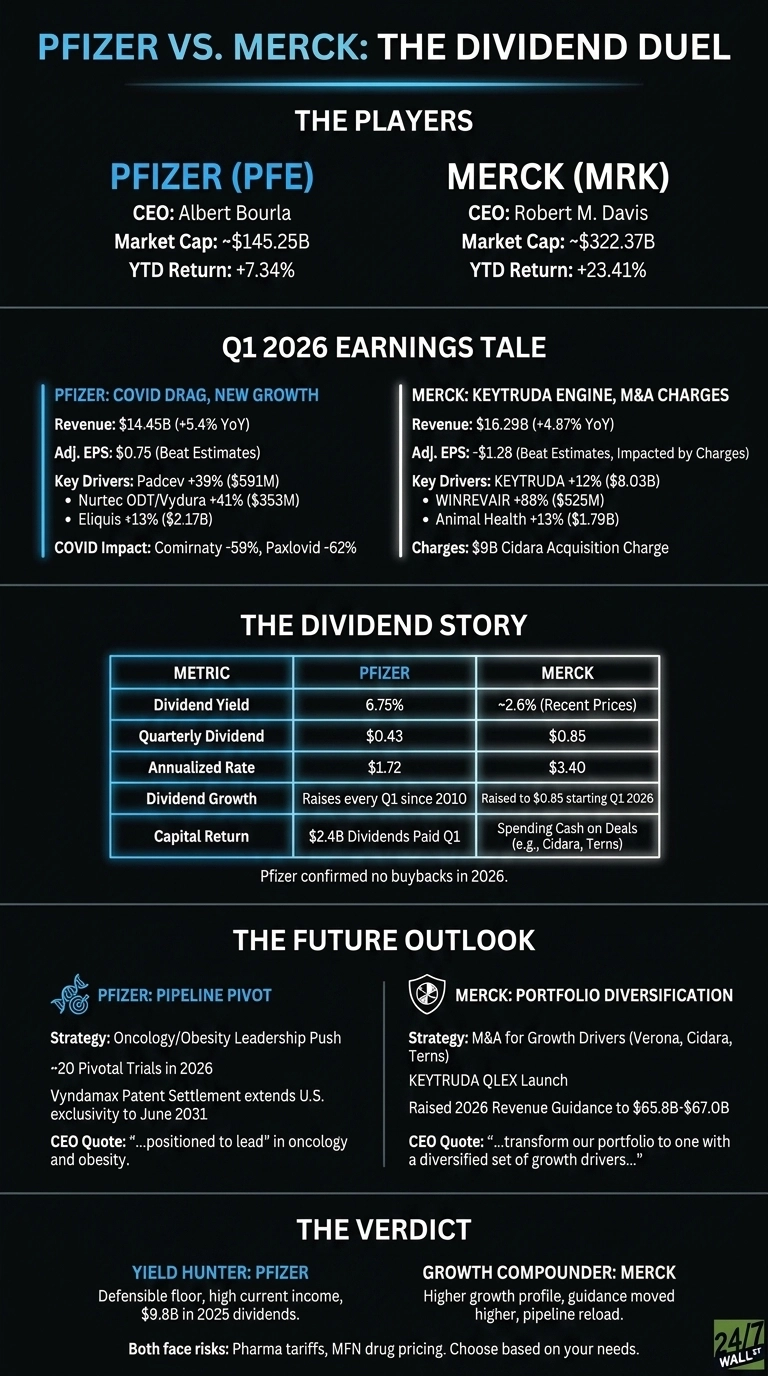
Pfizer’s most recent quarter showed the post-pandemic pivot in motion. Revenue reached $14.45B, ahead of the $13.80B estimate, with launched or acquired products growing 22% operationally.
Padcev jumped 39% to $591M on urothelial cancer share gains, Nurtec ODT climbed 41% to $353M, and Eliquis added 13% to reach $2.17B. Comirnaty fell 59% and Paxlovid dropped 62%. Adjusted EPS of $0.75 marked a fifth straight beat, though net income slid 9.44%.
Merck’s story tilts toward scale. Revenue landed at $16.29B, topping the $15.85B consensus. Keytruda produced $8.03B, up 12%, and the subcutaneous version Keytruda QLEX added $128M out of the gate. Winrevair surged 88% to $525M. Reported EPS of -$1.28 was dragged by a $9B Cidara acquisition charge, alongside a Gardasil slide of 19% after China’s catch-up program ended.
Yield Hunter vs. Growth Compounder
The dividend math tells the real story. Pfizer pays $0.43 quarterly ($1.72 annualized) against a 6.75% yield, with raises every Q1 since 2010. Merck lifted its quarterly dividend from $0.81 to $0.85 starting Q1 2026, with a forward annualized rate of $3.40, roughly 2.6% at recent prices.
| Lens | Pfizer | Merck |
| Dividend Yield | 6.75% | 2.6% |
| Core Growth Engine | Oncology and migraine launches | Keytruda plus Winrevair |
| Biggest Overhang | COVID runoff, Eliquis LOE | Keytruda patent cliff late decade |
| 2026 EPS Guidance | $2.80 to $3.00 | $5.04 to $5.16 |
| YTD Stock Return | 7.34% | 23.41% |
Pfizer paid out $2.4B in dividends in the March quarter and confirmed no buybacks in 2026.
Merck is spending cash on deals: Verona Pharma, Cidara, and a pending Terns transaction adding $2.35 per share in charges. CEO Robert Davis told investors the goal is “a diversified set of growth drivers across a broad set of therapeutic areas.” That signals a portfolio pivot ahead of any payout expansion.
The Next Test Is Pipeline Delivery
Pfizer runs roughly 20 pivotal trials in 2026, including 10 from the Metsera obesity purchase. Albert Bourla flagged “oncology and obesity, two areas where I believe Pfizer is positioned to lead.”
The Vyndamax patent settlement extending U.S. exclusivity to June 2031 removes a real overhang for dividend coverage. Watch whether obesity Phase 3 readouts show differentiation against GLP-1 incumbents.

Merck’s watchlist differs. Keytruda QLEX adoption, Winrevair’s PAH ramp, and the Terns closing shape whether the raised $65.8B to $67B revenue band holds. Interest expense climbed from $313M to $479M, so leverage carries a real cost.

Why I’d Split the Vote Based on What You Need
On current income and a defensible floor, Pfizer stands out. A 6.75% yield backed by $9.8B in 2025 dividend payments and Vyndamax exclusivity is a real cash story, even if the stock recovered only 7.34% year to date.
Growth investors will find Merck more interesting. Shares are up 65.67% over the past year, guidance moved higher, and the pipeline reload buys optionality before the Keytruda cliff. The main downside risk for both names is pharma tariffs or MFN drug pricing landing harder than expected. That risk is real, and neither yield is truly bulletproof.
Contact [email protected] for any questions or corrections.
Vandita Jadeja is a financial publisher with over a decade of experience writing about financial topics, including investment, savings, retirement, insurance and banking. Vandita is a Chartered Accountant who loves to debunk financial concepts for readers.
Her work has appeared on sites that include The Motley Fool, InvestorPlace, and Benzinga. She covers investing and focuses on stock picks and price prediction for 24/7 Wall St.
When not looking for the next stock investment opportunity, she can be found traveling, reading, chasing sunsets and enjoying her iced latte.