Pfizer Stock: Wall Street Sees a Rebound, Here’s Our Price Target
Pfizer shares sit near a 52-week high after years of post-pandemic punishment, and now Wall Street analysts are quietly shifting their tone. Here is what the pipeline, the dividend, and the valuation math actually say about where PFE goes from…


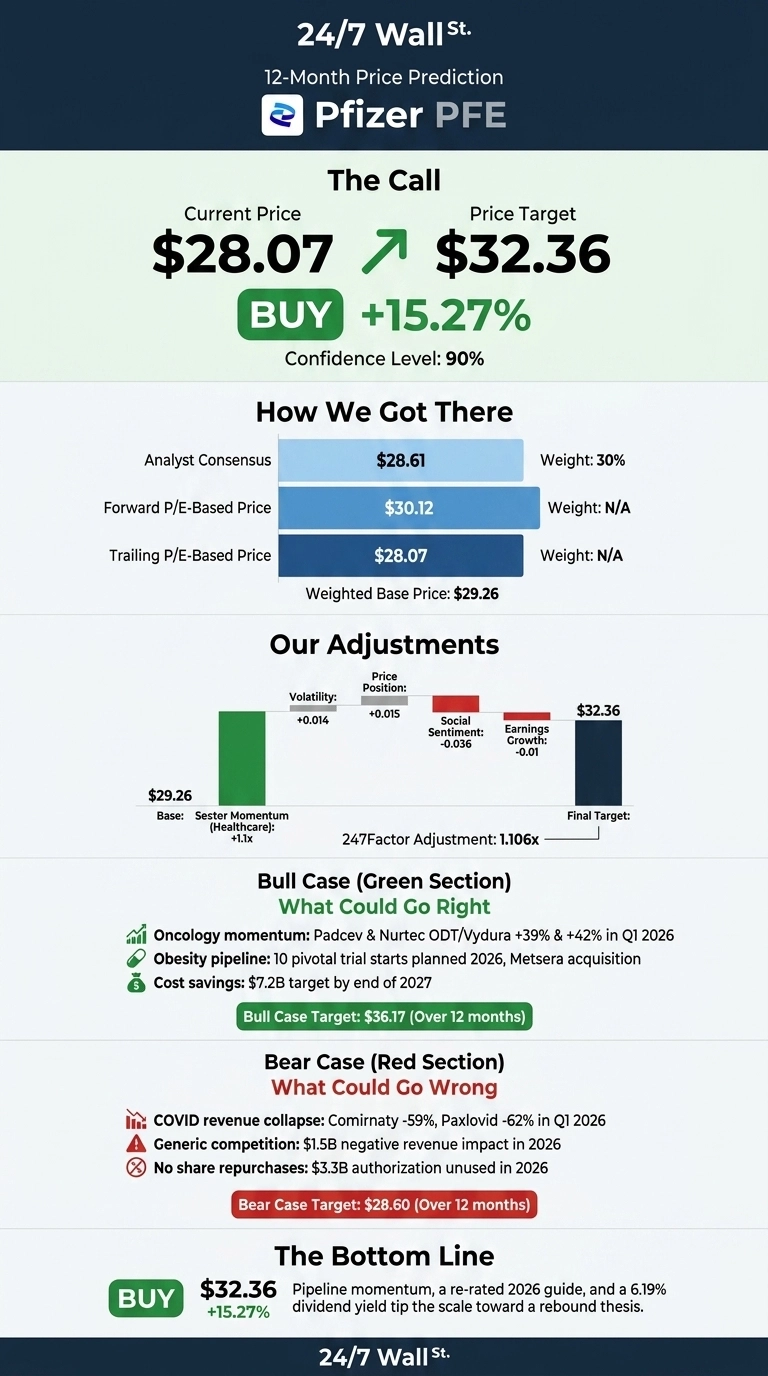
Our 24/7 Wall St. price target for Pfizer (NYSE:PFE | PFE Price Prediction) points to $32.36 over the next 12 months, implying 15.27% upside from the recent close of $28.07. Our recommendation is buy, with high model confidence of 90%. Pipeline momentum, a re-rated 2026 guide, and a 6.19% dividend yield tip the scale toward a rebound thesis.
| Metric | Value |
|---|---|
| Current Price | $28.07 |
| 24/7 Wall St. Price Target | $32.36 |
| Upside | 15.27% |
| Recommendation | BUY |
| Confidence Level | 90% |

A Quiet Rebound Is Already Underway
Pfizer has quietly become one of healthcare’s better price stories in 2026. Shares are up 18.58% year to date and 15.08% over the past month, closing at $28.07, essentially at the 52-week high of $28.44.
Q2 2026, reported August 4, delivered $15 billion in revenue, adjusted diluted EPS of 77 cents, and a raised revenue guide of $60.5 to $62.5 billion, even with a $4.3 billion writedown stealing headlines. CEO Albert Bourla noted this was the “ninth time we exceeded consensus expectations for revenues in the last ten quarters.”
Why Bulls See a Breakout Ahead
The bull case rests on execution. Launched and acquired products grew 22% operationally in Q1 2026, with Padcev up 39% and Nurtec ODT/Vydura up 42%. Pfizer expects 19 pivotal study starts over the next 12 months across oncology, obesity, and immunology.
Management is guiding to a high single-digit revenue CAGR from year end 2028 through 2033. If the obesity pipeline hits, our bull-case model reaches $36.17 within a year, and $52.18 over five.

Risks Worth Watching Now
The bear case starts with COVID: Comirnaty fell 59% and Paxlovid 62% in Q1 2026. Generic and biosimilar competition will drag roughly $1.5 billion off 2026 revenue, and no buybacks are planned despite a $3.3 billion authorization.
Q1 operating income fell 31.44% year over year, though bulls would argue that reflects heavy R&D reinvestment ($5.5 billion deployed in the first half of 2026) that funds the post-2028 growth ramp. Our bear-case path bottoms near $28.60.

How Pfizer Compares to Merck and Bristol Myers Squibb
Merck (NYSE:MRK) is the closest big-pharma peer on oncology and vaccines, anchored by KEYTRUDA, which posted $8.03 billion in Q1 2026 sales, up 12%. Merck guides 2026 non-GAAP EPS of $5.04 to $5.16 (absorbing a Cidara charge). Ex-charge, Merck trades near 18x forward earnings versus Pfizer at 10x. That valuation gap is the entire reason Pfizer looks like the rebound trade.
Bristol Myers Squibb (NYSE:BMY) shares Pfizer’s patent-cliff narrative and co-markets Eliquis. BMS guides 2026 non-GAAP EPS of $6.05 to $6.35, putting it near 11x forward earnings. Bristol Myers is priced for a similar rebound story to Pfizer, which supports the view that our 24/7 Wall St. price target is reasonable.
Pfizer Price Prediction 2026-2030
Our 24/7 Wall St. price target of $32.36 and buy rating carry 90% confidence. The single factor that tips the scale is the combination of a 6.19% dividend yield with a genuine pipeline reacceleration.
The bullish setup strengthens if oncology and obesity readouts continue to land and COVID declines stabilize near management’s $4 billion guide. The thesis weakens if Paxlovid disappoints again or the Metsera obesity data underwhelm in 2027.
| Year | 24/7 Wall St. Price Target |
|---|---|
| 2026 | $32 |
| 2027 | $35 |
| 2028 | $38 |
| 2029 | $41 |
| 2030 | $45 |
These projections extend our base-case CAGR of 9.7% and assume Pfizer executes on its 2028+ growth reacceleration. Significant upside or downside could come from obesity approvals, Vyndamax post-2031 competition, or Section 232 pharmaceutical tariffs.
Contact [email protected] for any questions or corrections.
Vandita Jadeja is a financial publisher with over a decade of experience writing about financial topics, including investment, savings, retirement, insurance and banking. Vandita is a Chartered Accountant who loves to debunk financial concepts for readers.
Her work has appeared on sites that include The Motley Fool, InvestorPlace, and Benzinga. She covers investing and focuses on stock picks and price prediction for 24/7 Wall St.
When not looking for the next stock investment opportunity, she can be found traveling, reading, chasing sunsets and enjoying her iced latte.