Three International Dividend ETFs Are Outyielding SCHD by Almost 2 Full Points in 2026
Schwab U.S. Dividend Equity ETF (NYSEARCA:SCHD) has become the default income holding for U.S. investors, with $71.6 billion in assets and a trailing yield near 3.5%. In 2026, three international dividend ETFs are paying meaningfully more: iShares International Select Dividend…

This post may contain links from our sponsors and affiliates, and Flywheel Publishing may receive compensation for actions taken through them.

Schwab U.S. Dividend Equity ETF (NYSEARCA:SCHD) has become the default income holding for U.S. investors, with $71.6 billion in assets and a trailing yield near 3.5%. In 2026, three international dividend ETFs are paying meaningfully more: iShares International Select Dividend ETF (NYSEARCA:IDV), Schwab International Dividend Equity ETF (NYSEARCA:SCHY), and Franklin International Low Volatility High Dividend Index ETF (NYSEARCA:LVHI).
Each yields roughly 2 percentage points more than SCHD, though each gets there differently. A softer dollar, an ECB still in easing mode, and a Bank of Japan slowly tightening have pushed payout ratios and headline yields on European, UK, and Asia-Pacific dividend payers above most U.S. large-cap baskets. The 10-year Treasury near 4.5% sets the bar for what an income stream has to clear to be interesting.
Why International Yield Looks Different in 2026
SCHD’s payout pattern has shifted over the last two years. Quarterly distributions ranged from $0.61 to $0.82 per share in 2023 and 2024, then reset to $0.25 to $0.28 per share in 2025 and the first quarter of 2026. That reset, combined with strong price appreciation, has compressed the trailing yield. SCHD’s top holdings include Qualcomm, Texas Instruments, UnitedHealth Group, and Coca-Cola, all with holding percentages over 3.95%, names whose dividend growth has slowed even as share prices climbed.
International payers face the opposite setup, as European banks and energy majors are distributing aggressively after the 2022 to 2024 earnings cycle; Japanese trading houses have adopted shareholder return policies that lift cash payouts; and Australian miners continue to pass through commodity cash flow as variable dividends. The result is a wider headline yield gap than U.S. investors have seen in years.
IDV: The Highest Yielder With the Most Concentrated Bet
IDV captures that yield gap most directly. The fund tracks the Dow Jones EPAC Select Dividend Index, screening developed-market non-U.S. stocks for high indicated yields and holding roughly 100 names. The portfolio leans heavily into the United Kingdom, Australia, and continental Europe, with sector concentration in consumer goods, financials, and utilities. The headline yield sits around 4.40%, the highest of the three funds.
That yield comes with variable quarterly distributions. IDV paid $0.787115 in June 2025 and $0.591921 in December 2025, while the most recent payment in March 2026 was just $0.200945. The lumpy pattern reflects how European companies pay: large annual or semiannual distributions rather than a smooth quarterly cadence. Total return has been strong, with shares up about 14% year to date and roughly 39% over the past year.
The tradeoff for that yield is concentration risk. A yield-weighted index pulls heavily toward whichever sectors are paying most generously, which in this cycle means UK financials, energy, and miners. Investors get the highest income, but the underlying basket is cyclical, and dividends are not smoothed.
SCHY: Quality Screening at a Lower Price
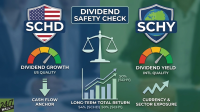
SCHY is the closest international analog to SCHD’s methodology. The fund screens for dividend sustainability and quality rather than raw yield, resulting in lower turnover and a portfolio tilted toward companies with stable cash flows and reasonable payout ratios. The trailing yield runs near 3.4%, a step below IDV but well above SCHD.
Distribution data confirms the more measured cadence. SCHY paid $0.3486 in June 2025, $0.2495 in September 2025, $0.3199 in December 2025, and $0.1818 in March 2026. The amounts still vary, but swings are narrower than IDV’s. Year-to-date price appreciation has been about 9%, with a one-year gain near 24%.
The quality screen will leave out some of the highest-yielding names that IDV captures. In a year when UK banks and European energy producers continue to raise payouts, SCHY will collect less of that windfall. The fund suits investors who want less-volatile income and are willing to accept a lower headline yield.
LVHI: The Currency-Hedged, Low-Volatility Option
LVHI is the overlooked pick and the only one of the three that actively hedges currency exposure. The fund applies a low-volatility screen to a high-dividend universe, then layers in currency derivatives to neutralize most of the FX swing. The trailing yield is around 4.4%, and net assets stand at $4.90 billion in the most recent NPORT filing.
The portfolio’s largest positions span European energy, healthcare, consumer staples, and financials, as well as Japanese trading houses, including Shell, Novartis, Nestle, and Mitsubishi Corp., near the top of the book. The geographic spread is broader than IDV’s, with meaningful Japanese exposure through trading houses and Singapore REITs alongside European weights.
The currency hedge is the structural differentiator. An unhedged international ETF can have its dividend income partially erased by adverse currency moves when distributions are converted back to dollars. LVHI removes most of that variable, which matters more in periods of dollar strength. The tradeoff: the hedge has a cost, and in a year where the dollar weakens, an unhedged fund like IDV will outperform on price even if both collect similar dividends. LVHI is up about 11% year-to-date.
Choosing Between the Three
The three funds map to different investor profiles. IDV suits the income seeker who wants the highest yield and can tolerate lumpy quarterly distributions, concentration in UK and European cyclicals, and full currency exposure. SCHY fits the investor who treats international as a long-term core allocation and prefers the quality screen and lower turnover, accepting a smaller yield premium for a smoother ride. LVHI suits the investor who wants international yield without currency math, particularly anyone worried that a dollar reversal would claw back the income advantage.
SCHD remains the simpler domestic option, with a 0.06% expense ratio and no foreign withholding tax. International funds incur higher costs and more complex tax treatment, including foreign tax withholding on dividends and varying qualified dividend status. That friction is the price of the extra two points of yield, and whether it is worth paying depends on the account type and the investor’s current income needs relative to total return.
Contact [email protected] for any questions or corrections.
David Beren has been a Flywheel Publishing contributor since 2022. Writing for 24/7 Wall St. since 2023, David loves to write about topics of all shapes and sizes. As a technology expert, David focuses heavily on consumer electronics brands, automobiles, and general technology. He has previously written for LifeWire, formerly About.com. As a part-time freelance writer, David’s “day job” has been working on and leading social media for multiple Fortune 100 brands. David loves the flexibility of this field and its ability to reach customers exactly where they like to spend their time. Additionally, David previously published his own blog, TmoNews.com, which reached 3 million readers in its first year. In addition to freelance and social media work, David loves to spend time with his family and children and relive the glory days of video game consoles by playing any retro game console he can get his hands on.