Schwab’s Global Dividend Play Delivers Cash Flow Without the Mega-Cap Concentration
Schwab International Dividend Equity ETF (NYSEARCA:SCHY) trades around $32 and pays a 30-day SEC yield of roughly 3.9%, giving income investors access to cash dividends from large, established companies in Europe, the UK, Australia and Canada. SCHY is the international…

This post may contain links from our sponsors and affiliates, and Flywheel Publishing may receive compensation for actions taken through them.

Schwab International Dividend Equity ETF (NYSEARCA:SCHY) trades around $32 and pays a 30-day SEC yield of roughly 3.9%, giving income investors access to cash dividends from large, established companies in Europe, the UK, Australia and Canada. SCHY is the international cousin of Schwab’s flagship US dividend ETF, and holders rely on it for quarterly distributions funded by real corporate cash flow rather than options premium or leverage. The question is whether that income stream is durable, or whether currency swings, tariff shocks and concentrated payout dependence make SCHY’s distribution wobblier than it appears.
Where the cash comes from
SCHY tracks the Dow Jones International Dividend 100 Index, which screens roughly 100 ex-US developed-market stocks for cash-flow-to-debt strength, return on equity, dividend yield and a minimum 10-year dividend payment history. The ETF collects dividends those companies pay, nets out an expense ratio of 0.08%, and passes the rest to shareholders quarterly. Income source is straightforward: cash dividends from real businesses, converted back into US dollars before distribution.
The yield you receive depends on two moving parts. First, whether underlying companies keep paying. Second, the dollar. When the greenback strengthens, euro and pound dividends translate into fewer dollars even if the foreign payout never changes. Over the last twelve months SCHY paid roughly $1.10 per share across four distributions, a trailing yield near 3.4%.
The holdings driving income
The top ten positions account for about 42% of assets, so a handful of names drive most income. The largest weights are BHP Group at 4.5%, Eni at 4.5%, TotalEnergies at 4.5%, Deutsche Post at 4.3%, Wesfarmers at 4.3%, Allianz at 4.2%, British American Tobacco at 4.1%, Enel at 4.0%, Vinci at 3.7% and Roche at 3.7%.
This is a defensible income roster. Allianz, Roche, Vinci and BAT all carry long dividend streaks backed by free cash flow that comfortably covers the payout. Roche has raised its dividend for more than three decades. BAT’s yield looks high because tobacco volumes shrink annually, but cash conversion remains strong enough to fund the dividend while reinvesting in heated-tobacco and nicotine pouch products.
Energy and miner positions are the soft spots. BHP, Eni and TotalEnergies pay generous distributions when commodity prices cooperate and trim them quickly when they don’t. BHP has shifted to a variable payout policy explicitly tied to earnings, meaning SCHY holders should expect those checks to flex with iron ore and oil cycles rather than grow steadily. Enel, the Italian utility, carries meaningful leverage tied to grid build-out, so a sustained jump in European rates would tighten coverage before threatening the payout.
Total return perspective
Income is only half the equation. SCHY is up 23% over the past year and 9% year to date, helped by the weaker dollar that 2026 outlook reports flagged as a tailwind for foreign assets. Over five years the ETF is up 48%.
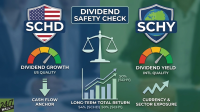
That trails the US sibling. The Schwab US Dividend Equity ETF (NYSEARCA:SCHD) is up 20% year to date, 29% over one year, and 51% over five years, so the international version has delivered similar long-run total return with more currency drag and a higher cash yield upfront. For investors wanting pure dividend growth in dollars, SCHD remains the cleaner vehicle. SCHY earns its place as diversification away from US concentration risk and the AI-heavy mega caps dominating domestic indexes.
Is the distribution safe?
The base dividend looks secure. The screen demands cash-flow coverage and a decade of payment history, top holdings throw off enough free cash to fund payouts, and the 0.08% fee leaves almost all income with shareholders. The variable piece is the exact dollar amount of each quarterly check. Tariff escalation, a stronger dollar, or a commodity downcycle forcing BHP, Eni or TotalEnergies to trim could pull the headline distribution down 10% to 15% in a given year without anything fundamental breaking. SCHY suits income investors wanting international diversification and accepting that variability. Those needing a predictable, growing dollar check each quarter will sleep better with the domestic sibling.
Contact [email protected] for any questions or corrections.
After 15 years on Wall Street with 7 of them as Director of Corporate and Municipal Bond Trading for a NYSE member firm, I started my own project and corporate finance consultancy. Much of the work involves writing business plans, presentations, white papers and marketing materials for companies seeking budgetary allocations for spinoffs and new initiatives or for raising capital for expansion or startup companies and entrepreneurs. On financial topics, I have been published under my own byline at The Motley Fool, 247wallst.com, DealFlow Events’ Healthcare Services Investment Newsletter and The Microcap Newsletter, among others. Additionally, I have done freelance ghostwriting writing and editing for several financial websites, such as Seeking Alpha and Shmoop Financial. I have also written and been published on a variety of other topics from music, audiophile sound and film to musical instrument history, martial arts, and current events. Publications include Copper Magazine, Fidelity (Germany), Blasting News, Inside Kung-Fu, and other periodicals.