Netflix vs. Disney: Which Streaming Stock Is the Better Long-Term Hold?
For a retirement-focused investor choosing between Netflix (NASDAQ:NFLX | NFLX Price Prediction) and The Walt Disney Company (NYSE:DIS), which streaming giant deserves a slot in the portfolio right now? Both have transformed since the streaming wars began, but they offer…

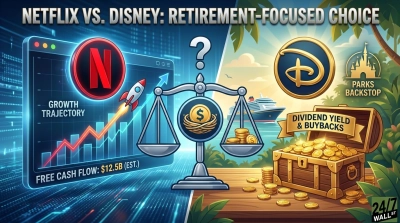
For a retirement-focused investor choosing between Netflix (NASDAQ:NFLX | NFLX Price Prediction) and The Walt Disney Company (NYSE:DIS), which streaming giant deserves a slot in the portfolio right now? Both have transformed since the streaming wars began, but they offer fundamentally different risk and reward profiles. Netflix is the lean, scaled growth machine. Disney is the diversified cash-return story with a parks backstop. Three dimensions decide it.
Dimension 1: On Income and Capital Return, Disney Wins
This one isn’t close for retirees. Disney pays a $1.50 annual dividend in fiscal 2026, structured as two $0.75 semi-annual installments, with the next ex-dividend date on June 30, 2026 and payment on July 22, 2026. The yield sits at roughly 1%, and management raised the FY26 buyback target to at least $8 billion, having already executed $5.5 billion in the first half.
Netflix pays nothing. Capital return is buybacks only, with $6.8 billion remaining authorization after repurchasing 13.5 million shares for $1.3 billion in Q1 2026. Buybacks help total return, but they don’t fund a retiree’s grocery bill. Disney wins.
Dimension 2: On Valuation, Disney Wins
Netflix trades at a trailing P/E of 28 with a forward P/E near 27 and a price-to-sales ratio of 8. That’s a premium any way you cut it. Disney’s trailing P/E sits at 16, with a forward P/E of 14 and a price-to-book ratio of just 2. Analysts target $129.49 on shares trading near $101. Netflix’s analyst target of $114.56 against a current quote of $83.69 is a wider implied upside, but you’re paying nearly double the earnings multiple to get it.
For a retirement portfolio that prizes margin of safety, Disney’s cheaper multiple combined with 10%+ adjusted EPS growth guidance for FY2026 is the better risk-adjusted entry.
Dimension 3: On Growth Trajectory, Netflix Wins
Here Netflix dominates. Q1 2026 revenue hit $12.25 billion, up 16% YoY, and free cash flow nearly doubled to $5.09 billion. Management guides FY2026 revenue to $50.7B to $51.7B, operating margin expanding to 32%, and free cash flow raised to approximately $12.5 billion. The subscriber base sits above 325 million paid members, advertiser count grew 70% YoY to over 4,000 clients, and ad revenue is on track to roughly double toward $3 billion in 2026.
Disney’s Q2 FY2026 revenue grew 7% to $25.17 billion, with net income falling 25%. Streaming did inflect, with SVOD operating margin reaching 11% and operating income up 88% in the segment, but the broader top line is growing at roughly a third of Netflix’s pace. Netflix’s return on equity of 49% versus Disney’s 11% seals it.
The Verdict
Disney wins for the retirement-focused investor. The combination of a reinstated dividend, an 16x trailing P/E, double-digit EPS growth guidance, and the parks and cruise business serving as a non-streaming cash backstop is what a retiree’s equity sleeve should look like. The Experiences segment posted record full-year operating income of $9.99 billion in FY2025, providing diversified cash flow that Netflix structurally cannot match.


Netflix is the superior business by almost every operating metric, but it’s wrong for retirement income. It belongs in growth-tilted accounts with a 10-plus-year horizon, where the 762% ten-year return can compound undisturbed by withdrawal needs. For a retiree drawing income today, Disney is the answer.
Contact [email protected] for any questions or corrections.
Joel South covers large-cap stocks, dividend investing, and major market trends, with a focus on earnings analysis, valuation, and turning complex data into actionable insights for investors.
He brings more than 15 years of experience as an investor and financial journalist, including 12 years at The Motley Fool, where he served as an investment analyst, Bureau Chief, and later led the Fool.com investing news desk. He has also co-hosted an investing podcast and appeared across TV and radio discussing market trends.