An Overlooked Cleantech Fund Just Did in Eighteen Months What the S&P 500 Took Five Years to Accomplish
A $10,000 stake in the ProShares S&P Kensho Cleantech ETF on the first trading day of 2026 has grown roughly 40% year to date, while the same $10,000 in the S&P 500 has grown about 11%. That is the headline.…

This post may contain links from our sponsors and affiliates, and Flywheel Publishing may receive compensation for actions taken through them.
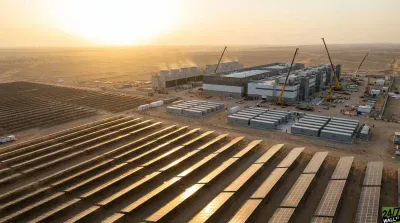
A $10,000 stake in the ProShares S&P Kensho Cleantech ETF on the first trading day of 2026 has grown roughly 40% year to date, while the same $10,000 in the S&P 500 has grown about 11%. That is the headline. ProShares S&P Kensho Cleantech ETF (NYSEARCA:CTEX) is up about 40% year to date through June 3, 2026, while SPDR S&P 500 ETF Trust (NYSEARCA:SPY) is up about 11%. Call it a triple, call it closer to a quadruple. The point is the same. Something happened inside this fund that did not happen inside the broad market, and if you saw the chart on someone’s screen this week you are right to want to know what it is.
The Arithmetic of a Three-Bagger Year
Start with the actual prices. CTEX opened the year at about $35 and closed June 3 at about $49. SPY went from about $682 to about $754. These are total-return adjusted figures on the CTEX side, which is the honest way to score a fund that distributes anything at all.
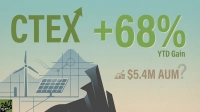
The one-year window tells the more arresting story. CTEX traded at about $19 on June 3, 2025. It is at $49.29 now. That is a 154% gain over twelve months, against SPY’s 27%. News coverage from earlier this year flagged a 68% surge in 2025, which means the fund has now strung together two consecutive years of doing something the index could not do.
The longer lens is the cold shower. Over five years CTEX is up about 25%. SPY is up about 78%. The fund spent most of its life since its September 2021 inception getting beaten by a balanced portfolio of bonds and cash, and the entire five-year return is the last eighteen months. Take those eighteen months away and you are looking at one of the worst-performing thematic ETFs of the post-pandemic era. That context matters because the recent rally reflects a violent re-rating from a depressed base rather than a vindication of cleantech-as-asset-class, and a reader who only sees the YTD figure can be forgiven for thinking they are looking at a quality compounder. The longer record says otherwise.
What Actually Did the Work
Three things are running at once. The first is power demand. The Energy Information Administration’s May 2026 Short-Term Energy Outlook shows renewable supply growth accelerating across solar and wind through 2027, and the 2026 Annual Energy Outlook projects total US electricity generation rising 25% to 50% by 2050 in every modeled case. Goldman Sachs Asset Management captured the regime change in its 2026 outlook, noting that over 90% of new US power generation capacity in the first five months of 2025 came from renewable sources, with renewables winning on cost and on deployment speed against natural gas turbines facing long backlogs. AI data centers need watts now, not in 2031, and the only watts available on a 2026 timeline come with solar panels and battery racks attached.
The second driver is energy storage, which has quietly become the highest-velocity buildout in the US grid. The EIA’s Electric Power Monthly for May 2026 lists battery storage projects coming online almost every month across Texas, California, and the Midwest, including utility-scale installations at 150 MWh and 200 MWh. Storage is what makes solar baseload-adjacent, and the companies inside CTEX that build the inverters, the racking, and the chemistry are the direct beneficiaries.
The third driver is policy timing, and this is where the story gets interesting. Coverage from early 2026 flagged a June 2026 clean energy tax credit deadline creating both urgency and risk for the sector. Pull-forward demand from developers racing to qualify projects before the deadline is exactly the kind of fundamental tailwind that shows up as a price spike in a concentrated, small-AUM thematic fund. CTEX held only $5.4 million in assets as of January 2026 coverage, which means modest flows can move the price hard in either direction. Add a turnaround story like SolarEdge Technologies beating Q4 2025 revenue on cost cuts and restructuring, and an AI-cleantech crossover trade like T1 Energy securing a 50MW grid allocation from Norway’s Statnett for an AI data center, and the fund’s portfolio reads like a list of stocks designed for exactly this moment.
The honest mechanism is concentration meeting catalyst inside a tiny wrapper. CTEX is a focused bet on a handful of names tied to a specific policy window, a specific power-demand surge, and a specific storage buildout, rather than a diversified bet on the energy transition. The same playbook applied to iShares Global Clean Energy ETF (NASDAQ:ICLN) returned far less because ICLN’s holdings are spread across more names and more geographies. Concentration is what produced the number on the screen, and concentration is also the reason a single bad print from a high-risk, unprofitable holding like Plug Power can take a meaningful bite out of the fund on any given day.
The June Deadline and Everything After
The fund cooled this week. CTEX fell about 4% on June 3 and is essentially flat over the past seven trading days, while SPY is still grinding higher. That is the first signal the mechanism is showing fatigue, and it lines up with the calendar. The clean energy tax credit deadline arrives this month. Once it passes, the marginal buyer of cleantech equity shifts from developers racing to qualify projects to investors who believe the next leg of grid buildout, AI power demand, and storage economics is still ahead of itself in the prices.
Three indicators are worth watching going forward, and they are all observable without a Bloomberg terminal. The first is the EIA’s monthly Electric Power Monthly report, specifically the pace of new battery storage and solar capacity additions in the back half of 2026. If those numbers hold or accelerate after the tax credit deadline expires, the demand side of the cleantech story is structural rather than policy-juiced. The second is the residential electricity price trajectory in the Short-Term Energy Outlook, which forecasts 4.9% nominal price growth in 2026 before decelerating. Sustained electricity inflation keeps utilities incentivized to deploy the cheapest available generation, and the cheapest available generation is currently renewable. The third is fund flow into CTEX itself. A $5.4 million AUM base means flows show up in the price within days, and a sudden expansion in shares outstanding would tell you the trade has been institutionalized rather than left to retail speculation.
Here is the calibrated read. The recent run is real, the mechanism is identifiable, and the conditions that produced it are weakening in one specific way (the policy deadline) and strengthening in another (the structural power-demand story tied to AI and grid replacement). The five-year track record argues this fund is a regime-dependent vehicle that prints heroic numbers when the regime is right and prints losses otherwise. The 2026 number on the screen is the regime working in your favor. If you are looking at it deciding whether to chase, the real question is whether you want to own a $5.4 million concentrated fund as the policy catalyst rolls off, or whether the broader, more diversified version of the same trade does the job with less daily heartburn. The answer depends on how much of the move you think is already in the price, and the price says the market thinks most of it is.
Contact [email protected] for any questions or corrections.
I am a long time investor and student of business, and believe finding good companies that can become great investments is the best game on earth. After 20 years of writing and researching the public markets it is clear that individuals have never had more tools and information to take control of their financial lives. From ETFs and $0 commissions to cryptos and prediction markets there has never been a greater democratization of access to investing.
I write to help people understand the investments available to them so they can make the best choice for their portfolio, whether they're starting out or looking for income in retirement.