




Microsoft sits at the controlling intersection of the two software industries every modern enterprise depends on: cloud infrastructure and productivity software, giving it a multi-decade structural footprint. Microsoft (NASDAQ:MSFT | MSFT Price Prediction) rewards long-term accumulation, and the latest results explain exactly why.
Pillar 1: Durability That Compounds Quietly
Durability starts with the dual-engine model. In Q3 FY2026, the Productivity and Business Processes segment generated $35.013 billion in revenue, up 17%, while Intelligent Cloud delivered $34.681 billion, up 30%, with Azure growing 40%. Windows and Microsoft 365 function as high-switching-cost cash machines, while Azure captures the enterprise migration to AI. Microsoft is one of only two public companies holding a pristine AAA credit rating, a status reflected in a debt-to-equity of 0.176 and interest coverage of 53.9x.
Forward demand is already booked. Commercial remaining performance obligations reached $627 billion, nearly doubling year over year. The OpenAI partnership now extends Microsoft’s IP rights through 2032, with $250 billion of incremental Azure spend committed. That is contracted revenue visibility extending into the next decade.
Pillar 2: Income and Compounding You Can Reinvest
The current dividend yield of 0.83% looks modest, and it is. The compounding story sits elsewhere. Microsoft returned $12.7 billion to shareholders in Q2 FY2026 alone, split between $7.42 billion in buybacks and $6.76 billion in dividends, up 32% year over year. With return on equity at 33.3%, operating margins at 45.6%, and gross margins at 68.8%, every retained dollar earns a rate of return that few businesses on earth can match. EPS came in at $4.27 against a $4.07 estimate, the fourth consecutive quarter topping Wall Street EPS expectations.
Pillar 3: Why It Survives Every Cycle
Microsoft 365, Windows, Dynamics, and Azure are mission-critical recurring subscriptions. Enterprise customers renew these subscriptions through recessions rather than ripping them out. The balance sheet carries $32.105 billion in cash against $414.367 billion in shareholders’ equity. FY2025 generated $136.16 billion in operating cash flow and $71.6 billion in free cash flow. That kind of internal funding capacity is what carried the company through every cycle of the last three decades.
The Underperformance Scenario
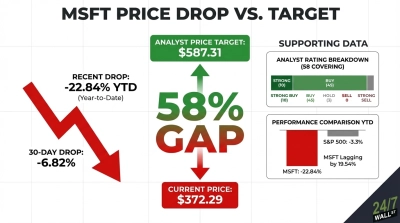
Here is where Microsoft can lag. Capital expenditures hit $30.876 billion in Q3 FY2026, up 84.39%. If AI monetization lags this infrastructure spend, near-term free cash flow compresses and the stock digests. Year to date in 2026, shares are trading near $428. That is the price of building the platform that will power the next decade of enterprise computing. The AI business already runs at a $37 billion annual revenue rate, up 123% year over year. Spend precedes monetization. The thesis does not change.
At a trailing P/E of 25 and forward P/E of 21, retirement investors are paying a fair price for the most durable cash flow stream in software. The setup favors long-term holders.












 Top Gaining Stocks
 Top Losing Stocks